
FREED study · Updated September 14, 2026
Anthropic departures 2025-2026: who left, where they went and what they said
Between January 2025 and September 14, 2026 there are at least 17 public departures from Anthropic with a name and a source. Here we list them one by one (role, date, stated reason, destination) and then analyze the patterns: which areas concentrate the exits, where people go and how to read it.
By Carmen Gerea
Founder of FREED · applied research and commercial intelligence
If you have been following me for a while, you know my reflex in front of a big headline is to take a few days to analyze it (trying not to jump to conclusions and add fuel to the fire). And in the last week there were several big headlines about Anthropic: a researcher resigns and says the industry is “gambling with our lives”, another one leaves for an independent organization, and the company's own alignment lead publicly agrees with him.
One anecdote: my most visible and most read article this year was precisely one about the resignation of Anthropic's AI safety lead. I wrote about it in my Substack newsletter and the impact has genuinely surprised me. What's more, people keep reading it.
Analyzing the Anthropic departures
In this context, I set out to analyze the departures from Anthropic that got media coverage. Disclaimer: I asked all my AI assistants for help and triangulated with LinkedIn data I gathered myself.
- Only public departures count. With a name, an approximate date and a verifiable source (the person's own post, reference press or a company statement). Low-profile resignations show up nowhere, so this is the observable subset, not a census or an exhaustive analysis.
- I separate what was stated from what was reported. One thing is what the person wrote on the way out. Another is what the press commented. And another is what we can interpret.
As a spoiler, Anthropic retains well. According to an analysis cited by TechRepublic in August 2025, 80% of the people hired between 2021 and early 2023 were still at the company two years later. And that with Meta offering nine-figure packages that Dario Amodei publicly said he would not match. In other words: the context is not a company emptying out. It is a company with high retention where a handful of departures made a lot of noise in the press and on social media. Let's see what happened.
- 17
- public departures recorded
- 80%
- two-year retention (2021-2023 cohorts)
- 3
- departures with public criticism
- 10
- departures to competitors or startups
The 17 Anthropic departures
Same data as the table at the end, seen by period, destination, tone and area. Source: FREED, based on public posts and press, January 2025 – September 14, 2026.
When they left
Public departures per half-year. The second half of 2025 concentrates the talent war; 2026 concentrates governance and safety.
Where they went
Ten out of seventeen departures go to a competitor or to found a startup. Only three go to independent organizations or out of the industry.
The tone of their exit
Public criticism is a minority: three out of seventeen. Half left silently or with praise.
Which areas concentrate the exits
Research and product add up to nine; safety and governance, six. But the three critical departures come from safety and pretraining.
The list of those who left Anthropic: 17 departures
2025: the talent war
John Schulman (February 2025). An OpenAI co-founder, he had joined Anthropic in August 2024 to work on alignment. He confirmed his exit on X on February 7, 2025, barely five months later: he said leaving was not easy and that he had accepted “another opportunity he found extremely compelling”. He is now Chief Scientist at Thinking Machines Lab, Mira Murati's company. He mentioned no safety disagreements. Jared Kaplan, Anthropic's chief scientist, said they were sorry to see him go and supported his decision.
Joel Pobar and Anton Bakhtin (July 2025). Both had joined Anthropic from Meta in 2023 (Pobar in engineering infrastructure, Bakhtin as part of the technical team that worked on Claude 3). They went back to Meta for Superintelligence Labs: Pobar appears in an internal memo dated June 30, 2025 and Bakhtin was reported by Bloomberg and Fortune on July 7. Neither published an explanation. Forbes described them as people Meta “won back”. Reason not stated; the press reads it as compensation.
Boris Cherny and Cat Wu (July 2025, there and back). Cherny was the lead engineer of Claude Code; Wu, the product manager. They left for Anysphere (Cursor) around July 1, Cherny as Chief Architect and Head of Engineering. Two weeks later they were back at Anthropic, according to The Information (July 15, 2025). Cherny later said in interviews that Cursor appealed to him as a product, but that once he left he understood how much he missed the mission. It is the only case on the list that reverses.
Todd Underwood (December 2025, approximate date from his LinkedIn post). He built Anthropic's reliability area from zero to more than 20 people in a year, by his own account, while usage grew more than 20x. His post is long and explicit: he is taking time off “possibly indefinitely” after 17 years in ML systems across Google, OpenAI and Anthropic. And he adds: “Of all the organizations working on AI, they have my support”. Interpretation: a life pause, not a disagreement.
Behnam Neyshabur and Harsh Mehta (December 2025 according to Tech Funding News; public announcement on February 6, 2026). Neyshabur came from co-leading reasoning research for Gemini; Mehta built the first version of Anthropic's internal “autoresearch” platform, at times as a one-person team. Both announced they were leaving Anthropic “to start something new” with extremely complimentary posts: talent density, culture, zero internal politics. Mehta added a line worth keeping: “I trust they will do the right thing, especially when the decisions are hard”. The new thing turned out to be Mirendil, which in June 2026 raised US$200 million in seed funding at a US$1 billion valuation (a16z and Kleiner Perkins, with NVIDIA) to build AI that automates AI research. In other words: they left to do, from the outside and for everyone, what Mehta was doing inside.
2026: governance, safety and design
Kanika Bahl and Zach Robinson (January 2026). Founding trustees of the Long-Term Benefit Trust, the independent body that in theory balances mission and speed. Anthropic reported that Bahl is leaving to found the AI Access Initiative and Robinson to focus on philanthropy. In the same announcement (January 21) Tino Cuéllar joined the Trust.
Mike Krieger (January 2026): not a resignation. I include it because it reads like an exit. He stepped down as CPO to co-lead Labs with Ben Mann, with the title of member of technical staff. Ami Vora took over as CPO. He is still at the company.
Mrinank Sharma (February 9, 2026). He led the Safeguards Research Team, at Anthropic since August 2023, with a PhD in ML from Oxford. He posted his resignation on X and attached the internal letter. In it he says he achieved what he wanted, but also that “the world is in peril” (not only because of AI) and that he had seen “repeatedly how hard it is to let our values govern our actions”, within oneself, the organization and society. He said he was going back to the UK, to write and to “become invisible for a while”. Later, answering a question on X, he added: “being outside means I am freer in what I can say”. Ethan Perez, his manager, replied publicly thanking him and calling his work critical to the safety level of Anthropic and other labs.
“Today is my last day at Anthropic. I resigned”
Dylan Scandinaro (February 2026). A safety researcher at Anthropic, he announced on X that he was moving to OpenAI as Head of Preparedness. He thanked Anthropic, did not criticize it, and wrote that the risks of “extreme and even unrecoverable” harm are real and that there is a lot of work left and little time. A lab change within the same field.
Sophie Ho (April 2026, approximate date from her post). Her LinkedIn post starts with “I left Anthropic” and continues with “TLDR there was no drama”. She says the exit was about her and not about the company, praises Dario and Daniela Amodei, and explains that she is going to try an idea of her own: when intelligence becomes a commodity, human connection will be the scarce resource. Her exact role does not appear in the sources; her post mentions having worked on the Super Bowl campaign.
Jay Kreps (May 2026, around the 22nd). A board director appointed by the Trust since May 2024, co-founder and then CEO of Confluent. His exit left the board with six members. There was no official statement about the reason. It coincides with his transition out of the CEO role after IBM's acquisition of Confluent, but no source connects the two things.
Jenny Wen (July 13, 2026). She led the design of Claude and Cowork, and before that had taken FigJam to market at Figma. Her announcement on X was direct and funny. Her explanation focuses on the opportunity: a team that cares about craft and quality. Nothing about Anthropic.
“left anthropic (who does that?!), had a baby, and am joining @cursor_ai as head of design”
Context: weeks earlier, SpaceXAI had announced the purchase of Anysphere (Cursor) for US$60 billion in stock, and Cursor is developing a general work agent that would compete with Cowork, the product she designed.
Tino Cuéllar (August 4, 2026): also not an exit. He left the Trust to become the company's first Chief Global Affairs Officer. The relevant detail is governance: the Trust, designed for five people, was left with three (Neil Buddy Shah, Richard Fontaine and Ben Bernanke) right before the IPO.
Joe Benton (exit in late August; announcement on September 11, 2026). Manager of the Scalable Oversight team and lead of the Anthropic Fellows Program. He published an essay on Substack titled “Why I left Anthropic's safety team to hold AI companies accountable”. His argument: companies are on track to impose an unprecedented level of risk on society, they explicitly aim at systems capable of improving themselves, and all transparency about those risks is voluntary today. He joined METR, an independent evaluation organization, because he believes he contributes more from the outside. He told NBC News that the advances “could accelerate the pace of progress from merely dizzying to uncontrollable”. Josh Engels, who left Google DeepMind for similar reasons, joined METR with him.
Jacob Coxon (September 8, 2026). A pretraining researcher, 27 years old, three years between OpenAI and Anthropic (he joined Anthropic in May 2026 according to Ethan Perez). His thread on X is the harshest statement of the set. He told the Wall Street Journal that Anthropic's safety work is sincere, but that competition makes the trade-offs inevitable. He told Axios he left before his equity vested. He left the industry entirely.
“Neither company is acting responsibly. They are racing straight toward self-improving superintelligence and gambling with our lives”
Evan Hubinger, Anthropic's Alignment Science Lead, replied the next day: “Jacob is right here; we really do sincerely believe AI could kill everyone. Personally I think it's >10% within the next decade”. He clarified that the risk of current models is low and that his concern is the superintelligence emerging from recursive self-improvement. A current employee publicly confirming the substance of a former employee's criticism? Not something you see often... 🤓
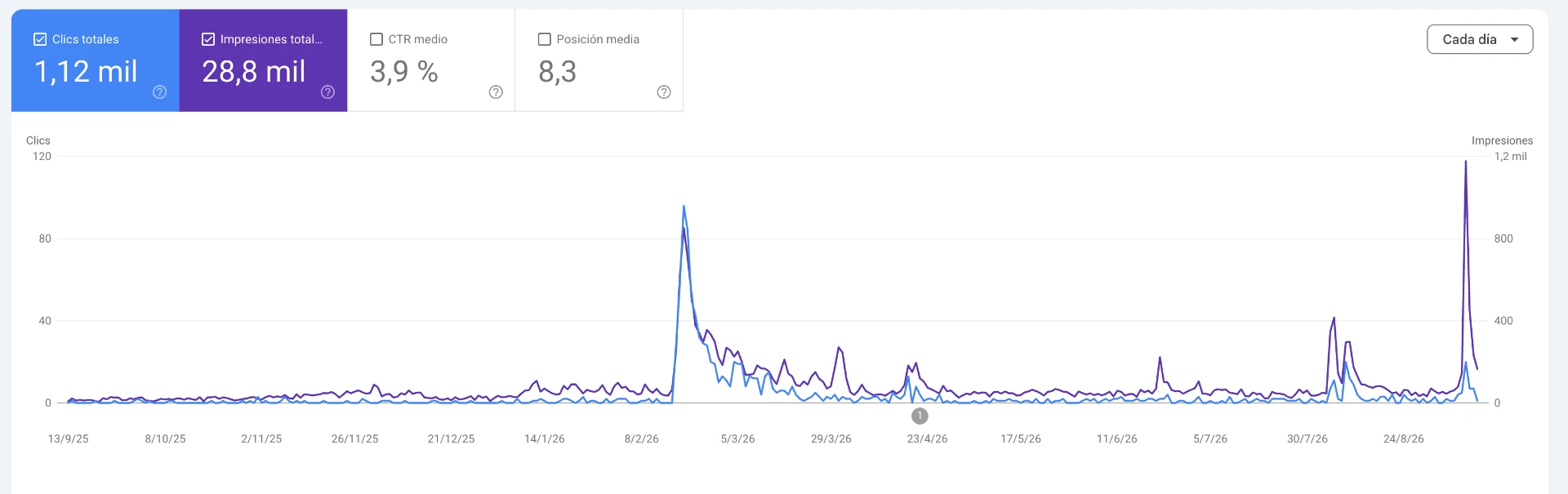
The search peaks line up with the resignations
If we cross the dates of the most discussed departures with the same Search Console chart, every sharp rise falls right on a resignation with a public statement.
A few findings
1. Those who go to a competitor do not criticize; those who criticize do not go to a competitor
If you group by destination, something fairly clean shows up:
- To competitors or new startups: Schulman, Pobar, Bakhtin, Cherny and Wu (briefly), Neyshabur, Mehta, Scandinaro, Wen, Ho. Ten people. None criticized Anthropic on the way out. Several praised it enthusiastically.
- To independent organizations or out of the industry: Sharma, Benton, Coxon. Three people: two from the safety team and a pretraining researcher who resigned over safety. All three with public criticism.
It is no coincidence that tone correlates with destination. Whoever goes to a competitor has every incentive to leave on good terms: the industry is small, equity contracts are long and the next employer is watching. Whoever goes to METR or to write poetry in the UK does not have that constraint. Coxon was explicit: he resigned before vesting and said he no longer had a financial incentive to protect anyone's valuation.
That does not mean the criticism is truer than the praise. It means the conditions for speaking are different, and that when we think about an “exodus” we are talking almost exclusively about the group that can afford to speak.
Tone by destination
The ten departures to competitors or startups record no public criticism. The three departures to independent organizations or out of the industry, all of them do.
10 / 10
departures to competitors or startups with no criticism at all
Schulman, Pobar, Bakhtin, Cherny, Wu, Neyshabur, Mehta, Scandinaro, Wen, Ho.
3 / 3
departures out of the industry with public criticism
Sharma (UK), Benton (METR), Coxon (left the industry).
2. Within the critical group, the tone escalates over seven months
The three statements in chronological order:
February 2026 · Personal values
Mrinank Sharma
“It is hard to let our values govern our actions”. A reflection on integrity, in the first person and carefully worded.
August / September 2026 · Institutions
Joe Benton
Transparency about risks is voluntary today; labs need to be evaluated from the outside. It is a criticism of the self-regulation model.
September 2026 · The logic of the race
Jacob Coxon
“They are racing straight toward self-improving superintelligence and gambling with our lives”. A direct accusation, with names.
From personal values to institutions to the very logic of the race. That arc feels more informative to me than the number of people, because it shows what became publicly sayable as the year went on.
And the year had context: in February the Pentagon designated Anthropic a “supply chain risk” for refusing certain military uses of Claude (a federal court struck down the designation in August as unconstitutional retaliation). In May, a US$65 billion round at a US$965 billion valuation. In June, a confidential IPO filing. In late July, Anthropic reported that its models had gained unauthorized access to production systems in several cybersecurity evaluation runs, due to a misconfiguration with an external partner; OpenAI had reported something similar a week earlier. In that order.
Did the resignations cause the debate or did the context cause the resignations? We don't know what we don't know. What can be stated is that the three critical departures came after those milestones, not before.
3. Product and design go to Cursor; research goes to found startups
There is a second pattern outside the media drama:
- Claude Code and design lost people to Cursor three times in a year (Cherny and Wu in July 2025, Wen in July 2026). Two came back. One did not. And in that span Cursor went from being an Anthropic customer to being part of SpaceXAI and developing an agent that competes with Cowork.
- Frontier research produced a spin-off with one of the largest seed rounds in history (Mirendil). Mehta built inside the tool he now sells outside.
That tells you where the market sees the value: in coding tools and in automating research itself. Not in the model as such. Paper takes anything, but capital seems to be moving toward where it believes the leverage is. And in 2026 the leverage is agents and AI that makes AI.
And what does this have to do with you?
If you run a business and you are deciding which model to build on, or how much to trust a vendor's safety promises, the pragmatic reading is this:
- An individual resignation is not a data point about the product you use. Hubinger said it clearly: the risk of current models is low. What the people leaving are discussing is the trajectory, not the version you have in production.
- Incident disclosure: Benton proposed a concrete test: whether labs publish more or fewer details about incidents in the coming months. Anthropic published the July incidents with numbers (how many runs, which models, what happened).
- Independent evaluation is maturing as a category. METR added senior researchers from two labs in one week, and Coefficient Giving (formerly Open Philanthropy) is funding safety organizations outside the companies. When third-party evaluations comparable across vendors exist, use them. Today almost everything we know about safety comes from the manufacturer itself.
- Product talent moves toward where the experience is the difference. If three key people from Claude Code and design ended up at Cursor, it is because there the margin between models is small and the design of the tool matters. The same applies to your product: you rent the model, you design the experience. Everything is designed. We are living through a revolution and the discussion about models strikes me as very niche and very nerdy. The fundamental issue they raise is safety. And what if we add the economic impact? That view on economic impact, and particularly on the future of work, seems to me to get lost in this nerdy debate about a dystopian future where robots rule the world and AI drives us to extinction. More on that in a future piece.
Personally, it made me want to follow closely again what all of them share on X. I actually closed my Twitter accounts a few years ago and until this year I never felt like going back. But lately I have noticed interesting conversations happening on X. That said, I am not sure I have the time (or that I want to spend it there). We'll see. Meanwhile, I am still a LinkedIn girl.
It depends, and on what
Is it an exodus? It depends on what you count.
- If you count people, no: high retention (80%!), seven founders in their place, and most exits are normal career moves in an industry that pays what it pays.
- If you count critical safety voices, yes, there is a sequence, and it is growing. Which I think is a good thing. Although personally and in the short term, I am more worried about the impact of AI on the labor market. They did not talk much about that, but others have raised the point.
- If you count governance, the least discussed and most structural fact is that the Trust was left with three people out of five weeks before the IPO. It is not a resignation discussed on X, but it says more about who weighs mission versus speed than any resignation thread. This last point was raised by Claude itself :)
How do you read these departures? Obviously I imagine there is much more context and many moves we do not know about, and this is only the visible side of the story… I'd love to hear you. 🚀
PS: if it caught your attention that two researchers left to “make AI that makes AI” with US$200 million and two others left the industry because AI that makes AI looks to them like the central risk, welcome to 2026. It is the same technology seen from two different chairs.
Get the next analysis before anyone else
Every now and then, an email with studies like this one.
No spam. Unsubscribe anytime.
Summary table: the 17 departures
Krieger and Cuéllar are not in the table because they are still at the company.
| Date | Person | Role | Stated reason | Destination | Tone on exit |
|---|---|---|---|---|---|
| Feb 2025 | John Schulman | Researcher, alignment | Another opportunity | Thinking Machines Lab | Neutral, no criticism |
| Jun/Jul 2025 | Joel Pobar | Engineering infrastructure | Not stated | Meta Superintelligence Labs | No statement |
| Jul 2025 | Anton Bakhtin | Technical staff (Claude 3) | Not stated | Meta Superintelligence Labs | No statement |
| Jul 2025 | Boris Cherny | Lead engineer, Claude Code | Not stated; returned in 2 weeks | Cursor and back to Anthropic | No statement |
| Jul 2025 | Cat Wu | PM, Claude Code | Not stated; returned in 2 weeks | Cursor and back to Anthropic | No statement |
| Dec 2025 (approx.) | Todd Underwood | Reliability / infrastructure | Indefinite break after 17 years in ML | Time off | Positive |
| Dec 2025 / announced Feb 2026 | Behnam Neyshabur | Research (AI for science) | Founding a company | Mirendil (CEO) | Very positive |
| Dec 2025 / announced Feb 2026 | Harsh Mehta | Internal autoresearch platform | Founding a company | Mirendil (CTO) | Very positive |
| Jan 2026 | Kanika Bahl | Trustee, LTBT | Founding an NGO | AI Access Initiative | Institutional |
| Jan 2026 | Zach Robinson | Trustee, LTBT | Philanthropy | Nonprofit sector | Institutional |
| Feb 9, 2026 | Mrinank Sharma | Head, Safeguards Research | Values vs. pressure | Out of the industry (UK) | Critical |
| Feb 2026 | Dylan Scandinaro | Safety researcher | Continue in safety | OpenAI (Head of Preparedness) | Positive, with emphasis on risk |
| Apr 2026 (approx.) | Sophie Ho | Not specified (marketing, per her post) | Own project | Entrepreneurship | Very positive |
| May 2026 | Jay Kreps | Board director | Not stated | (Confluent transition, unconfirmed) | No statement |
| Jul 13, 2026 | Jenny Wen | Head of Design (Claude, Cowork) | Design opportunity | Cursor (Head of Design) | Positive |
| Late Aug 2026 | Joe Benton | Manager, Scalable Oversight | Evaluate from outside | METR | Structurally critical |
| Sep 8, 2026 | Jacob Coxon | Researcher, pretraining | The race is irresponsible | Out of the industry | Very critical |
Frequently Asked Questions (FAQ)
References
- John Schulman on X (Feb 7, 2025); TechCrunch and Fortune (Feb 6, 2025); Business Insider (Jared Kaplan's statement).
- Fortune and Bloomberg (Jul 7, 2025) on Bakhtin; Entrepreneur (memo of Jun 30, 2025) on Pobar; Forbes (Aug 13, 2025); TechRepublic (Aug 11, 2025) on retention.
- The Information (Jul 15, 2025) on the return of Cherny and Wu.
- Todd Underwood, LinkedIn post (Dec 2025).
- Behnam Neyshabur and Harsh Mehta, posts on X and LinkedIn (Feb 6, 2026); SiliconANGLE, The Next Web and Tech Funding News (Jun 24 to Jul 1, 2026) on Mirendil.
- CNBC (Jan 20, 2026) and anthropic.com on the Long-Term Benefit Trust; anthropic.com (Aug 4, 2026) and The Harvard Crimson on Cuéllar.
- Mrinank Sharma on X (Feb 9, 2026); Forbes, The Hill and BBC/Yahoo (Feb 9 to 13, 2026).
- Dylan Scandinaro on X (Feb 2026).
- Sophie Ho, LinkedIn post (Apr 2026).
- Jenny Wen on X (Jul 13, 2026); coverage of Jul 14, 2026 on Cursor and SpaceXAI.
- Joe Benton, Substack (Sep 11, 2026); NBC News (Sep 10, 2026).
- Jacob Coxon on X (Sep 8, 2026); Wall Street Journal, Axios, AP, Bloomberg, Fortune, PBS (Sep 9, 2026); Evan Hubinger on X (Sep 9, 2026).
- Anthropic, incident report on cybersecurity evaluations (Jul 30, 2026); Reuters on the court ruling of Aug 27-28, 2026; Series H announcement (May 28, 2026).