You can also watch and listen to this article in podcast format
If you don't want to risk wasting resources and not achieving the expected results with your product or service, I recommend making people-centered decisions, considering the real contexts, preferences, motivations, and desires of the people for whom you are designing a solution.
The idea is to empathize with users, and for this, you can explore the information held by the organization and the team in charge of the product, conduct UX Research, for example, by conducting in-depth interviews, surveys, using web analytics or other behavioral data, and implementing other instruments that allow you to collect data about users.
Note, it is not always necessary to collect new data; most companies already have a lot of underutilized data. Sometimes, it's about analyzing existing data or making better use of information.
The result of user research can lead us to identify codes, patterns, characteristics, and contexts of users with the product. From this information, we can build archetypes that can be used in ideation, conceptualization, and definition processes for product or service features.
Here we will tell you about the Customer Archetype, its definition, and a brief guide to creating an archetype representation.
But before we start, let's clarify that in practice, "user archetype" and "customer archetype" can be total or partial synonyms. For example, in the design process of a company's mobile application, we can talk about a user archetype or user persona that points to the context of product use.
If we look at the service as a whole, beyond the application, we have to refer to a customer.
In this article, we will use both terms interchangeably. Moreover, we can even talk about "buyer persona" to refer to a buyer archetype that points to the context of product purchase.
Ultimately, we don't want to confuse you with vocabulary, but it is important to understand all total or partial synonyms to avoid misunderstandings.
Get our analysis in your inbox
Subscribe to the FREED newsletter: applied research, trends and tools.
No spam. Unsubscribe anytime.
1. What is an archetype?
By definition, an archetype is a visualization that systematizes user characteristics and behaviors regarding a specific topic or context of use of a product or service.
The RAE defines an archetype as a "representation considered a model of any manifestation of reality."
The meaning of archetype can also be understood as a fictional representation of characters who use or will use a product or service. This representation is built from real and existing data.
When we talk about fictional representation, we mean that an archetype takes on personality during the design process. In no case does it refer to an invented representation or an overrepresented user in their characteristics.
Ultimately, a Customer Archetype is a representation of people's characteristics, motivations, goals, and behavioral patterns.
2. What is an archetype for?
An archetype serves to understand and identify groups of users who share certain characteristics and behaviors in relation to a product or service, whether in a context of use or purchase.
We can cover a wide spectrum of users and move from an abstract concept to user archetypes with thoughts, emotions, needs, desires, and goals.
An archetype allows focusing a design process and designing better experiences because decisions should respond to the identified user groups. Basically, we use an archetype to design with a specific person in mind and to have a better understanding of users.
3. How is an Archetype identified?
While some teams work with hypothetical archetypes, at FREED we always prefer to collect real data to arrive at archetypes based on reality. In this sense, our user archetypes (user personas), customer archetypes, or buyer personas are always based on information we collect in qualitative, quantitative, or mixed research processes.
There are different ways to build a customer archetype, mainly according to the purpose for which the archetype is intended. Here is a brief step-by-step guide:
Build empathy within the team through the willingness to get to know the users. This means we must take the time to research.
Collect data from a user research plan that may include qualitative, quantitative, or mixed methods, according to the study context (basically, according to what you want to study). In practice, this usually translates into the use of in-depth interviews, surveys, and also behavioral data (e.g., Google Analytics data or transaction logs). It is important here to cross-reference information or triangulate; that is, to use several sources of information.
Organize and systematize the findings. A step that consists of analyzing users, their problems, and, if applicable, the cause-effect. Links, codes, and behavioral patterns are also visualized, allowing users to be differentiated, grouped, and prioritized.
Identify user groups and give them a name. For example, the investor, the tech-savvy, the practical, the vintage, etc. This name should identify their characteristics, be very differentiating, and generate recall.
Define for which user groupswe are going to design or, in other words, whom we are going to represent in our design process.
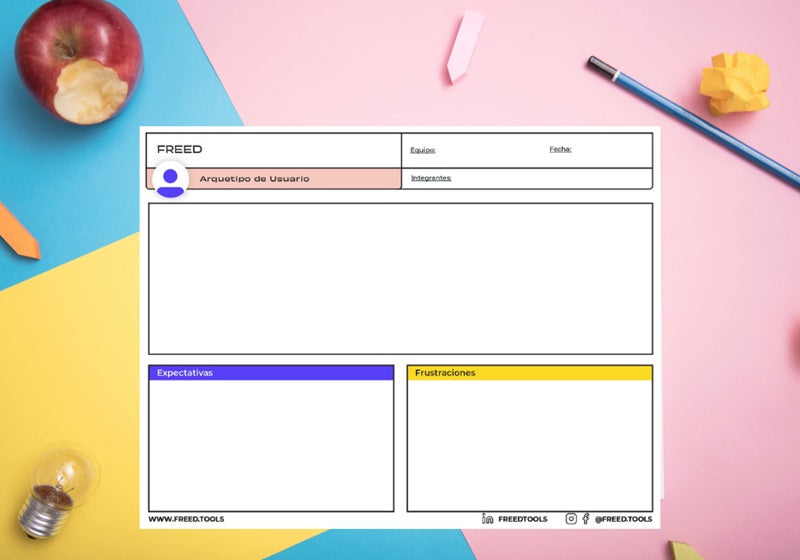
Create visualizations of the archetypes we are going to represent. To do this, use a PowerPoint presentation, a Drive sheet, a specialized tool, or one of our downloadable templates.
Follow these tips, fill out the template, and analyze your results:
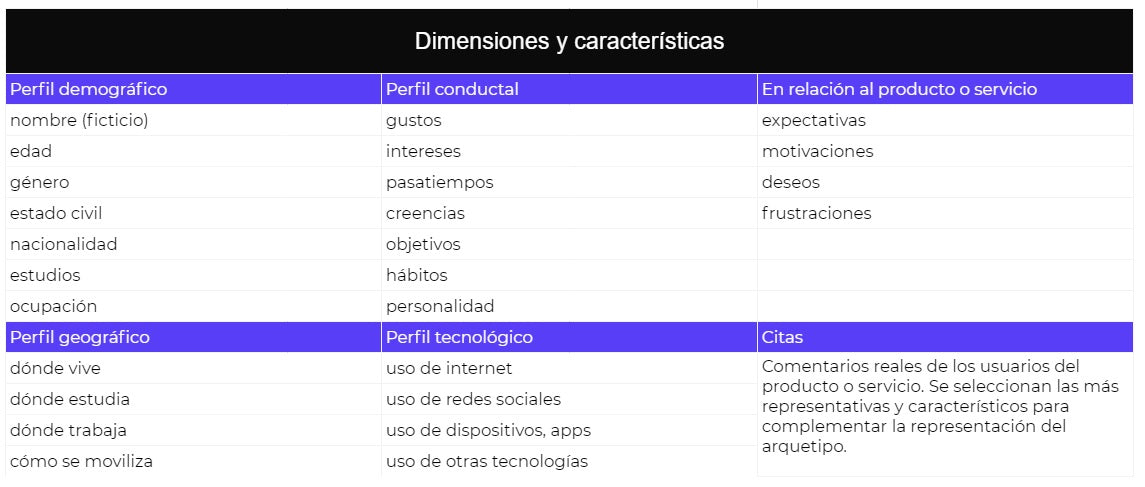
Organize your information considering that the objective is to recreate characters and contexts that represent real scenarios. This is how you should identify variables such as the Use Context of the product or service, the Level of Technology Proficiency, their Motivations and Goals, their Frustrations and Obstacles, and their Needs.
A User Persona should describe the different types of customers you have detected, including specific observations for each group. The definitions obtained will tell you who the users are, which will help you when designing or redesigning your product or service. That's why it's good to give your archetype a name, such as The Digital Expert, The Senior Professional, or The Novice.
It should describe behavioral patterns in relation to specific tasks and not the tasks themselves. That is, you should focus your analysis on what the user's experience with the brand, product, or service is like. Therefore, it is not the same as a customer segment, as it does not seek to be a precise representation of a percentage of customers but rather a description in terms of behavior.
In addition to qualitative data, also consider quantitative information that allows for a good characterization of the archetypes.
Include in each User Persona only relevant information that serves to guide the design of your solution. Only include the right amount of data; avoid long lists of characteristics.
Use a limited number of archetypes. Between 3 and 5 allow you to cover 80% of typical users.
Cover the objectives relevant to the design, which are those that people expect to achieve when using your product or service.
Deepen the different dimensionsof the identified archetypes' lives, for example, demographic, geographic, behavioral profile, etc.
Link the archetypes with the problem being addressed in the design process of a product or service to design a better experience.
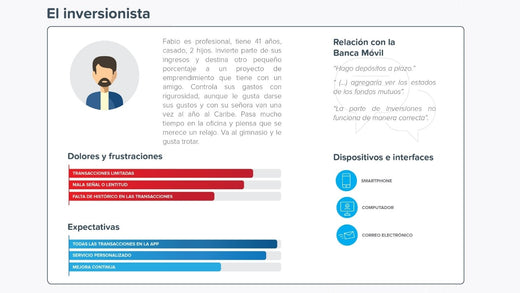
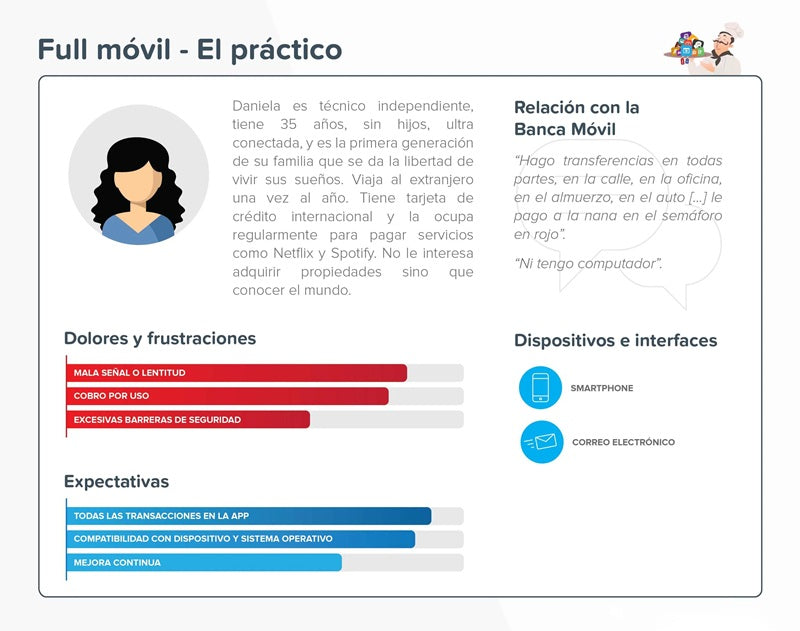
To better understand, here is an example of one of the User Personas we filled with data obtained in a UX Research study conducted with FREED. Specifically, it was a study on mobile banking in Chile, where we recruited users who habitually make transactions online, regardless of the device: laptop, PC, smartphone, or tablet:
Although an archetype is a character, it must respond to real users; its definition must be rigorous and precise, and it must be applied in the early stages of a design process, during the research and ideation of a product or service.
The characterization of archetypes answers how this user is in their daily life and how they relate to the product or service. This, in turn, allows understanding aspects of the product or service that work well or poorly.
The constructed archetypes become fictional characters representing all users who will use, for example, your website or mobile application.
To complement the characterization of archetypes, other means and resources can be used to briefly express other essential aspects of the identified user types; for example, an image of the person (fictional or representative icons).
4. How many Archetypes should be created?
An archetype can be applied in the early stages of a design process, during the research and ideation of a product or service.
The number of archetypes will depend on the type of project and the scope of the organization.
Some companies have very specific users, while others reach a broader group.
We cannot create an archetype for every person who uses the product or service, nor can we miss opportunities by not wanting to increase the number of archetypes.
It is important to find a number of archetypes that helps solve the stated problem and is appropriate for the design process.
In practice, at FREED, we have observed that about 3 to 5 archetypes are sufficient to then design solutions. A large design team could eventually work with 6 to 8 archetypes, but using 30 would be counterproductive.
5. How to validate archetypes?
It is important to integrate the validation of your archetypes into your design process with the people who will use them in their daily work, such as product and service designers, UX designers, sales executives, customer service executives, etc.
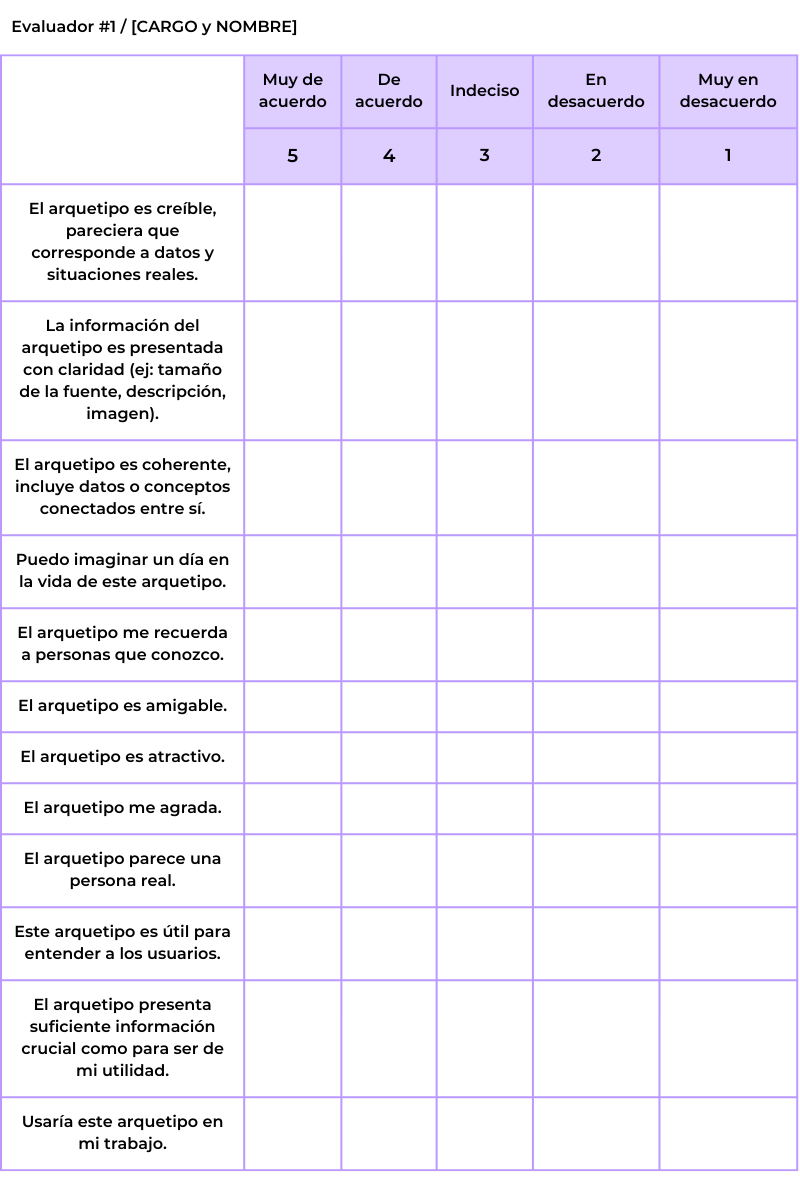
To do this, we have created a validation instrument in survey format based on a scale proposed by Salminen et al. (2018), which we provide as a reference at the end of this article.
You can recruit a limited group of these professionals to individually analyze your archetypes and provide their feedback on them. They should respond to a series of statements by evaluating their agreement or disagreement, where each level has a rating from 1 (Strongly Disagree) to 5 (Strongly Agree). To collect this information, you can construct a guide like this:
Source: self-made based on Salminen et al. (2018).
Have you worked with User Archetypes (User Personas) to support your product or service design processes? Do you want to contribute ideas to complement this article?
Download the User Archetype Template
Reference
Salminen, J., Kwak, H., Santos, J. M., Jung, S., An, J., & Jansen, B. J. (2018). Persona Perception Scale: Developing and Validating an instrument for Human-Like Representations of data. ResearchGate. https://doi.org/10.1145/3170427.3188461
Authors: Denise Sánchez, Carmen Gerea, and Rafael Baquedano.
To run these exercises collaboratively and remotely, at FREED we use digital whiteboards such as Miro, which let you map, cluster and vote with the whole team in real time. (Affiliate link: signing up through it supports FREED at no extra cost to you.)
Share this article
Follow us on YouTube
Nuevas Economías, Research Thinking and FREED AI Studio: conversations and analysis on business, technology and human behavior (in Spanish).
Imagine you've developed a product full of potential, but upon reaching the market, it simply doesn't connect with people or doesn't sell enough. User recruitment for UX Research is key in a human-centered project. Discover the criteria for selecting users.