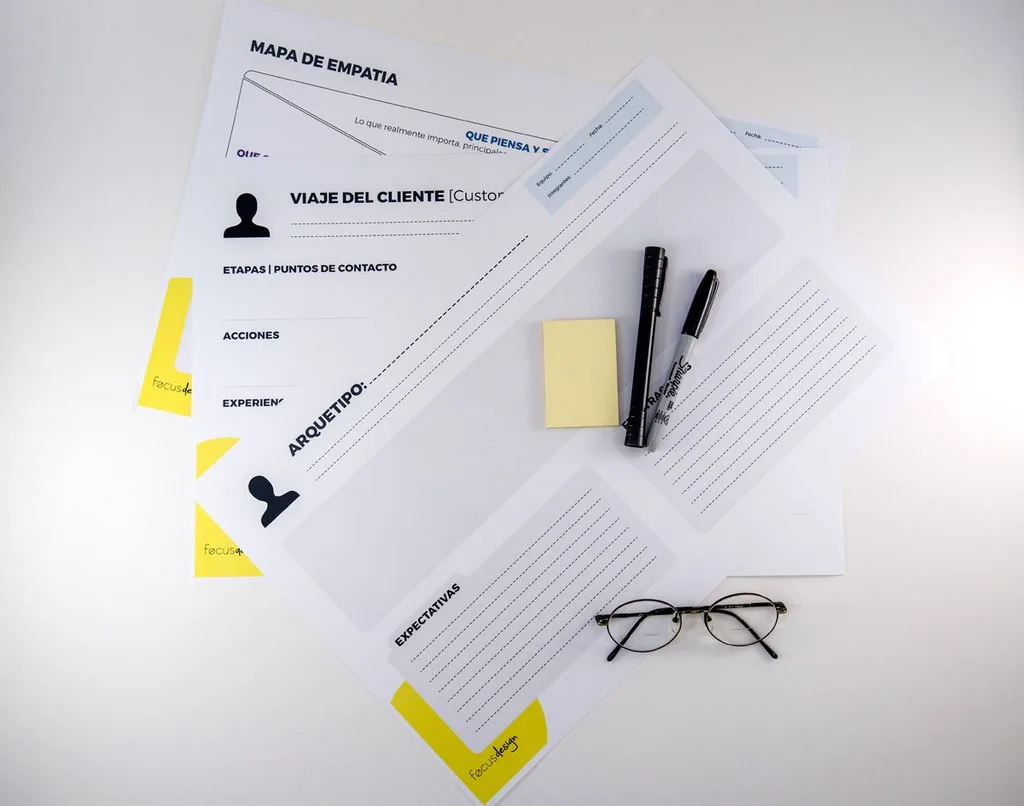
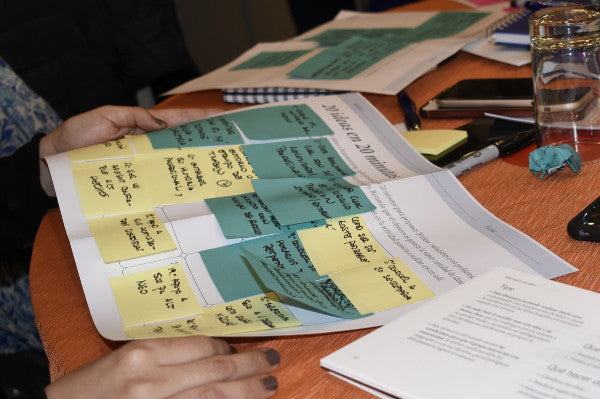
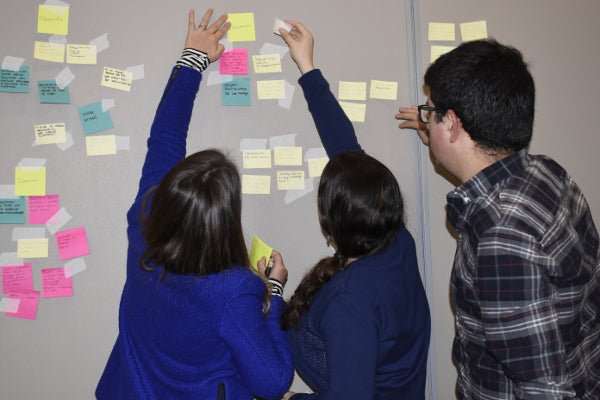
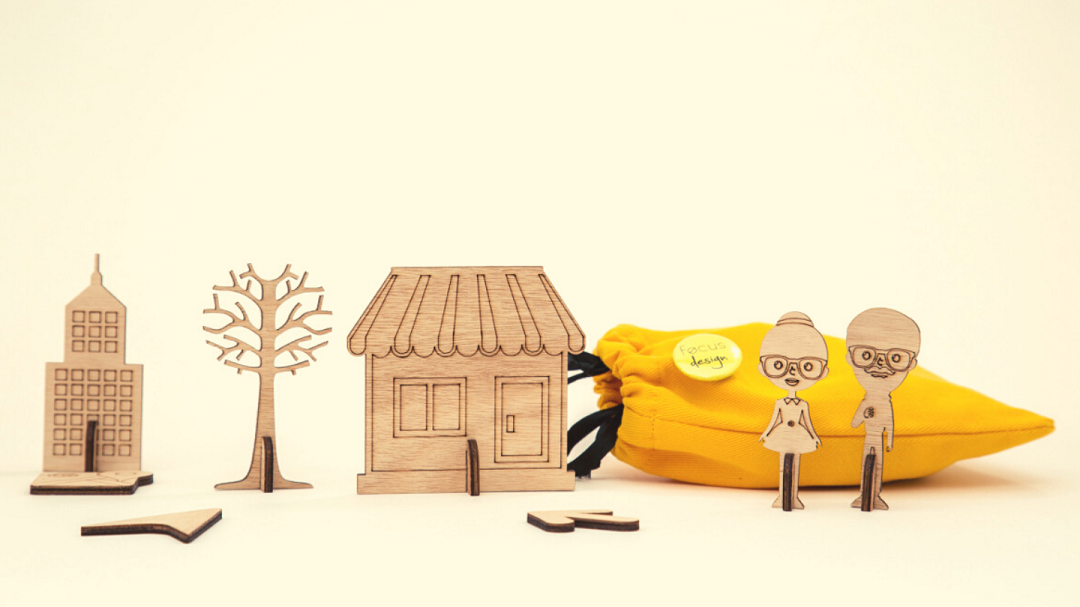
With this article, we want to introduce a product that makes us very proud but that we haven't highlighted as it deserves. It's our design kit, of which we've developed different versions to be used in various activities and disciplines, such as workshops and courses on Lean methodologies, service design, user research, or prototyping. This material is a great support for instructors or facilitators, as well as team leaders who develop agile projects within an organization.
In this first article, we will talk about the Lean methodologies (Lean Startup, Lean Enterprise, or Lean UX) and agile development kit, but first, we want to explain how it came about and provide some context.
How our kits were born
Those who know us know that one of our passions is teaching through the coaching and courses we offer to those who wish to advance in generating innovative businesses. Initially, we arrived at these activities with typical materials to make classes more attractive and participatory, such as flip charts, post-its, and markers. Soon, responding to our students' concerns, we began to incorporate other didactic elements like templates and more playful ones.
After a couple of years, we realized that we had accumulated the experience and knowledge to create our own design kit and thus professionalize these tools. However, what motivated us most was making it possible for students to continue using these tools in their daily work.
Get our analysis in your inbox
Subscribe to the FREED newsletter: applied research, trends and tools.
No spam. Unsubscribe anytime.
Who our kits are for
It was also important that this kit had different versions that adapted to a variety of disciplines and could be used by professionals performing various roles, such as:
User Experience (UX) designers, project managers, product managers, and other professionals involved in innovation projects, regardless of their disciplinary approach, i.e., service design or Lean methodologies.
Consultants who conduct innovation courses or workshops.
Professors who teach service design, Lean methodologies, user research, etc.
Our kit is a toolbox aimed at facilitating teamwork in innovative projects or courses, and its content varies depending on the discipline it targets. But basically, it consists of templates for capturing and selecting ideas, recording project progress, portraying our customers' journeys, and user archetypes. It also includes didactic elements such as stickers and figures of characters, symbols, and actions that allow for a graphic representation of an experience. Finally, it includes tips for conducting activities and more traditional materials such as post-its, pens, markers, notebooks, etc.
What are the advantages of using the kit
In our Lean methodologies and agile project development courses, we use the design kit specifically created for this discipline to facilitate the entire learning process. This begins by sensitizing all work teams to the backbone of the method: the place people occupy is fundamental, as Lean methods are centered on both the customer and the internal work team.
In this, the kit's tools help internalize that the person will always be present at all stages of the project:
when systematizing results,
when generating and selecting ideas to solve identified problems,
when selecting ideas with high impact potential,
when prototyping solutions,
when testing prototypes, and
when planning the next development stages.
Another positive aspect we notice in our courses is that using the kit encourages creativity when seeking solutions, especially when it is understood that one can go beyond the traditional use of its component tools, generating debates and interactions among group members, thus enriching the creation process.
With the Lean methodologies and agile development kit, various methods and techniques can be developed, such as:
Brainstorming,
prioritization of ideas and initiatives,
rapid prototyping,
paper prototyping of digital interfaces,
prototype testing.
Having the tools that come with the kit and the freedom to include others that are at hand contributes to creating a more playful environment that pushes innovation and invites sharing one's own visions, in order to find the best solutions to problems that require attention to improve the business.
While we created our kit thinking of those who attend our workshops to get started with agile methodologies, its use is flexible and allows for individual activities. Likewise, it is meant to be used beyond the learning process, as a daily support tool in the workplace for the development and management of agile projects.
And once the team has prioritized ideas on paper and wants to turn them into a functional digital product, AI tools like Lovable make it possible to build the first MVP without writing code — ideal for validating before investing in development. (Affiliate link: if you subscribe through it, you support FREED at no extra cost to you.)
To run these exercises collaboratively and remotely, at FREED we use digital whiteboards such as Miro, which let you map, cluster and vote with the whole team in real time. (Affiliate link: signing up through it supports FREED at no extra cost to you.)
Share this article
Follow us on YouTube
Nuevas Economías, Research Thinking and FREED AI Studio: conversations and analysis on business, technology and human behavior (in Spanish).