Keywords are essential for improving your website's SEO and capturing searches from people who use Google to find information, products, or services that will help them satisfy a need.
Search term research is the first step to understanding how our potential users and customers search, and thus creating relevant content for our website.
Working on your site's SEO will gradually allow it to gain authority and climb in organic search rankings. Here, we'll teach you what keywords are, how to research them, and other tips to perfect them.
It's a term that shows what internet users are looking for, related to the information provided by web pages or the search engine they access. They can also be called search terms.
Examples from Google Chile using the Ahrefs tool:
- Homemade flan recipe: volume 450, difficulty 7.
- Women's formal shoes: volume 5.3K, difficulty 0.
- Chinese food restaurant: volume 500, difficulty 1.
- Flowers for gifting: volume 450, difficulty 9.
As you can see, keywords or search terms are the queries people enter into search engines. When we talk about volume, it's the number of monthly searches for that keyword, while difficulty is how easy or difficult it would be to rank in search results using that keyword.
You get these statistics with specific SEO tools for keyword research.
-
Terms composed of one or more words. It's becoming more common to perform a more refined search of four or five words that give us more competitive terms. Google recommends better defining keywords.
- Example of a generic term: Smartphone has a volume of 21K and difficulty 34.
- Example of a compound term: Samsung Smartphone has a volume of 2.5K and difficulty 12.
From these examples, we conclude that it's better to opt for a compound term, as the difficulty of ranking is lower.
- All these terms are keywords or search terms.
- Terms are used by people to get answers and solve their problems through search engines.
- It can be in any search engine like Google, Amazon, or any marketplace. Even using social media like Instagram or TikTok instead of the Google search engine is the latest trend.
It's the process we must carry out to find the keywords that people enter into search engines, which we then must analyze according to their volume and difficulty.
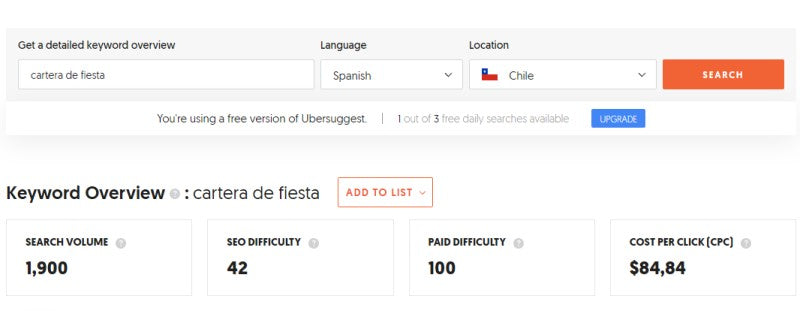
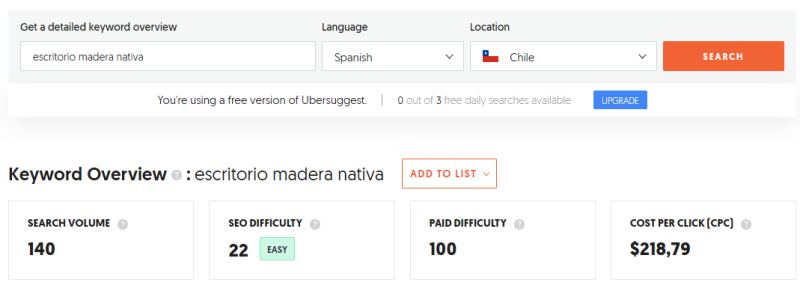
If you're just starting in SEO, we recommend using Ubersuggest to begin your inquiries. It's important to set the search to the country you are writing for.
We write to attract potential customers to our website, and improving SEO is essential to increase authority in organic rankings. For this, it's important to start by:
- Understanding what people search for online to develop content that meets their needs.
- Identifying your main competitors.
-
Selecting niche markets. If the keywords in the chosen niche have high difficulty, you should focus on long-tail terms, meaning those with an interesting search volume (not necessarily high) and a difficulty below thirty.
- With this information, start your content strategy.
First, you should think about your potential customers, how they would search for what your website has to offer them, and what other related topics might interest them. Then, you should start entering keywords into the tool you want to use and note down the results it provides.
Analyze all the data and choose the keywords that best suit your website's needs. Remember that long-tail terms are a good option for niches with fierce competition.
You can approach the research from two perspectives:
-
Product-oriented. If you have a product or service you're trying to sell, you should focus on what you produce as a source of inspiration. You can make a list of search terms to research to get started.
Examples of variables you can use:
- Product category. Example: sneakers.
- Product type/class. Example: canvas sneakers, leather sneakers.
- Product use. Example: running sneakers, climbing sneakers.
- Product user. Example: children's sneakers, elderly sneakers.
- Product attributes. Example: red sneakers, velcro sneakers.
- Occasions when the product can be used. Example: party sneakers.
- Trends. Example: platform sneakers.
All depend on our own product and will help us find more specific search terms that narrow down the market niche, reducing positioning competition.
- Customer-oriented. If your brand has the ability to create products or services based on the needs you can detect in your potential customers, it's a good option to orient the search towards your target audience.
The core value of this approach is the customer, and the business must be oriented towards understanding them. Who is the customer who might buy or already buys your products or services? What are they like? What are their interests? What stage of life are they in when looking for your product or service?
Additionally, we can further specify the orientation by choosing between:
- Understanding people, how they search today.
- What else can we do for these people?
-
People's vocabulary: You must consider that we all write and speak differently. Also, your potential customers may have a less technical vocabulary than yours. Choose words carefully, keeping this in mind.
-
Semantic differences from one country to another. You must consider the specific words in the vocabulary of the country you are writing for. But also remember that within the same country, multiple nationalities coexist.
If you need to understand more about vocabulary and how people search, you can conduct user research (UX/CX Research) or market research such as:
-
Interviews.
-
Focus groups.
- Complaint analysis.
- Request analysis (customer service, sales).
- Comment analysis (Google Play, Google Reviews, or social media comments).
Article by Camila Oliva.