For some years now, Chile has been fertile ground for startup competitions, accelerators, incubators, and competitive funds to support entrepreneurs, and specifically, technological entrepreneurship.
Since the idea of creating UsabilityChefs, now FREED, emerged back in 2013, we have applied for several funds, from SERCOTEC's Capital Abeja to CORFO's Capital Semilla, and we have won some.
We also participated in several startup competitions such as Wayra, Geek Camp, and Startup WeekEnd. Through this process, we have learned and identified reasons that go beyond direct monetary benefit and that over time show you that it is worth investing time and energy in these activities.
Below are 10 reasons to participate in competitions and apply for startup funding.
Having to talk about what you are doing means being able to articulate a discourse according to the target audience. When you are developing a mass product for a B2C (business-to-consumer) market, where potentially anyone could be your customer, it is often easier to explain what it is about and what benefits it has. However, when you are in a B2B market where the customer is a company in a specific context, you will have to adapt the pitch to each audience. With a bit of luck, the jury of a competition is working in a company and has gone through the problem you are mentioning, therefore they perfectly understand what it is about. As semifinalists in the Entrepreneurship competition organized by Softland and Innovo, we found ourselves with a specialized jury since Softland is a technology company and talking about usability, user experience, and testing is part of their business.
As you participate in several startup competitions, you will realize that your pitch will never be what it was at the beginning. Nor will it be identical in every competition since the evaluation criteria are different. Carefully review the rules and criteria to design your pitch accordingly. Do not confuse the pitch presented to a jury with a sales speech. While they may have some similar content, they intrinsically have different objectives and target different audiences.
In almost all competitions, there is a feedback instance. If it's not formal and you don't know why you weren't selected or didn't win, insist on knowing what happened and ask for feedback. And listen to what they tell you as well as others. Once you've received comments, filter and work to improve your presentation, pitch, articulation of the idea, business model, and everything else. Don't take everything they tell you literally, learn to filter, but have the humility to recognize what you need to improve and the ability to adapt.
One of the best feedback instances we had was at Wayra Week. They had seen several ventures based on a crowdsource model, part of our initial idea, and they gave us a series of super valuable observations that only experience can provide.
For an early-stage venture, formalization is not an end in itself. Moreover, entrepreneurs tend to focus on doing what they are passionate about: taking care of ongoing clients/projects and developing their business.
Many do not see formalization as necessary, and often it isn't before starting to sell. The same goes for accounting or separating personal expenses from business expenses. Winning a fund is a tremendous opportunity to get organized since you must comply with a series of formalities that, beyond the apparent bureaucracy, will help you better track the business.
The first formal instance for accounting follow-up came when I won SERCOTEC's Capital Abeja, a small fund for women entrepreneurs. The good thing is that the executive assigned to follow up helped me a lot by demystifying concepts and procedures that were not really a priority but were necessary. Funds come and go, but learning stays.
Our participation in Wayra Week allowed us to meet Tomás Cifuentes from Reqlut, who gradually became our mentor. He generously gave us a lot of advice. Competitions come and go, mentors stay.
Every entrepreneur should have a mentor or a network of mentors. The feedback from a jury can be specific and out of context, because the judge does not know the origin of the venture or the entrepreneurial team (in addition to the short time you have to pitch). On the contrary, a mentor by definition is someone who takes the time to understand what you are developing, your market, your customers, and your team. Given that their advice or approaches are based on knowledge of your journey, and at the same time on their own experience, their role is fundamental.
Perhaps the most obvious reason to get out of your office and away from your coffee cup is the opportunity to network and meet people who are going through something similar to you.
Depending on who your potential customer is, in the hallways of Startup WeekEnd or Wayra you might meet someone who has a need that your product addresses and who is willing to pay. If not today, then tomorrow. And if it's not that person directly, it will be one of their acquaintances.
The world is very small. One of the organizers of a competition where we were semifinalists called us because their company had a need related to the usability of digital interfaces. We have also evaluated several mobile application interfaces for entrepreneurs we met at some startup competitions, making recommendations on usability and user experience (UX).
It goes without saying that attending professional events is a way to stay abreast of trends, know what new services are available, and how they can be useful in the development of your business. Since several competitions organized by accelerators and incubators include preparation instances, such as workshops or talks, you will also learn about legal issues, partnership agreements, how to seek funding, etc.
Exposure can range from mentions in the press to links to your website on the organizers' websites and social media. It's much better than paying for advertising without knowing how profitable it will be.
Startup competitions are an excellent opportunity to meet professionals with whom to collaborate, and what better way to see how you work together before "formalizing" a professional relationship?
Finally, remember that competitions and funds are not an end in themselves, but a means. Therefore, you know how much time and resources to dedicate to applications and when to stop doing so to avoid losing focus on the business.
What other benefits did you find in participating in entrepreneurship competitions?
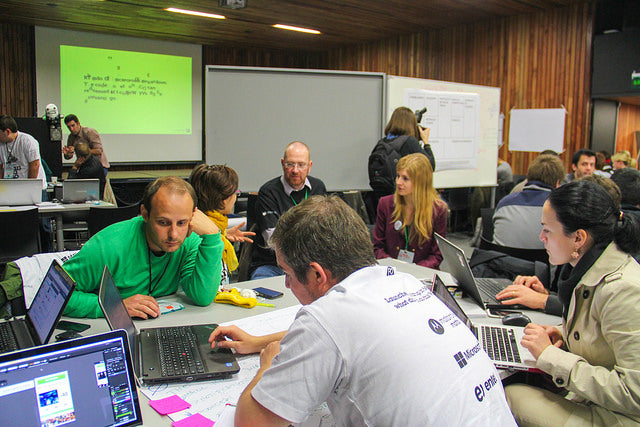
Photo by @DavidFChang from the album Startup Weekend Santiago, 2014.

 By
By