Benchmarking is a comparative evaluation that allows us to obtain the necessary information to understand how to compare our organization with similar ones, or those belonging to a different industry, or even those with customers that differ from ours.
This evaluation can cover the products, services, and processes developed by other organizations. And there is also SEO benchmarking, as we discussed in a previous article.
This comparative evaluation can help an organization identify areas, systems, or processes that need improvement, whether continuous or requiring re-engineering. In other words, it helps you determine what your competition is doing.
And to achieve these objectives, you must obtain external data, looking at what is happening outside your organization, in the market.
The scope of your research will depend on what you want to measure. Let's look at some benchmarking examples:
- If your startup is developing an application and you want to know what the competition is doing, then you can conduct a benchmark of existing applications that have similar attributes and offer similar solutions. To obtain the data, you would start by reviewing which applications in the industry are being offered in the Android and Apple stores, and analyzing their features and the user experience using those applications.
- If you want to find out how your competition is doing in the world of mobile applications in terms of reliability and customer service, check the Android and Apple app stores for customer ratings and comments. We'll show you a real case later.
- Your business sells tangible products through physical or online stores and you want to find out what the sales process is like. Then, you can use the Mystery Shopper method: you pretend to be a regular customer and experience the entire purchase process for one of their products.
- You could also do that if your goal is to analyze their products. You go, buy them, and ask your experts to reverse engineer them.
- If you have an e-commerce website and want to understand why a competitor's brand is so successful, start by reviewing their online store and analyze what they are doing better than you in terms of design, products, content, and customer experience. You should even make a real purchase to get more information.
- You see that a small competitor is crushing it with their social media, attracting hundreds of thousands of followers a month. Then, thoroughly analyze their digital marketing strategy to understand what they are doing better than you. And also analyze what their followers comment and share to understand what they value most about a brand like that.
We could extend this list of examples much further, but what we want to point out is that the scope of a benchmark can be as varied as what you are interested in finding out about your competition.
As we said, it is a research method available to companies of all sizes, and at FREED, we have put it into practice in many projects for a variety of clients and in our own studies. So here are some benchmarking examples that will help you understand its scope and usefulness.
Our client was a startup from Central America that offers its services through a mobile application. This allows the client to follow a plan to improve their health and receive support from a specialist via chat.
For this project, we conducted a benchmark of health-related applications, investigating alternatives such as Calm, Huawei Health, Meditopia, Noom, and MyFitnessPal, among others.
For this, we analyzed:
- The main functionalities designed to encourage recurrent use and habit formation.
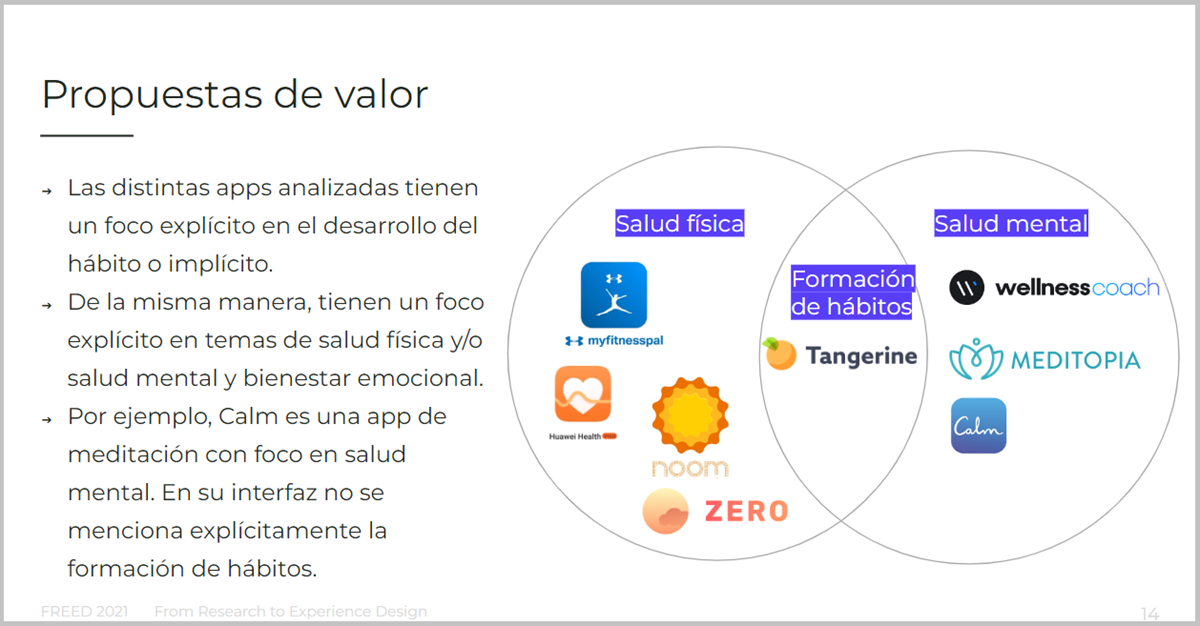
- The value proposition and the area in which they are positioned.
- Unique aspects of interaction design approach.
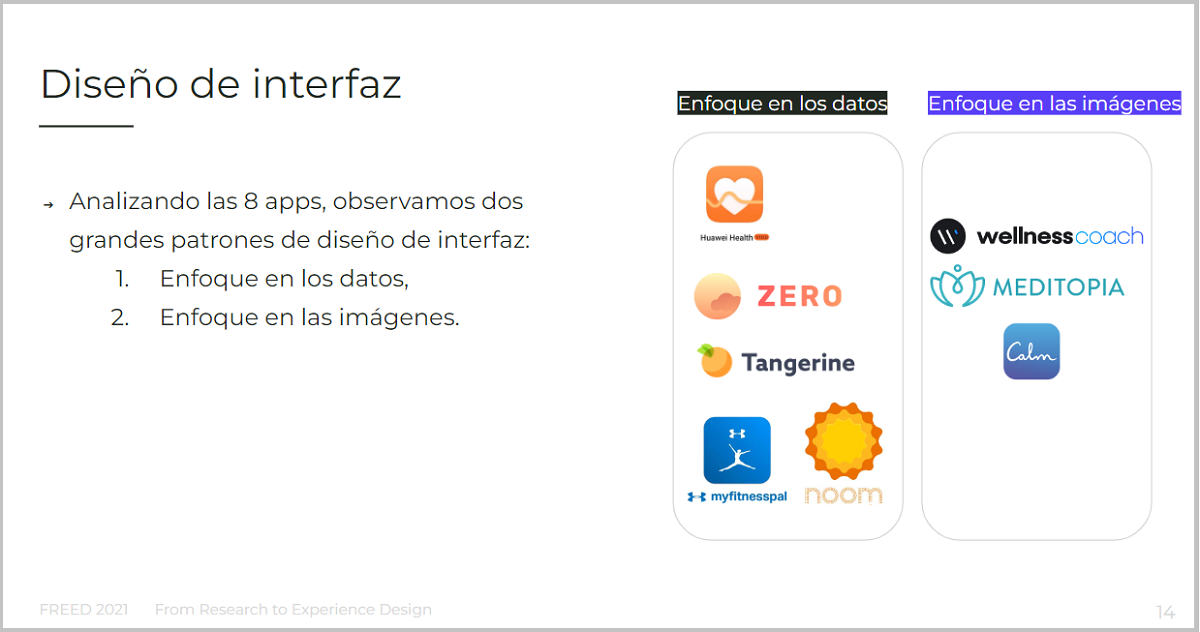
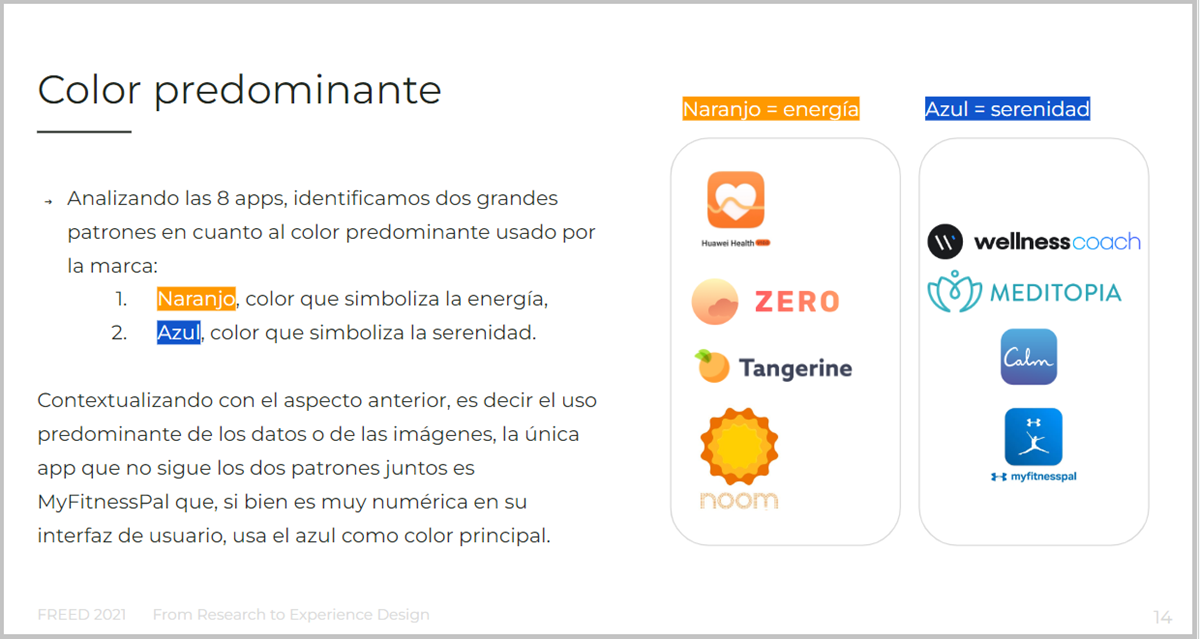
From the analysis, we identified some design patterns. For example, we saw that there are applications more focused on collecting and displaying user data (like Zero, an app for intermittent fasting, and Huawei Health, Huawei's fitness tracking app) and others focused on visual aspects through imagery like Calm, Meditopia, or Wellness Coach.
In essence, both categories help the user achieve greater well-being, but in different ways.
Excerpt from the presentation of the mobile health applications benchmark conducted by FREED.
Excerpt from the presentation of the mobile health applications benchmark conducted by FREED.
With the results of this comparative evaluation, we suggested to our client some additional functionalities they could implement and aspects to correct in their application, focusing on improving the user experience.
Excerpt from the presentation of the mobile health applications benchmark conducted by FREED.
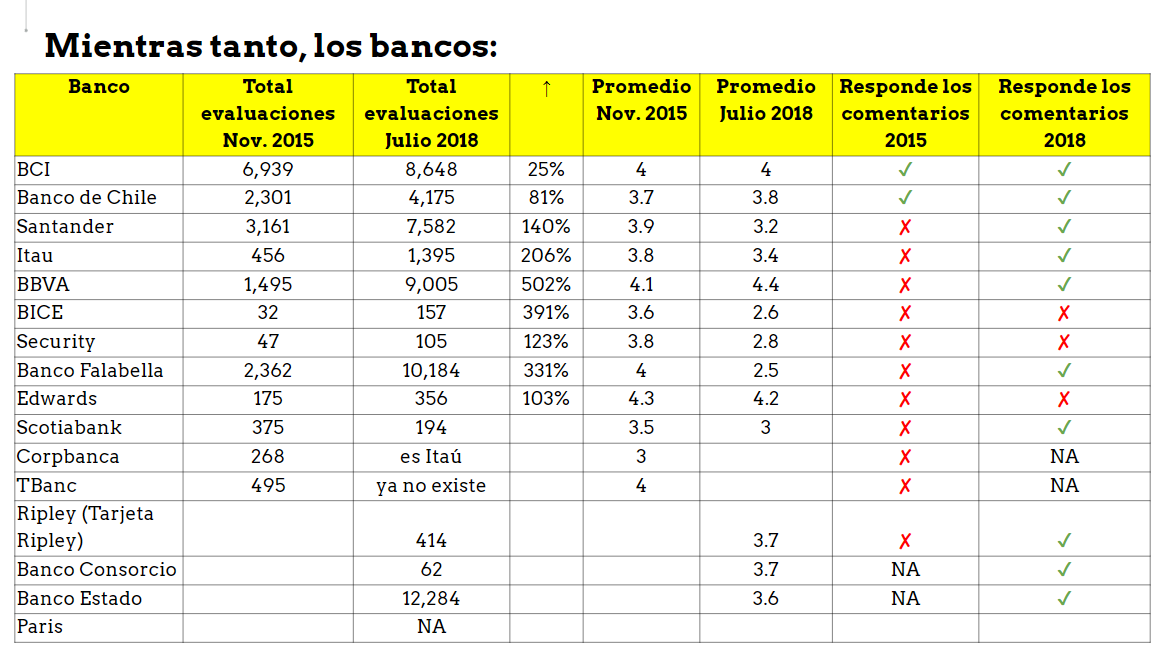
Another benchmarking example we want to share is from a FREED's own study where we addressed the customer experience with the mobile applications of 16 banks in Chile.
In addition to conducting tests with experts and users, we performed a benchmark to compare the level of customer satisfaction with the use of these applications.
To show you that you can do very simple research and that the data is readily available, we reviewed the Apple and Android stores to analyze what customers say about these applications and the ratings they give them.
From this part of our research, in two different periods, the comparative table "An app that improves with updates vs. an app that worsens with updates" emerged:
Excerpt from the presentation of the mobile banking applications benchmark in Chile conducted by FREED.
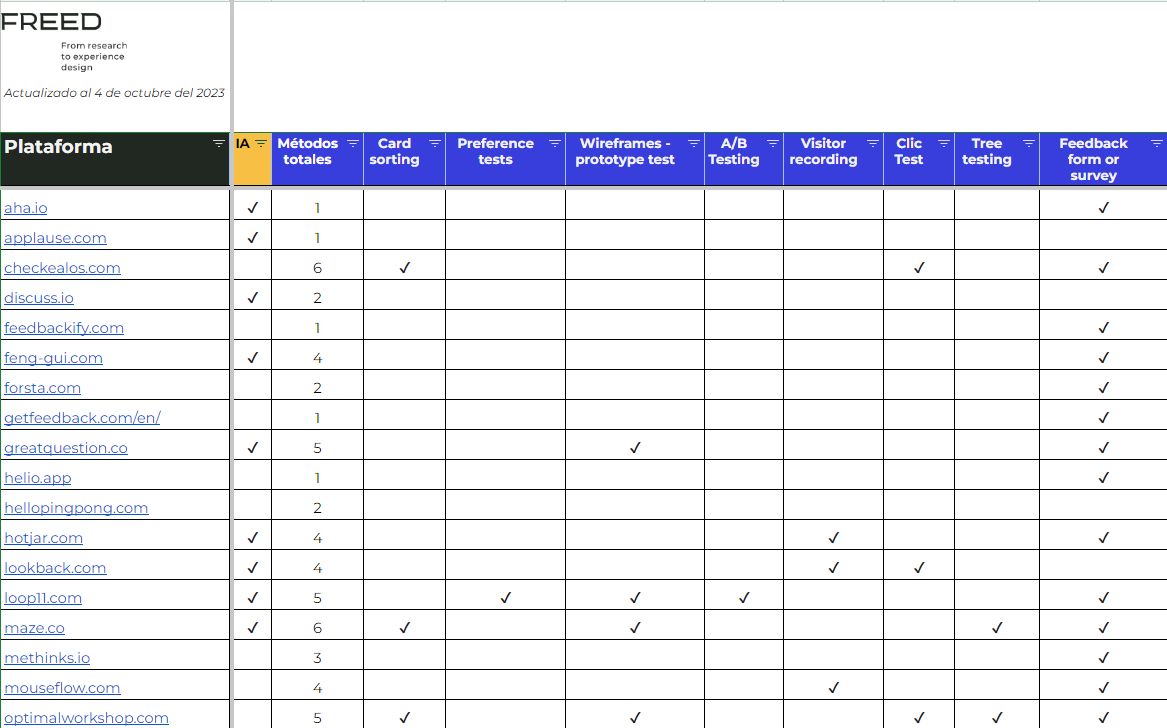
Another benchmarking example we will look at is from the field of training, so our clients are a company and its employees who took the online UX Research course taught by our founder Carmen Gerea.
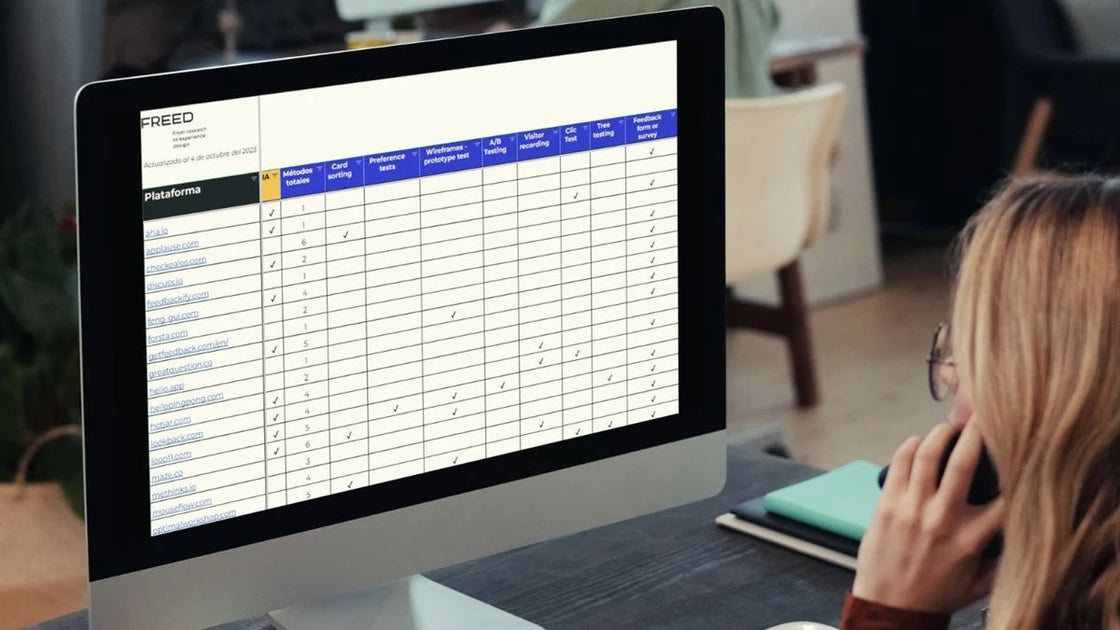
The requirement was to create a database of platforms that help researchers conduct tests, surveys, interviews, and other methods with users and clients. For this, we searched for these platforms online through Google and through recommendations given to us by colleagues in the sector. We evaluated them and collected all the data we were interested in obtaining, including whether they offer functionalities with artificial intelligence.
In this way, we created this database which was made available to students and for our use in future projects:
Excerpt from the database of platforms for UX Research created by FREED.
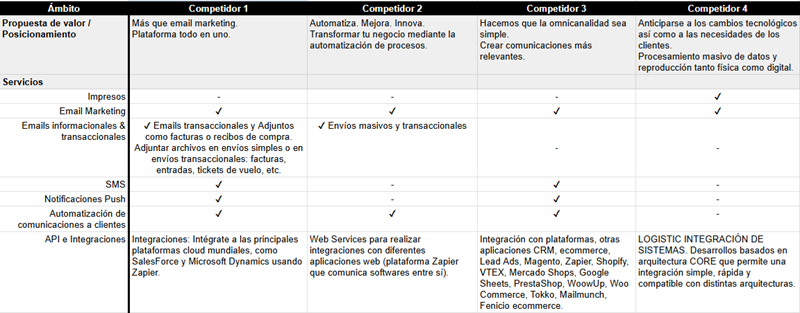
In this project, our client was looking for ideas to develop an innovative product that would help them expand into a new market. One of the products explored was an email marketing platform.
To show the client the market situation, we conducted a benchmark that went beyond simply identifying the functionalities and services of each analyzed application, as we looked at other parameters such as available digital assets, organizational structure, team size, and roles, for example.
Excerpt from the benchmark on email marketing platforms conducted by FREED.
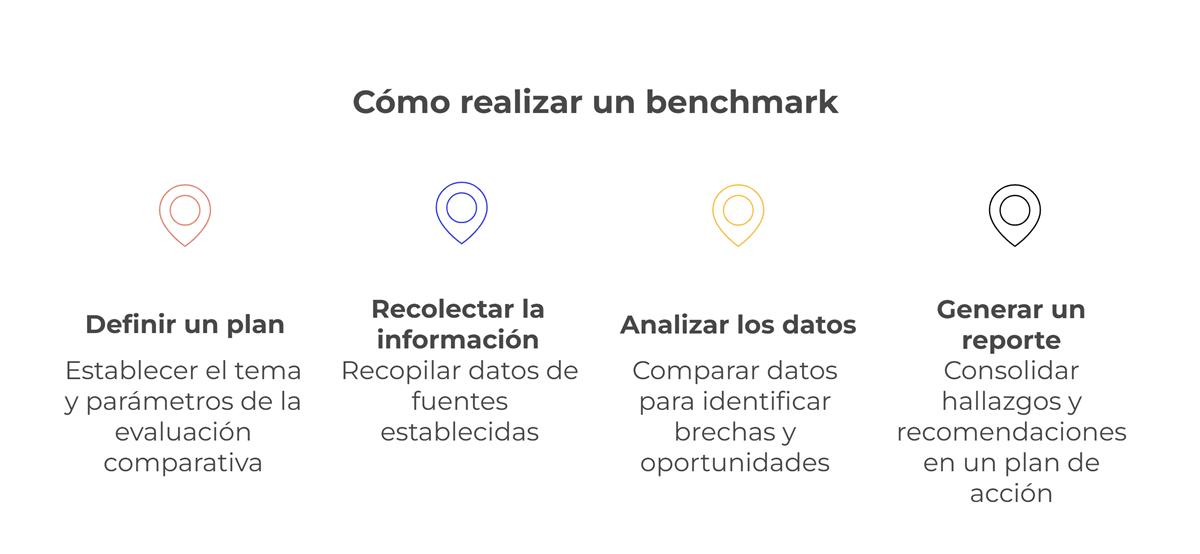
In the final part of this article, we will look at a methodology or the steps you can follow to conduct your own benchmark.
1. Define a plan
- To begin, you must define the topic of your comparative evaluation, which must be important to your organization and very specific.
- This will lead you to define which parameters you want to analyze, which ones you really need, because you cannot measure or investigate everything.
- Then, you must select the most suitable competitors, focusing on those that are useful for your objectives (for example, those that stand out for having the best practices in the area you are interested in).
- If it is about comparing what your organization is doing with what the competition is doing, then you must analyze your own process and know it in detail.
- If you have a work team, distribute the tasks and explain very well what the objectives of the research are.
2. Collect the data
Gather all data from the sources established in step 1, when defining the parameters and competitors. This data can be obtained from metrics, interviews, website and social media reviews, and surveys, for example.
3. Analyze the collected data
It's time to compare and analyze the data obtained. This depends on your objectives: for example, identifying gaps between your organization's performance and that of your competition, or discovering growth and improvement opportunities, new trends, and best practices in the sector.
4. Generate a report
The last step is to consolidate the data, analysis, conclusions, and recommendations for an action plan, according to the objectives the organization aims to achieve. This report could also include an implementation and monitoring plan for the recommended actions.
As you have seen in this article, there are different ways to approach a benchmark, and you can carry it out following a methodology that is not at all complex. It is a research method simpler than many believe, accessible to all types of ventures.

 By
By