Would you like to make the leap into UX Research but lack experience? You're not alone. Did you know that only 12% of job openings for UX Researchers are for professionals without experience? The trend is similar in Latin America and globally.
We obtained this percentage by reviewing job postings on LinkedIn on April 10, 2021. This is interesting data when put into context with the following: 34% of job postings for UX Designers seek professionals without experience.
Why are there so many job postings for experienced UX Researchers? As a hypothesis, this gap may arise in design teams where the UX Researcher role is a single position, not something that is "divided" within the team. Therefore, they seek a professional with mid to high seniority to take charge of "everything" autonomously, as they won't have a mentor or someone to train them internally.
Why are there many more job postings for inexperienced UX Designers? The opposite happens here: these are teams with more than one UX designer, meaning if there's a senior designer, they can hire a junior one whom they will train.
Either way, we understand that this context can be challenging for those who wish to make the leap into user research.
Now, what should you do if you don't have experience but are interested in a new adventure in the UX world?
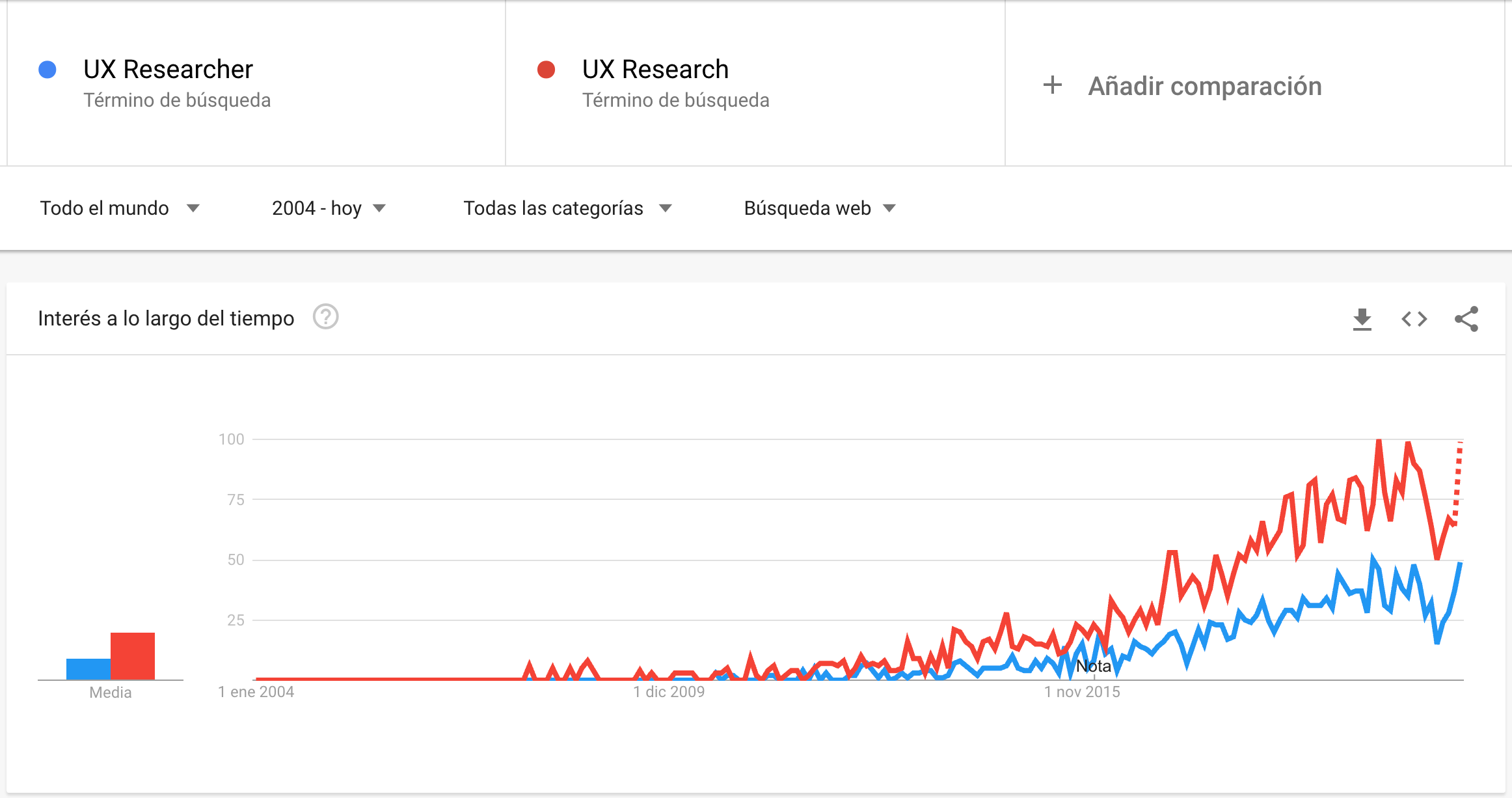
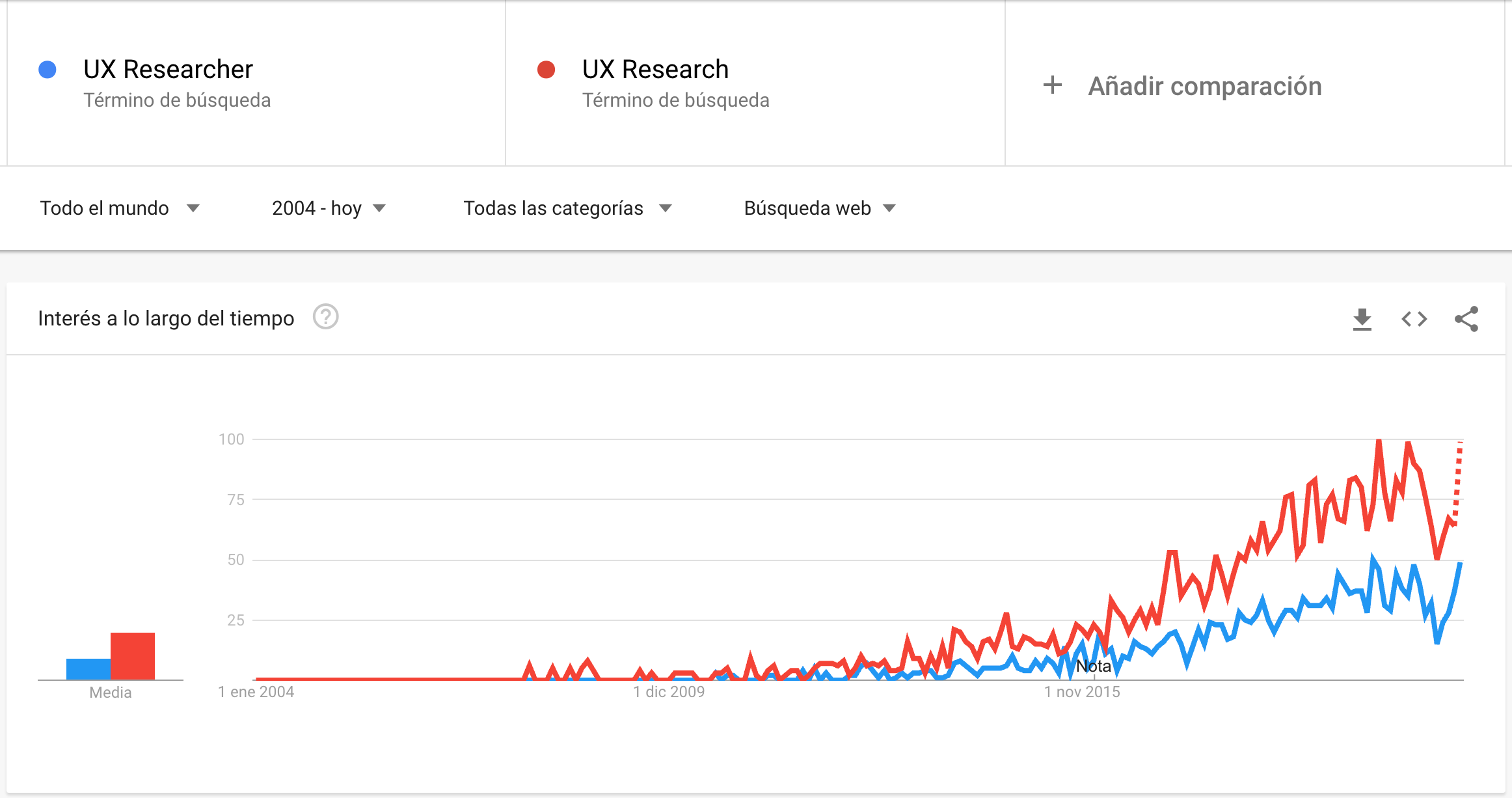
As you can see in the Google Trends graph below, Google searches for topics related to the UX Researcher role and UX Research functions have been increasing since 2015. This is excellent news. It means that globally, it is a job field that is gaining ground:
But where things get complicated, at least in Latin America, is that there isn't an academic career path for UX Researcher as such, precisely because it's a new field. What do we find there? Many self-taught professionals and individuals who have gained experience through different functions, roles, and projects that allowed them to shape their CV to present themselves as UX Researchers.
The problem of how to find a job as a UX Researcher can arise in a multitude of contexts, among which we highlight:
I- Professional designers (graphic, visual, editorial, product, UX/UI) who have never had the opportunity to do research.
II- Professionals from other disciplines such as sociology, psychology, journalism, who, although they haven't worked in design as such, are NOT junior, but rather senior or semi-senior in their fields.
Begoña, a sociologist with more than 5 years of experience in research projects, comments: "They ask you to be a researcher with a designer profile. The stumbling block there is that they ask if you know how to design, program, or use design tools."
This approach to the recruitment process seems to be synonymous with:
- a company looking for a "unicorn," i.e., someone who can do everything;
- a headhunter or recruiter who doesn't perfectly understand the differences between a UX Researcher and a UX Designer, and therefore cannot delve into a conversation about methodologies, research design, techniques, skills, and personal qualities necessary for research, so they get stuck on tools. It's much easier to ask someone if they know how to use tools A, B, C instead of getting them to tell you the story of how they approached a research question.
Have you thought about what you can do in your job to bring customers closer to the business? As we mentioned earlier, there is no single established path to user research.
Read more about:
It's better to ask for forgiveness than permission: if you are currently in a job that allows you to make design decisions, even without doing UX Research, then go for it and take the initiative. Even if something is not in your job description, do it.
Does your company not believe it's important to test with users? Do it yourself, conduct the first tests, and show your team how much it can contribute to the development of a product or service when the user is involved. Specifically, you can:
I recently wrote about how I started doing user testing in my first e-commerce job, when UX Research was not yet a common term.
Are you struggling to convince your boss to invest in UX and usability? Is everything in your team needed yesterday, and they don't have the time or resources to involve the user? Here are some experience-based tips on how to sell the idea to your boss without dying trying. And by the way, to show that you can do UX Research in lean times (with or without COVID).
Innate curiosity is essential for research, and you probably already have that. Obviously, curiosity alone is not enough if you don't have a grasp of methods, techniques, and tools to carry out research projects and communicate the results.
UX Research as a disciplinary field is not so defined as to say that there is a perfect combination of studies + skills + professional experience, so you must understand:
- what you already have in your background that you can use on this path,
- what you lack, and
- how you can get what you lack.
Read more about: online UX Research courses.
If you studied design but your degree didn't include research courses, you might need to befriend data. That's right, to do user research, you must use qualitative, quantitative, and mixed methods (combining quant with qual). While the concept of "data" is more commonly associated with quantitative research, in both cases – quant/qual – it's about using data to inform design and business decisions in general.
If you studied sociology, you definitely already know a lot about quantitative and qualitative methods, but you might need to understand how design teams work and in what contexts they operate – you'll probably learn that on the job. In this case, you might already have the necessary experience to apply for a UX Researcher job, and you just need to highlight it or develop a common language with UX designers. That's what we'll look at next.
"I'm just starting in the UX world. I'm a journalist with 4 years of experience in communications, and I feel I could contribute a lot to a UX team. When I graduated and decided to change fields, I faced the job search. It's intimidating that most of the offers are for seniors or semi-seniors. There are very few searches for Jr profiles, and the few that exist specifically look for design knowledge." (Ana Daniela Valero, Journalist, Chile).
A. If you have previous work experience
Let's clarify one thing: if you already have work experience, you are NOT a junior profile. You may not have UX Research experience, but you are not starting from scratch.
You can have a project portfolio without being a graphic, visual, or UX/UI designer.
How to do it? Familiarize yourself with the typical stages, artifacts, and deliverables of a UX Research project. Without making an exhaustive list – it's not the purpose of this article to delve into the topic of portfolios for non-designers – here are some ideas you could incorporate:
- evidence of your field observation sessions (if you come from sociology, you've probably done a lot of that),
- examples of customer archetypes you've identified,
- examples of data visualization from research results,
- evidence of workshops with internal and external stakeholders, and
- evidence of case studies.
Finally, tell the story of your research projects and the methodological framework you used in each case.
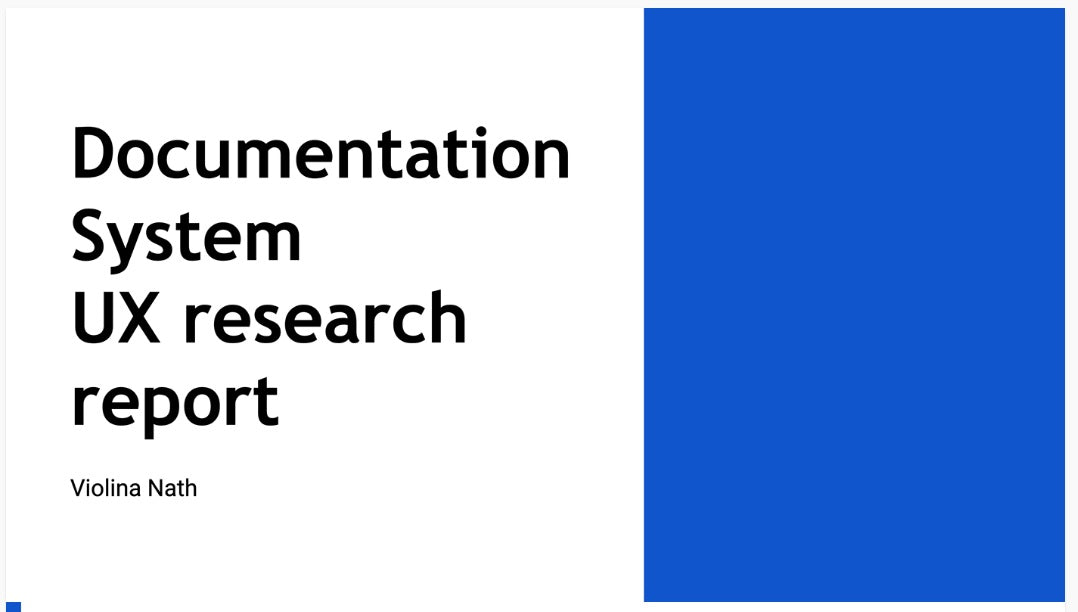
Below is an example from Violina Nath on Behance:
We chose this example on purpose because, although it's on a platform designers are familiar with, Behance, it is essentially a presentation-style document that doesn't require graphic or editorial design tool skills.
As Begoña, a sociologist, told us, in the end, a UX Research process is essentially that, a research process.
B. If you don't have work experience
If you invested time, energy, and money in a diploma or master's degree, you've surely had individual or group projects for a company or your own final project or thesis. Retrospectively evaluate everything that meant and make a list of every project in which you:
- interviewed users/customers,
- were able to test a prototype,
- validated a business idea, etc.
Use this background to your advantage. Experience doesn't have to be based solely on formal paid work. All the opportunities mentioned allowed you to do, learn, and make decisions, therefore, you must show them on your CV or project portfolio, depending on the context.
Sign up for a hackathon
A hackathon is an event that usually lasts a couple of days and brings together interdisciplinary teams to solve a problem or, at least, brainstorm quick solutions and test them. Here too, from experience, we tell you that it's a tremendous opportunity to conduct interviews and guerrilla testing. How so?
Precisely because to quickly validate a business concept, you need to involve the user. Look on LinkedIn, Eventbrite, Meetup, and other similar platforms for open events in your region. If you don't have a team, it doesn't matter. You'll find one. Once you've found it, take on the role of UX Researcher (you'll probably have to fulfill more functions) and take charge of exploring, validating hypotheses (very common in a hackathon), and testing prototypes.
It's an easy experience to gain, doesn't require much time commitment – unless you decide to continue with the hackathon team and embark on a startup-type venture – and you can showcase it on your CV.
Use your network
If your network doesn't know about your interests, how do you expect them to consider you for a project or a UX Research role?
Talk to people who are currently in this role and ask how you can shadow them, which means accompanying them in their duties to learn. This will allow you to immerse yourself in the reality of user research and even develop your observation skills.
Keep your network active; networking is one of the main tools for finding a job.
"Everyone knows each other (...) Getting in is difficult, at least from the research area." (Begoña, Chile).
Seek a mentorship
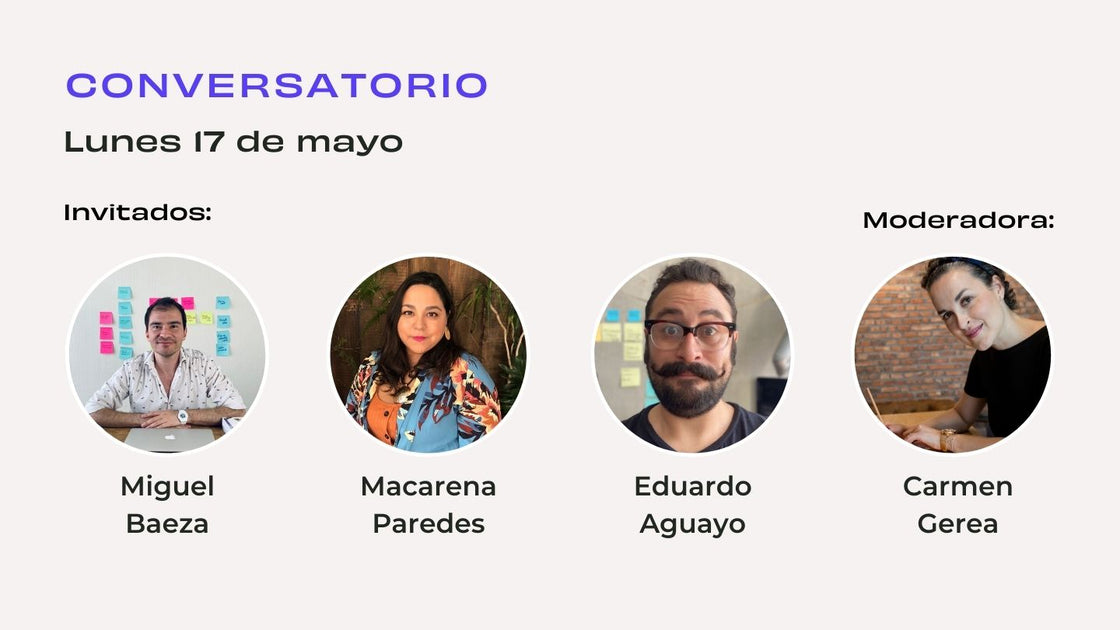
There are paid or free mentorship programs. There are also professionals who offer their services, like our colleague Eduardo Aguayo who provides mentorship and coaching. For women in UX, there is the community +Mujeres en UX.
Check with your network. Your mentor can help you not only by guiding you but also by opening doors if you don't have UX Research experience.
Using the empathy so required in UX Research and so as not to demonize those on the other side, and also because I myself have been in the recruiter's position, let's see what happens with professionals who are building a team or are recruiters.
How have they managed to incorporate "inexperienced" talent?
Miguel Baeza from Wunderman Thompson Peru comments: "In 2019, we needed to hire a UX Researcher, and I saw the opportunity to incorporate a visual designer who had no research experience. (...) I could invest time, and there was no restriction from the client."
Miguel's team chose to hire a visual designer who had previously worked with them but had gone to train in UX in Argentina. Although this designer had no research experience, he perceived that she would make a great contribution to the team. In this decision-making process, Miguel was helped by:
- his availability of time to share and teach,
- management support, and
- the desire to develop talent.
That's right, wanting to develop talent is fundamental: "We won't change the world if we don't change it ourselves." (Miguel Baeza).
Finally, Miguel highlights the need for "fresh and diverse eyes, as it is vital to have different points of view and varied perspectives" to avoid confirmation biases.
Still undecided? As a final piece of advice: take charge of your career decisions. If you've already decided that you need to shift from UX Design to UX Research, do it. Figure out how to reframe your CV to highlight your experience. You probably already have a lot to contribute to a team.
You can start today to plan a shift with the help of the Career Planner. 114 pages with:
- self-exploration activities,
- tools to set, plan, and track your progress,
- and techniques to face the challenge of designing the professional career you desire.
Image 4 by UX Indonesia on Unsplash

 By
By