You can also watch and listen to this article in podcast format
Defining a Buyer Persona helps you keep a clear image of your customer in mind. It's a very useful visualization for designing solutions aimed at improving the purchasing process and is primarily used in Marketing and sales contexts. It is one of the key customer archetypes teams build from research.
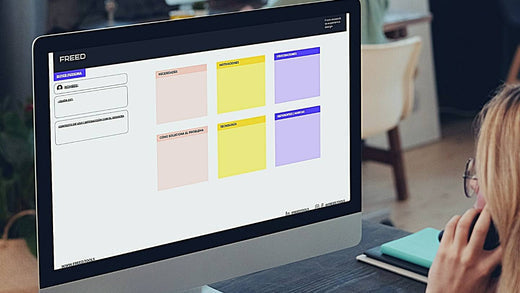
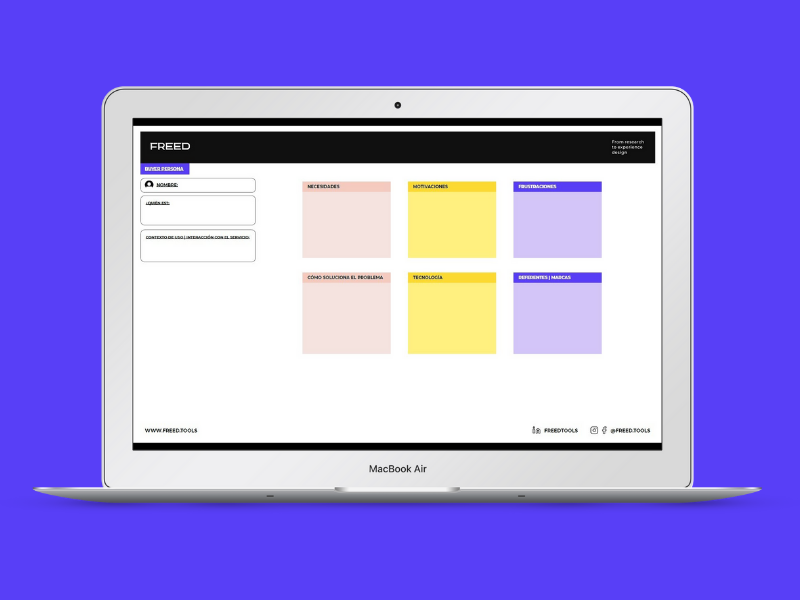
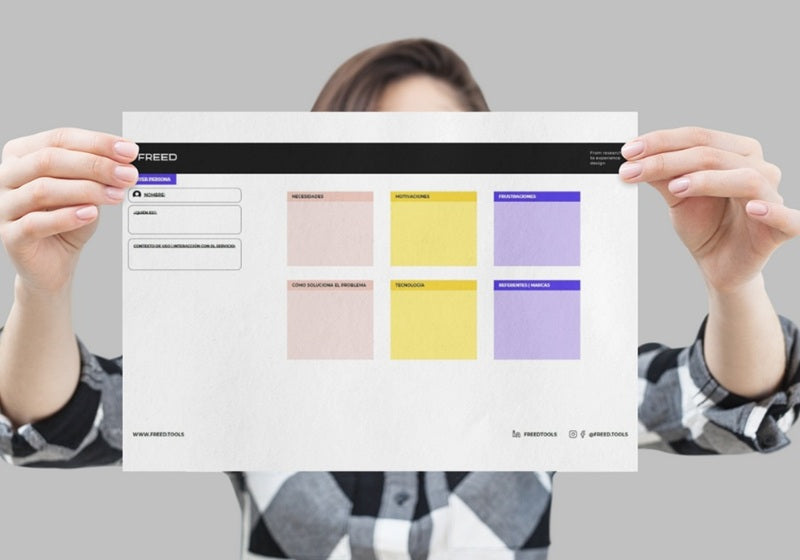
Before you start, we'd like to inform you that to identify your Buyer Persona, you can download our template and follow the steps outlined below.
Get our analysis in your inbox
Subscribe to the FREED newsletter: applied research, trends and tools.
No spam. Unsubscribe anytime.
What is a Buyer Persona?
A Buyer Persona is a way to systematize the characteristics and behaviors of consumers around a specific product or service.
This systematization process transforms into a fictional representation of your ideal customer. This does NOT mean you have to invent your customer or over-represent their characteristics.
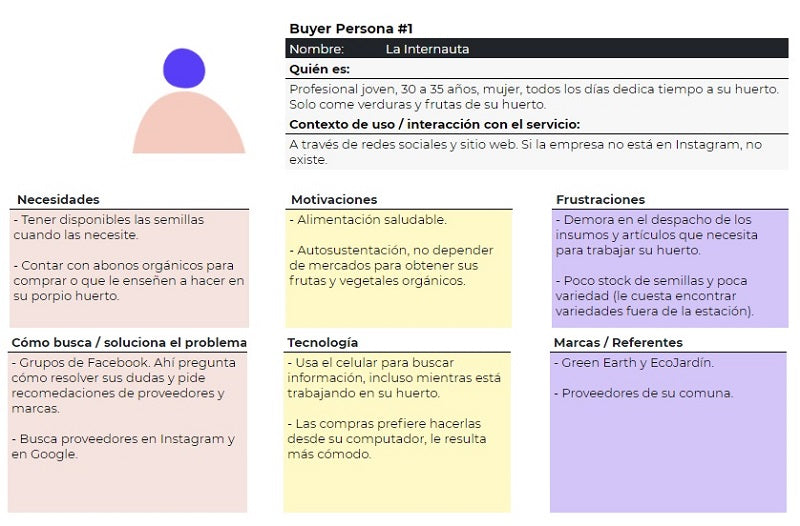
Simulation of a Buyer Persona in the field of fertilizers and products for home gardens.
A Buyer Persona should be a visualization based on real data of your customers' behavior that describes specific tasks and situations.
This data is primarily qualitative, but you can also cross-reference it with quantitative data to help you detect relationships between both variables.
What is the importance of the Buyer Persona?
The Buyer Persona helps us design the purchasing experience, focusing on marketing and sales.
Based on your customers' purchasing experience, their expectations, and desires, you can guide the design of solutions. That's why it's so relevant to identify your Buyer Persona before launching a specific product or service to the market.
In summary, it's a valuable tool that helps you to:
Drive marketing and communication strategies.
Make decisions about products and services.
Define the content to be offered to customers.
Improve touchpoints in the purchasing journey.
Improve customer response levels.
In the case of a website, for example, the ultimate result of defining a Buyer Persona is to capture the attention of quality visitors who match your customer's characteristics and attract potential customers.
At the end of the article, we will provide a link to download the Buyer Persona template we created at FREED.
Steps to identify a Buyer Persona
The Buyer Persona is also known as the Customer Persona or Persona Marketing. It is based on real customer behavior data that you can obtain from:
Market research.
UX Research.
Information held by the organization.
External third-party sources.
To identify a Buyer Persona that provides relevant information, follow these steps:
1 - Analyze your research data and begin to describe your ideal customer in the Buyer Persona template. The idea here is not to work with an imaginary customer, but to take the real data mentioned above and answer the question: if today I have 10 profitable customers and I want to reach another 100, what should those 100 be like?
2 - You should first fill in the spaces for Needs, Motivations, and Frustrations. This will allow you to identify patterns, i.e., recurring information in studies and research.
3 - Then, complete the sections that tell us about their behavior:
How they search for and solve the problem.
Technologies they use.
Brands and references they have in mind.
4 - With a clear understanding of the various aspects of your customer, fill in the upper fields that tell us how and when they use your product or service.
5 - Finally, if relevant, describe their personal characteristics, such as age, gender, educational level, and occupation. For their name, you can use a concept that fully identifies them, such as "Tech Savvy," "Early Adopter," "Brand Ambassador," etc.
Some tips for creating your Buyer Persona:
Remember to organize the information thinking about recreating characters and contexts that should represent specific tasks and situations.
In the template, do not describe the tasks that users perform when interacting with your product or service. If you are looking to improve the user experience of your product, we recommend creating a Customer Archetype, not a Buyer Persona.
The Buyer Persona does not aim to be a precise representation of a percentage of customers but rather is descriptive in terms of their behavior.
It is important that you only include information relevant to guiding solution design. By this, we mean that you should only have just enough data and not long lists of characteristics.
Additionally, you must cover the objectives relevant to the design, which are those that people expect to achieve when purchasing your product or service.
Finally, a research study may lead you to the conclusion that there is more than one Buyer Persona interested in acquiring your product or service. Consider that between 3 and 5 Buyer Personas are sufficient to cover 80% of the most common customers.
The important thing is to identify only the most representative ones to clearly visualize your customers' needs, frustrations, and expectations.
If your goal today is to define your Buyer Persona, download the template we have created for you.
Article developed by Denise Sánchez. Edited by Rafael Baquedano.
To run these exercises collaboratively and remotely, at FREED we use digital whiteboards such as Miro, which let you map, cluster and vote with the whole team in real time. (Affiliate link: signing up through it supports FREED at no extra cost to you.)
Share this article
Follow us on YouTube
Nuevas Economías, Research Thinking and FREED AI Studio: conversations and analysis on business, technology and human behavior (in Spanish).
The advantages and challenges of Vibe Coding for creating digital products with artificial intelligence, including examples of what the FREED community has devised.