Keyword research is the process of finding and analyzing the search terms that people enter into search engines.
And through this inquiry, you will be able to understand how they search the internet for a product or service like yours.
- Because it's about understanding what people search for online.
- It helps identify your main competitors.
- It helps discover and select market niches where you can compete with your product or service.
- It provides valuable information for developing your content strategy.
There are two perspectives that can guide your approach to keyword research.
- The first perspective relates to product orientation. This is a very common situation where you produce something and try to sell it.
- While the second approach (which I personally recommend, if your situation allows it) is customer orientation, where the customer is the core value of the business.
Depending on the orientation, your keyword research will be different. Let's first look at what product orientation is.
If you already have a product or service, this will be your source of inspiration. In this case, you can start from:
- The product category (e.g., "the handbag").
- The type or class of product ("leather handbag," "faux leather handbag").
- The intended use of the product ("office handbag," "laptop handbag").
- The product user ("women's handbag," "men's handbag").
- Product attributes ("small handbag," "elegant handbag," "green handbag," etc.).
- Occasions when the product can be used ("cocktail handbag").
- Trends ("mini handbag").
- Styles ("crossbody type," "satchel," "clutch bag," "shoulder bag," etc.).
Additionally, there are two elements you should consider when starting your keyword research:
-
People's vocabulary, because sometimes we write and speak differently. Also, your potential customers may not use the technical language you do.
-
Semantic differences from one country to another. For example, in different Spanish-speaking regions, we say "bolso de dama," "bolso para mujer," or "cartera para mujer," and there are many ways to refer to a similar product.
If we move to the second type of perspective for keyword research, we have customer orientation. If you believe you can reflect on your current product or service, making an adjustment in the design, reviewing the way you sell your product today, this approach will help you.
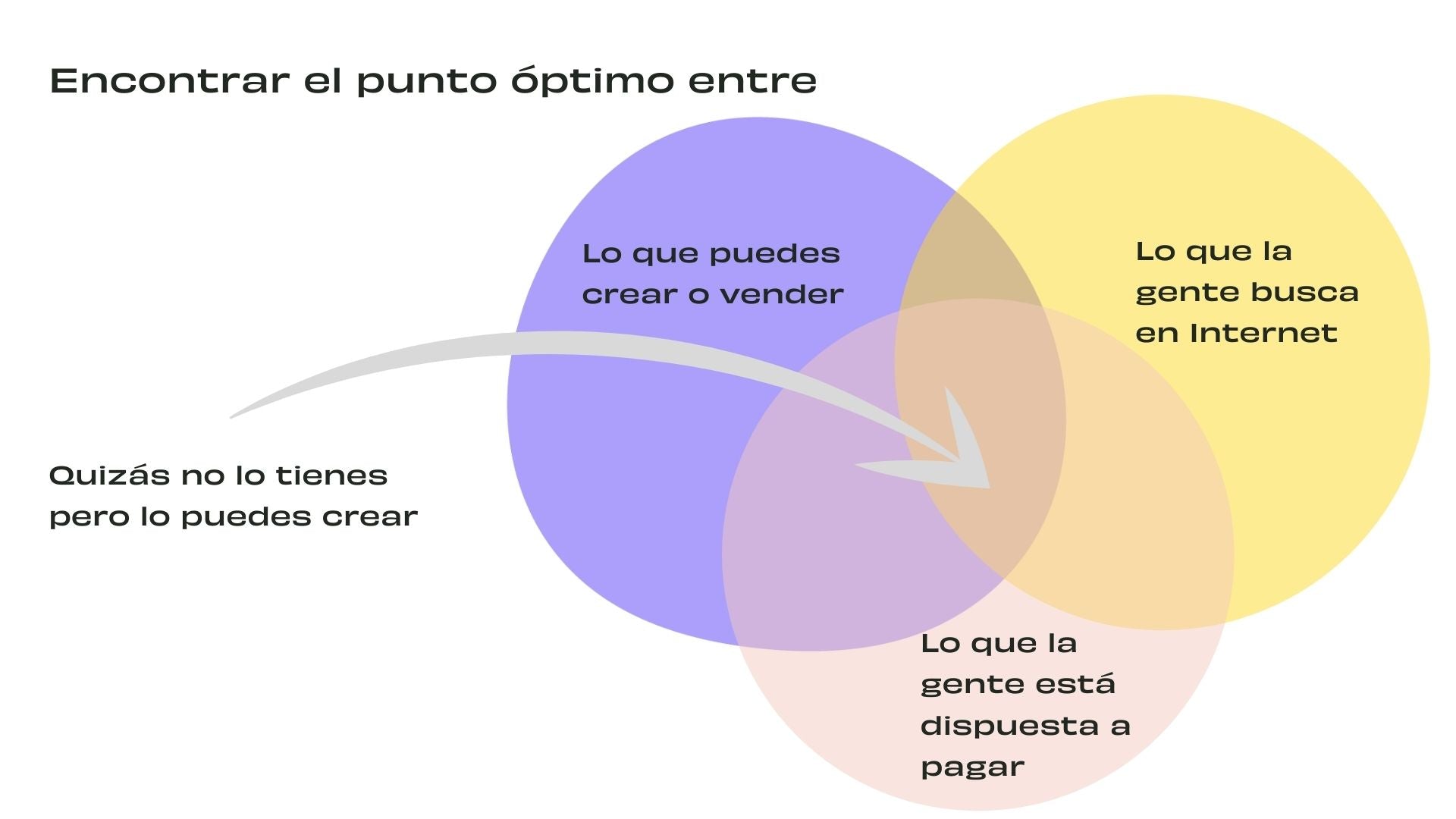
It's about understanding and finding the optimal point between what you can create or sell versus what people search for online and what people are willing to pay for.
Perhaps that space, that opportunity, is something you don't have at the moment. You're probably not manufacturing a product or generating a service, but you can create it, you can design it.
The interesting thing here is to identify opportunities that you can execute or capture in the short term.
For example: if, during your keyword exploration and search volume analysis, you find more terms related to a product for men than for women, you should consider whether you are willing to design a new product. Can you do something different and eventually stop competing in one market to start competing in another?
This is the customer perspective: it's about stopping thinking about what we are generating as a business, about the type of product we usually manufacture, and starting to think about what people are looking for and solving those people's problems.
First, and even more so if you have a customer orientation, you need to understand people's behavior well, that is, how they speak and how they search. To do this, you can:
-
In-depth interviews with your current customers.
- Read the comments and reviews your customers leave on your e-commerce site (this way you'll see what vocabulary they use).
- Analyze the emails you've received with comments or complaints.
- A focus group with customers.
In conducting the research, what you mainly need are SEO tools that collect strong and precise data about what people search for in search engines and that allow you to estimate variables such as monthly volume and competition.
There are many tools that allow keyword research, which you can access directly online. Let's see how some of them work, such as Ubersuggest to estimate search volume on Google, Marmalead for Etsy, Jungle Scout for Amazon, and ERank, which allows you to obtain search volumes from different search engines.
Consider that this process is iterative, and there can be many back and forths between the first step (understanding people's behavior) and using tools to quantify or put numbers on the use of that vocabulary in queries.
Ubersuggest is our favorite tool due to its intuitive operation, quick learning curve, and because it offers a free usage option, which will help you try it out before subscribing to a paid account, as well as for conducting shorter research. We will develop a step-by-step guide with Ubersuggest that will also help you understand concepts and the operation of other tools, which we will cover more briefly.
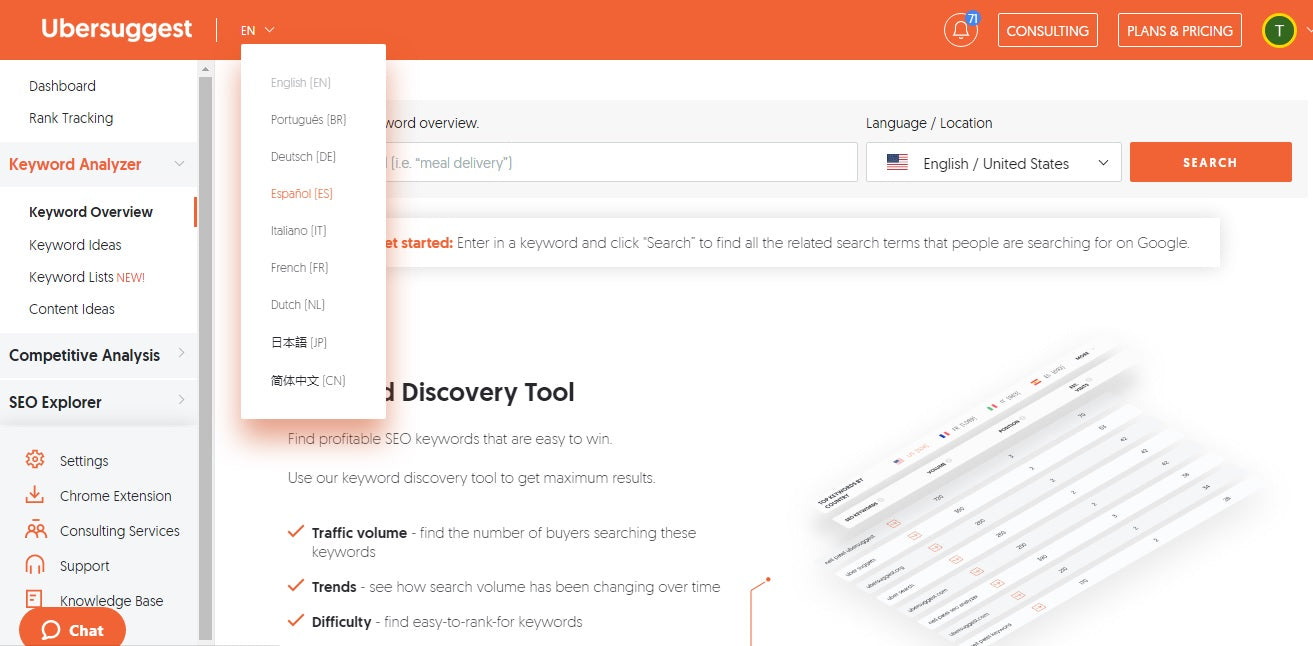
1- First, you must change the interface language to English.
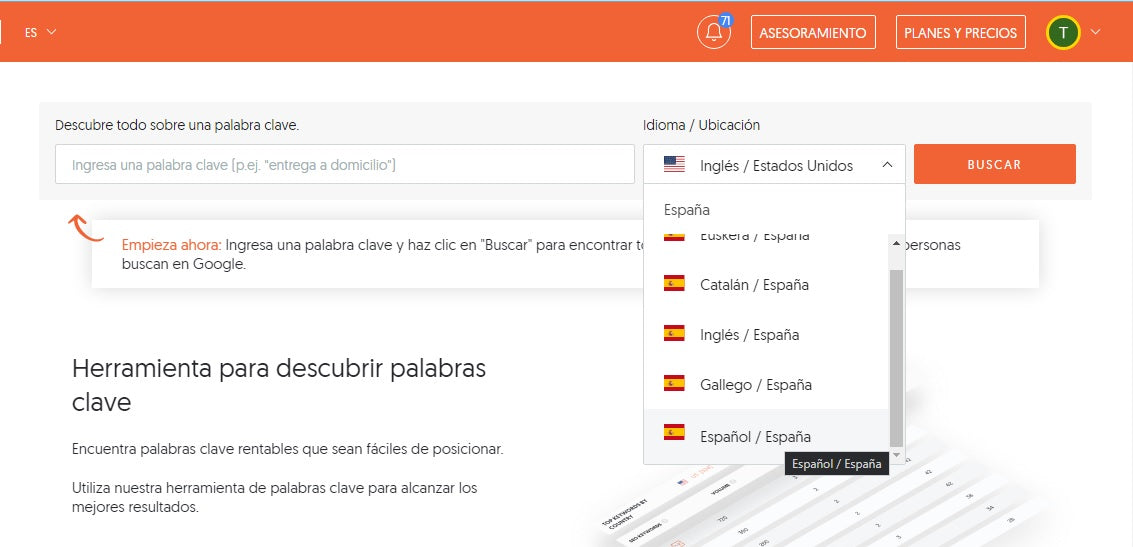
2- Second, a detail you should always keep in mind is the territories and languages you are searching in. For example, if we continue with the same example of "leather bag," then we want a Spanish-speaking country. It is important to understand that we must search exactly in the language of the user in that country: Spanish from Spain, Catalan from Spain, English from the United States, English from England, etc. So, here what we want to see is Spanish from Spain, for example.
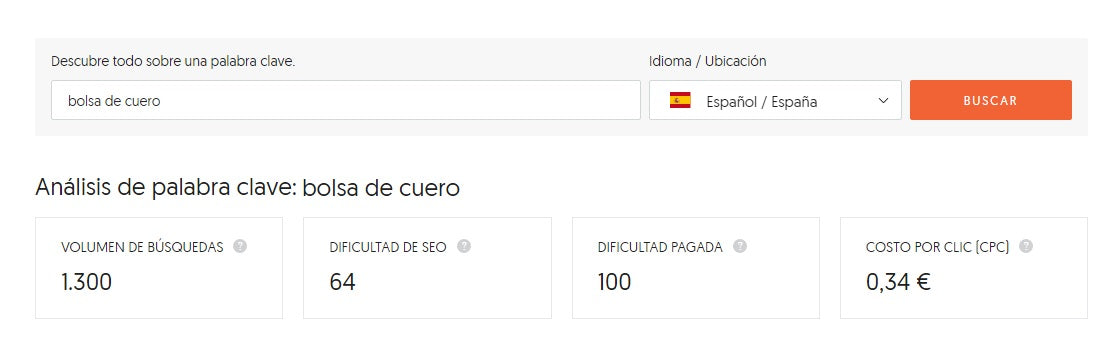
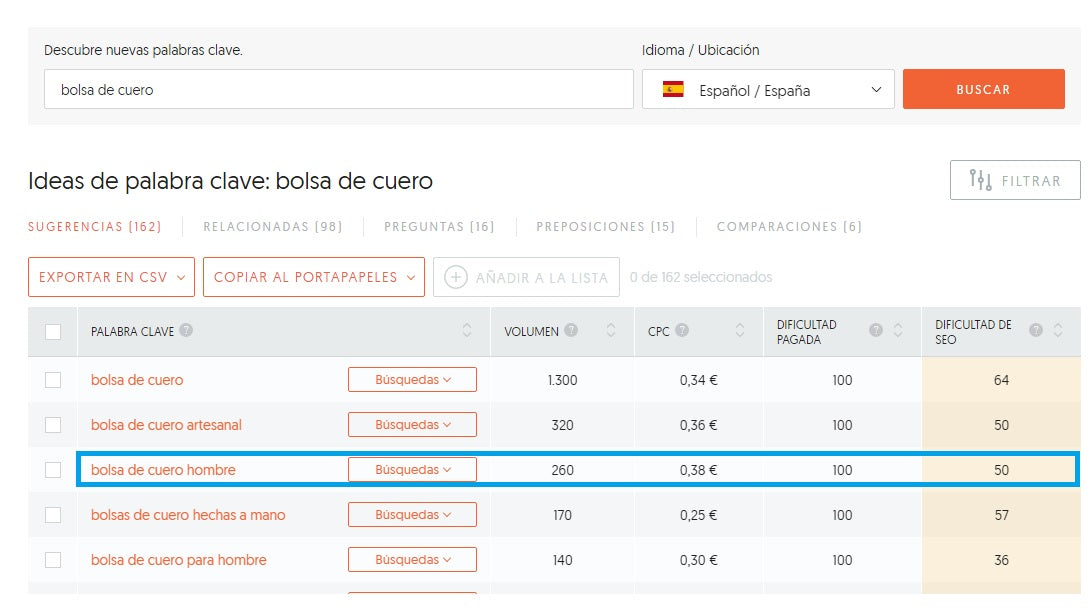
3- We find volumes of 1300 monthly searches and a difficulty of 64. This level is very high; generally, we try to find keywords with a difficulty lower than 40 because if it's higher than that, it becomes more difficult to rank.
4- If you go to "Keyword Ideas," you will see suggestions. For example, "men's leather bag" performs better with a volume of 260 and a difficulty of 50.
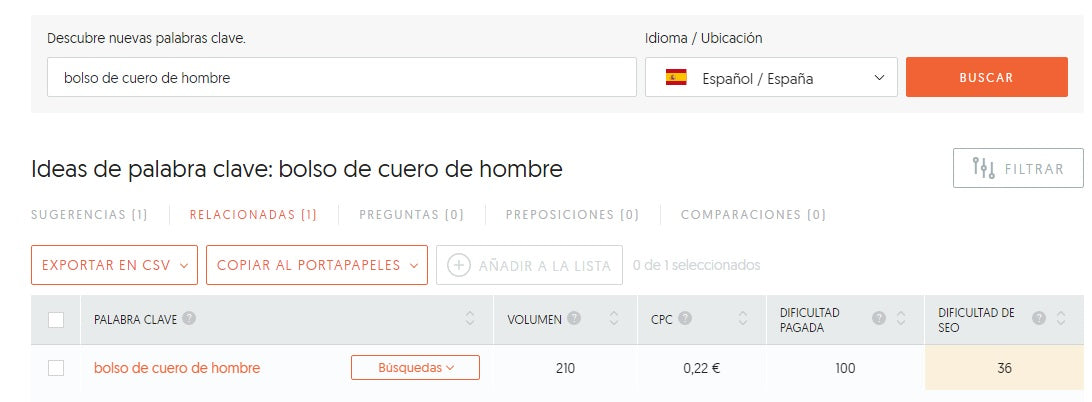
4- The recommendation is to keep looking for variations of the keyword until you find a term with an interesting search volume and a difficulty lower than 40. Here we changed to "leather bag for men" and it returned a volume of 210 and a difficulty of only 36.
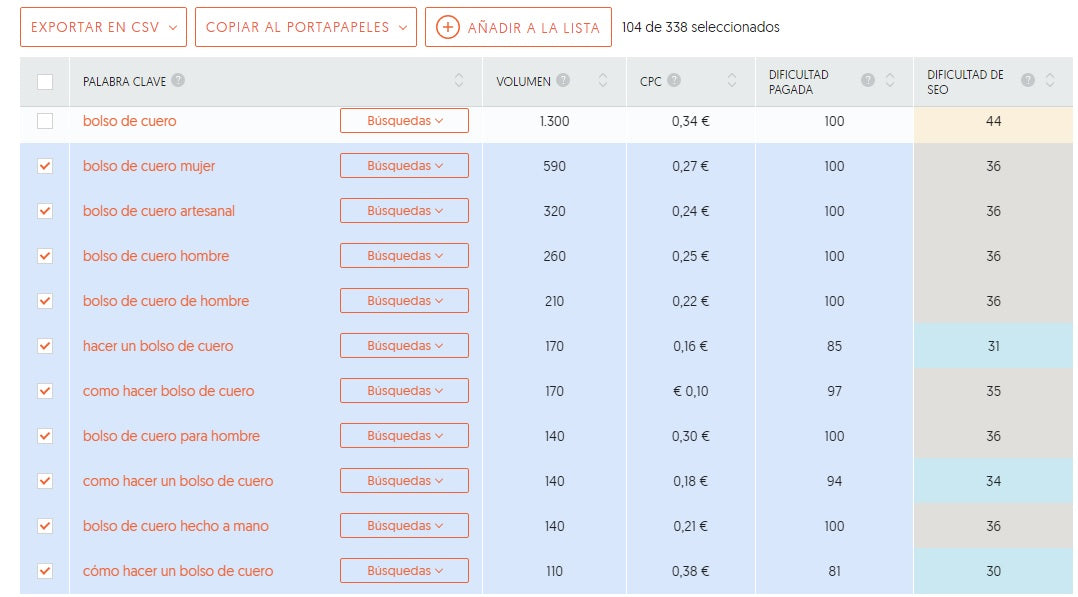
5- You will also find terms that we do not associate with a search intent. For example, "How to make a leather bag." Later, when you apply all the keyword filters, highlight them because they will be useful for other purposes, such as generating a blog article.
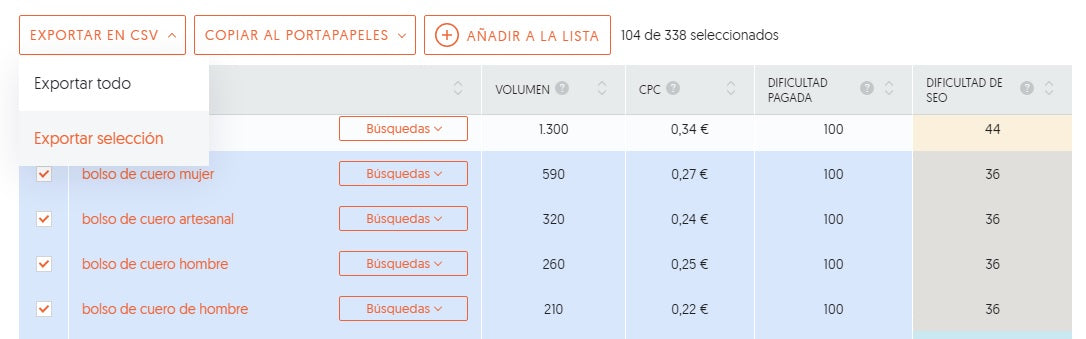
6- After reviewing all the keyword ideas proposed by Ubersuggest, you need to transfer these results to another format that you can work with. Therefore, you must select the useful words and export them to CSV, which will allow you to work in Excel or Google Drive Spreadsheet format.
Marmalead is a tool where you will only see the search volume for Etsy, one of the most important global marketplaces for handmade products. This means it will be very useful if you have a shop on Etsy.com or decide to do so in the future.
Here, the results are independent of the country from which users access, so it is a bit more complex to estimate where those searches are coming from.
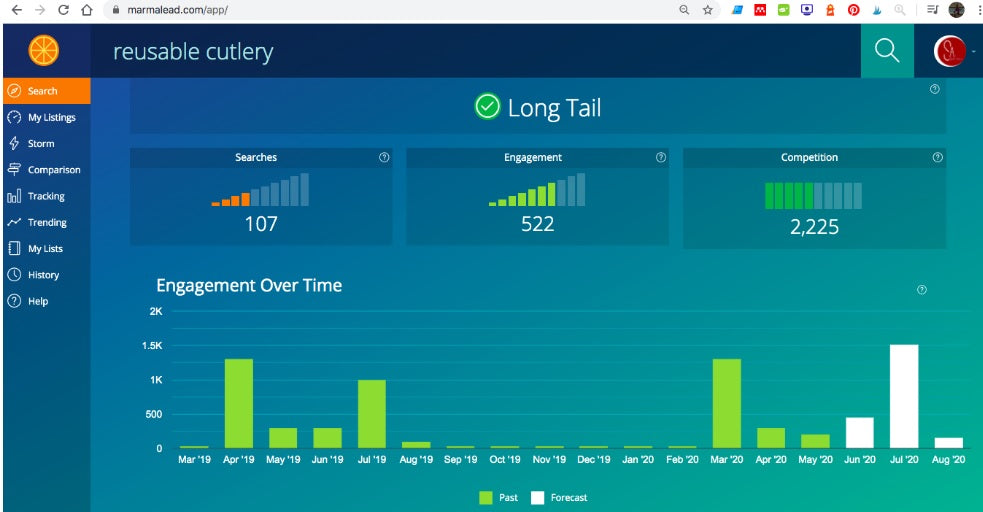
After entering the keyword you want to check, it is relevant to look at:
- monthly searches,
- engagement, and
- competition.
Low competition can be good, although it's also possible that not many people are searching with the keyword you are investigating.
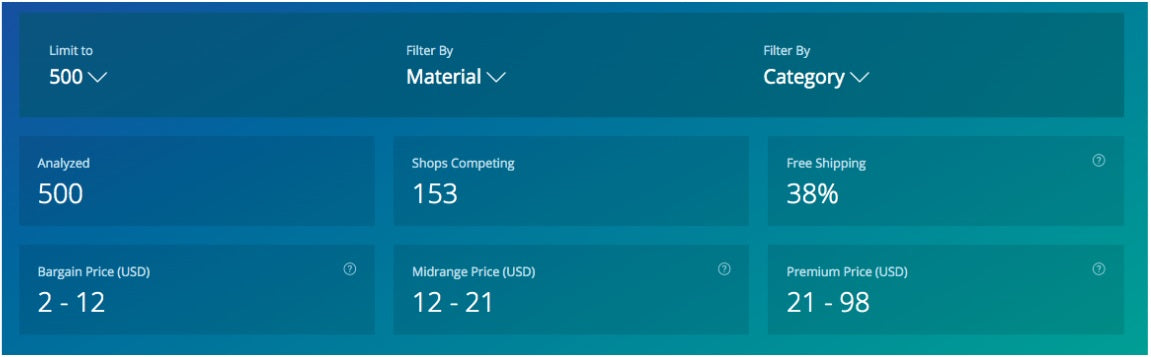
You will also be able to observe a large amount of information such as:
- prices,
- product types,
- shipping type, etc.
And, just like in Ubersuggest, you will find related terms that will help you expand your keyword research.
For Marmalead, the recommendation is to search in English, because most of the traffic to Etsy.com comes from the United States, and obviously, that is the primary language there.
Another recommendation is to look at the graph that indicates whether the terms are "long tail". This means there is some search volume for those terms and low to medium competition.
When you find an interesting term, create a list and add it. Then, add other terms to that same list. But if you change products, create a new list. That's the working logic in Marmalead. To organize your keyword research, filter the ones you're interested in and add them to your list.
Unfortunately, Marmalead does not have an export function, so you must select the terms from your list and copy them into a file that allows you to work later (Google Drive Spreadsheet or Excel).
Jungle Scout is a tool that allows us to investigate search volume within Amazon, in addition to many other functionalities. But now we will only look at what interests us for the purpose of this article: Keyword Scout and niche search.
To research with the Keyword Scout functionality, the first thing you need to do is select the country.
When it generates the list of results for the keyword you entered, select the terms that interest you most and download them, just like in Ubersuggest.
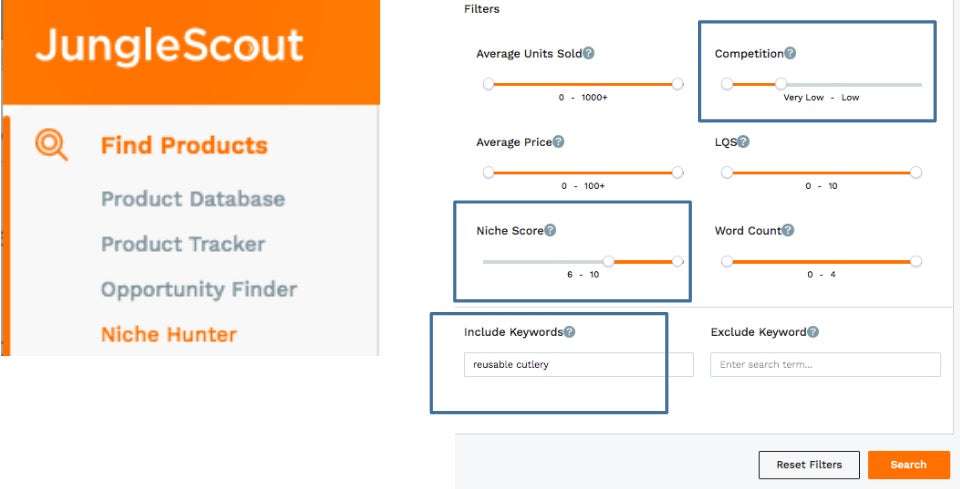
Another quite interesting feature is niche search in "Niche Hunter". Here you also need to select the country and then enter your keyword. Use the filters to narrow down your search results, for example, by specifying low competition.
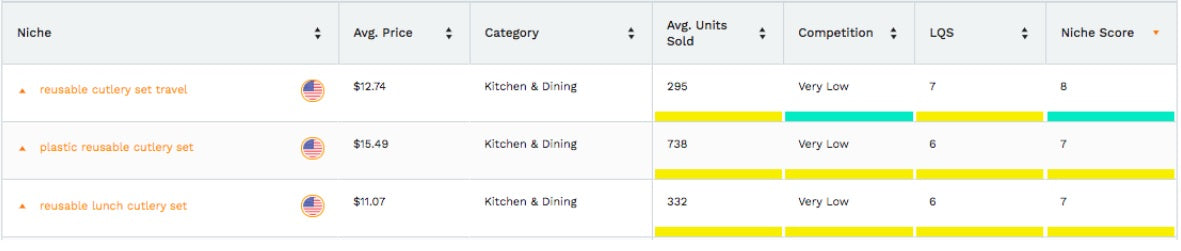
For different keywords, you will be able to see information such as:
- product price,
- average units sold,
- competition level, and
- a niche score.
If your product is not in the category, you must continue to investigate until you find a related niche.
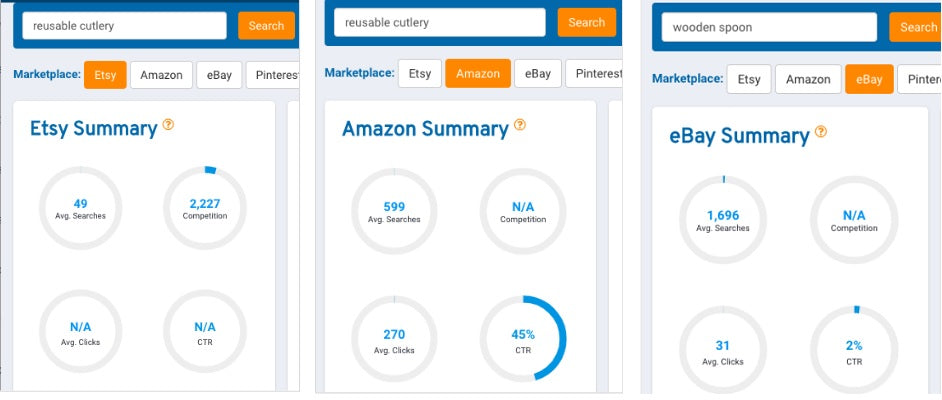
Let's now look at how ERank works. It's a tool that allows us to investigate search volume for Etsy, Amazon, eBay, Pinterest, and Google Shopping.
ERank works very well in English; however, it may return results for some Spanish terms. But, in general, it's preferable to focus on researching only English keywords.
In "Get keywords," search for the term you're interested in and compare the search volumes on Etsy, Amazon, eBay, Google Shopping, and Pinterest.
As we saw in Marmalead, you can check if the terms are "long tail".
In ERank, you can also download a file with your results.
A couple of considerations:
- It's normal for a term to have more searches on Etsy than on Amazon, for example. Consider the size of its search engine, whether it's a very specific keyword, and the level of competition for that product in each marketplace.
- If a term shows no searches, that doesn't mean they don't exist at all. In reality, it's because the tool didn't pick them up, probably because they are very few. The truth is that with these tools, we work based on assumptions.
- You need to define your perspective, whether it's product-based, customer-based, or a mix of both. This will determine whether your goal is to position your current products or services or to seek inspiration for the design and development of new products or services.
- Create a first list of keywords related to your products or services.
- Select the appropriate tool according to the sales channel. If you are looking to improve your website, you will work with Ubersuggest; if you have an Etsy shop, you will use Marmalead; for Amazon, you have Jungle Scout, etc.
- Conduct your keyword research with these tools. Select the terms that interest you most and export or copy them to a document that allows you to work easily.
- Refine your keyword research. It's important to view this as a process where you enrich your inquiry as you progress and realize that you are understanding better each day what and how people search.
- That is, consider your keyword research as an iterative process, where you first need to define one of the two perspectives, then research, and finally, list a number of terms that you should refine along the way.
1. Filter your keywords in your Google Drive Spreadsheet or Excel. For this, consider:
a) The relevance of the terms.
b) The difficulty of ranking (less than 40 in the case of Ubersuggest).
c) An interesting search volume.
d) Focus on "long tail" terms, those with medium or low volume and low or medium competition.
2. Select the most interesting ones. If you find 500 keywords, you should still choose a reasonable number to work with initially, depending on the products and content you can create in the future.
3. Match them with the current and future content of the website, product pages, or store on a local or international marketplace.
4. Optimize your current content about your products or services, and start planning new products or services and the corresponding content.
Has it become clear how you can do your own keyword research? If you have any questions, leave us your query.
I'd like to tell you that this article is based on a tutorial I created for the International Trade Centre, so you can watch the video on their YouTube channel.
You might also be interested in how we apply these keyword research tools and techniques, so we invite you to download the Home and Decoration Market Study 2021: Most Searched Brands and Products.

 By
By