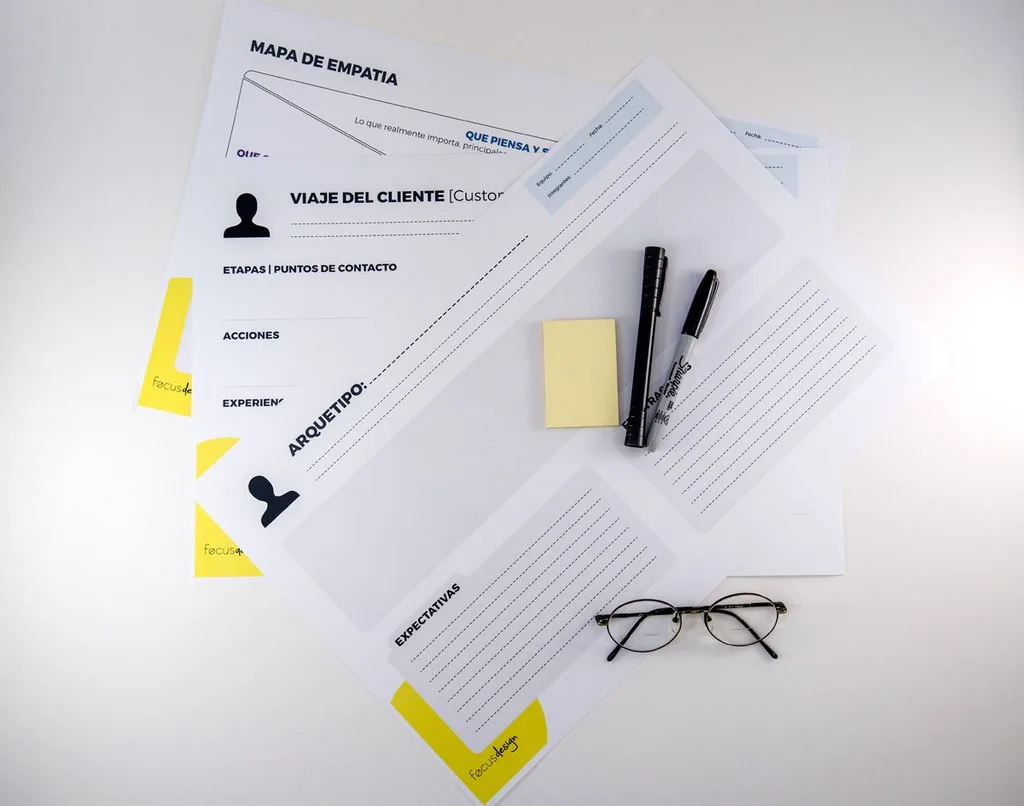
Continuing with the series of articles highlighting the qualities of our design kit, this time we will describe how the UX Research kit version is used and what are the advantages of incorporating it into your workshops, courses, or workshops on this discipline.
What is the design kit?
In the previous article, we already explained why we created the design kit, so we will only remind you that we have developed different versions for Lean methodologies, service design, prototyping, and, of course, for user research.
The content of this "toolbox" varies according to the discipline it is intended for, but it basically consists of templates, stickers, prototyping figures, post-its, pencils, markers, notebooks, etc. A set of materials designed to facilitate learning in the academic field and also to foster creative work in the development of innovative businesses within a company.
Who is the kit for
Initially, we developed our kit to support user research (UX Research) processes in the workshops we teach to those new to this discipline. That is, it is aimed at consultants, professors, and instructors who conduct courses or workshops, and event organizers around UX topics. Even if you want to have personalized kits for your workshops, with a brand or according to the aesthetics of an industry, write to us to request yours.
What are the advantages of using the kit
The strength of the user research (UX Research) kit lies in the initial stage of the innovation process, where students and agile project teams must identify a problem, and for this, it is essential that they know the client or user, that they understand their interests, needs, and pain points.
This way, they will be able to configure a profile of them and portray their experience with the product or service, with valuable information that will help them generate the best ideas to respond to a specific problem.
But the dynamics with this kit do not end there, because it also provides the tools to develop subsequent stages, where participants will build prototypes of their solutions, and then return to the client or user to perform tests that confirm they are on the right track.
With this kit, we address the complete learning process, which starts by sensitizing students to the importance of empathizing with the client and teaches them to systematize the data obtained in research with their clients, to generate innovative ideas to solve identified problems, to select ideas with high potential for impact, to prototype solutions, and, finally, to test their prototypes.
Although it was created for teamwork, the proposed methods can also be developed individually, and we hope that students will take their kit with them to continue using the tools beyond the academic sphere, incorporating them into the workplace as support in their innovative projects.
In summary, with the user research (UX Research) kit, you will be able to develop with your students or with the members of your project team a series of methods and techniques ranging from the discovery of a specific problem to the prioritization of ideas that are feasible to implement as the best solution. And with the guarantee that this solution will be the most efficient, because they considered their client throughout the innovation process.