Every day, impressive amounts of articles are published on websites and blogs, all competing to appear at the top of organic search results. This makes it increasingly difficult for traditional SEO work to deliver the expected results.
Furthermore, ever since Google updated its algorithm with the arrival of Hummingbird, it forever changed how it responds to a user's request, moving from merely searching for keywords to literally responding in a more human way to more complex queries. Other search engines have followed suit, creating a new standard.
But there's no need to despair; you don't have to start spending large sums of money on campaigns to get better positioning in organic search results. There's a solution to this challenge: applying semantic SEO techniques.
It's about thinking of the user, how they search for information or solutions to their problems, and developing relevant content accordingly, creating value.
In practice, semantic SEO is a process for building content by giving greater meaning to the words used, to provide them with greater depth and value. Google will reward this because its criterion is to send its users to pages where they will find exactly what they are looking for.
This means you must enrich your content to respond to your users' true intent and not just to a simple query or keyword. In other words, you will answer the first question they ask when searching and immediately the other questions that arise afterward.
The idea then is for your content to answer a query without needing to ask exactly for the object, person, place, etc., being able to describe it by referencing concepts associated with that specific term.
As Alexis Sanders, SEO Manager at Merkle agency, explains in her article published on MOZ.com, "using semantics and entity-based search, engines can gain a better understanding of what users may want." (1)
And she gives us an example that makes this concept very simple to understand. If we search for The Simpsons (this will be our entity), the algorithm will include other related entities:
- the members of this famous family (Homer, Marge, Bart, Lisa, and Maggie), their relationships with each other, and characteristics;
- the city where they live (Springfield), Homer's workplace, attributes, and descriptions;
- their pets and other characters from the series with whom they interact, etc.
In other words, entity-based search aims to connect various entities,
"which creates more depth for finding answers." (1) In other words, when writing, in addition to thinking about the general topic, you should simultaneously develop other specific, main, and secondary topics.
Semantic SEO suggests that you write to answer your customers' concerns, but also that you think like the search engine, because the search engine's algorithm also tries to anticipate the user's next query by associating terms.
To do this, you must discover what other questions will arise once your customer learns the answer to their first query, by analyzing their search behaviors and discovering search patterns.
All this information is vital for you to strategically place within your content, and to find it, you can resort to two readily available sources on Google's own search engine results pages (SERP):
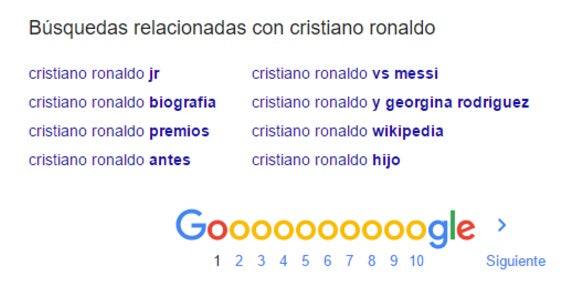
Related searches: appear at the bottom of the results page. If we search for Cristiano Ronaldo, we will see that users have also been interested in the awards he has received, his biography, close people, etc. Here is material that can be used to enrich the content.
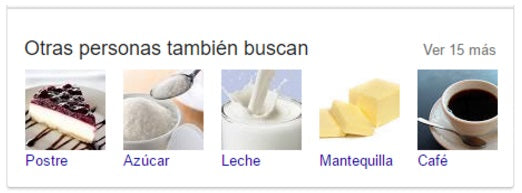
People also ask is information found at the end of the featured snippet section, which appears on the right side with a highly relevant article or website related to the concept we are searching for. Now we search for Chocolate and it returned other concepts such as Dessert, Sugar, Milk, etc., all related to our central concept. And if we click on "see 15 more," it will show us another results page with a variety of topics that may be useful.
Google Keyword Planner: a traditional keyword research tool available in Google AdWords. The goal is to start by choosing an important topic for your business and build from there. This time we will use an example based on a specific service:
A professional photographer wants to offer their services and already has experience creating product catalogs for some retail company websites. The first concept for a new article is "photography," but we can immediately extract a broad and valuable term like "product photography," from which we can start building. The next step is to arrive at an expanded term, which could be "product photography for small businesses."
To figure out how to build your content with semantic SEO in mind, these questions can help:
- What kind of problem are you trying to solve?
- How will you solve that problem with your content?
- Once you solve this first problem, how do you address additional problems the customer might have after learning the first answer?
Word clouds: with them, you can visualize relationships between concepts, test synonyms, structure your paragraphs, and measure the strength of each keyword. The best known are MOZ, SemRush, Sistrix, or Ubersuggest, although they were conceived for keyword research. Another tool that is more related to semantic SEO is LSI Graph.
You can combine several of these tools to then structure your new content around the patterns you have discovered.
You should not forget that to achieve better positioning in a world of algorithms with a strong semantic component, you must create your content thinking that search engines are focusing more on concepts and their relationships than on keywords, although the latter and other SEO factors have lost all their relevance.
-
To rank through more keywords: one way to illustrate this is by referring back to the links that appear in the 'Related searches' section of Google's search engine results pages (SERP). Clicking on each of them generates a completely different results page, and if content manages to appear on several pages and even in the featured snippet section on the right, "it means it has depth, because it addresses different layers of search queries related to the most popular one." (2)
-
To rank for a longer period of time: your content may lose ranking for a specific keyword over time, but if your content is deep and rich in related terms, it will retain traffic and continue to grow over time.
In summary, in the long run, you won't be able to control whether your content will stand out for the keyword you originally chose as the main one, but you can create strategies to appear on various SERP results pages with a series of different keywords.
Photography: Rafael Baquedano Charad
(1) "What Is Semantic Search and What Should You Do About It?", Moz.com Blog, by Alexis Sanders, November 2016: https://moz.com/blog/what-is-semantic-search
(2) "How to Write Content Using Semantic SEO", Search Engine Journal, by Wells Yu, 2017: https://www.searchenginejournal.com/content-semantic-seo/201596/?ver=201596X3