We're talking about the title that heads the product page and is distinguished by the "<h1>" tag. This is where everything begins when a person lands on your e-commerce site; it will be the first thing they see. Therefore, it must grab attention in such a way that it stimulates the desire to keep reading, and to achieve this, the title must be unique, specifically describe that product, using keywords and naming the most important features.
After writing content for many e-commerce sites, it's clear to us that it's not easy to create unique titles if you sell several items from the same brand or that are similar. Obviously, you will repeat some words, but think that the customer who is willing to buy is looking for a key phrase. From this perspective, we recommend structuring your titles by starting with the keywords that best describe the product, but if the brand or model is most important, you can start there.
For example: Men's formal black Office leather shoes.
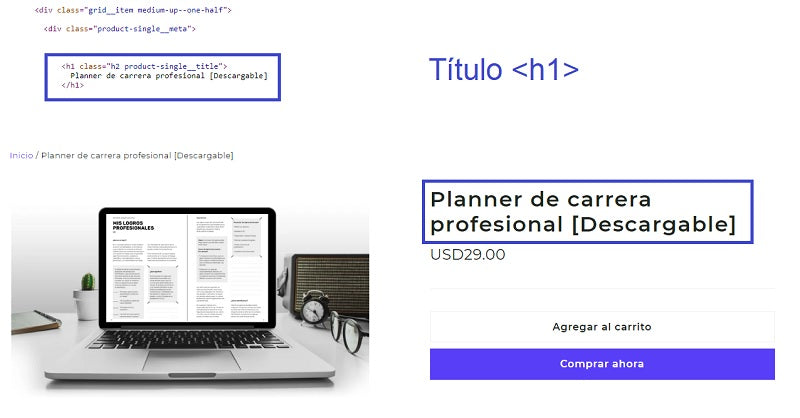
Example of a title seen in the page's source code with the "<h1>" tag and in the publication.
In 2021, we still find e-commerce sites where this basic aspect has been neglected. Think that if you invest time in creating good descriptions for each of your products, your pages will appear better positioned in Google's search results, and your potential customers will have arguments to decide to buy. In this regard, we recommend:
- Writing descriptions of no less than 750 words.
- Each description must be unique, and do not fall into the error of duplicating content on your product pages; even less so copying texts from other websites or your other sales channels. Also, consider that if you have a store on a marketplace like MercadoLibre, you must ensure that your descriptions on the web are unique and not a copy/paste of what you published on MercadoLibre.
- Use keywords that describe your product (we will delve into this later).
- Use arguments that help the potential customer imagine themselves using it.
- Talk about the product's benefits: what will the person gain if they buy it?
- Highlight what differentiates it from the competition.
- Talk about its materials, textures, and describe its colors very well.
- Don't forget the technical sheet: weight, size, color, materials, care, etc.
- Always include a call to action: what should the person do to get it? "Buy now," "Add to cart," "Pay now," etc.
First and foremost, they must be reviews from real customers: don't try to cheat because it will negatively affect your Google ranking, as its algorithm highlights pages that contain reviews. It is also known that for buyers, reviews are good arguments to stimulate the purchase decision. On the other hand, having a section available on each product page for this purpose allows you to form a community of loyal customers who create their own content to talk about your product, which we call social proof. Encouraging your customers to return to leave their testimonials will keep your product pages alive, stimulate purchases, and, incidentally, help search engines return more frequently. To get your buyers to leave their reviews, you can:
- send them an email invitation a few days after receiving the product,
- use the packaging to include this information,
- offer discounts on their next purchase for posting a review, etc.
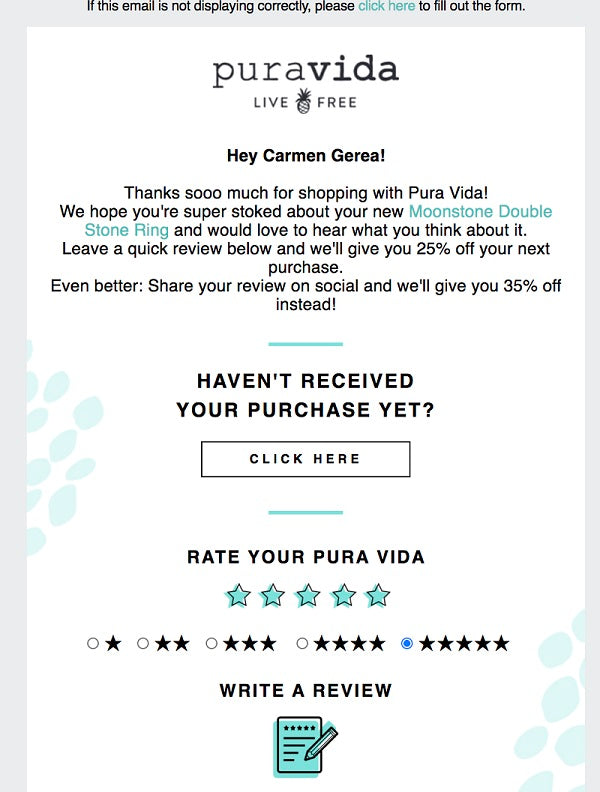
Example of an email invitation to leave a product review in exchange for a discount on the next purchase.
4. Avoid duplicate content
We have already mentioned this before, but we want to delve a little deeper into this aspect of SEO improvements for e-commerce. First, clarify that having duplicate content within your e-commerce site is inevitable, to the point that online stores could reach 30% repeated content on their pages. So, your effort should focus on staying below this barrier, precisely by following the advice we have given you.
And there is another type of duplicate content that Google's algorithm detects: that which occurs in relation to other websites. Therefore, never reuse the manufacturer's product description, because it is very likely that your supplier and other e-commerces are using the same content, and that will penalize your Google ranking.
To check if your e-commerce site complies with this item and with other parameters we are seeing here, check our article The 14 best free and paid SEO tools (tested).
5. Optimize your product pages with keywords
For this, you will have to conduct research that considers the demand for keywords in the searches people do on Google. You must use truly relevant keywords so that you can improve your Google ranking and thus capture those searches. Remember that search intent is fundamental.
Likewise, there are search terms that are very generic (for example, "notebook"), while others do not show a search intent associated with purchase (such as "notebook image"). Therefore, you must select target keywords relevant to your product and relevant to the purchase intent.
To conduct keyword research, at FREED we recommend the online platform Ubersuggest for its ease of use, for the number of ideas you can get from it, and because they have a free option. To do this, follow these steps:
- Select the country or territory that will be your target market. Start by entering a simple concept like "men's leather shoes."
- Ubersuggest will show you a series of statistics, but the most important are Search Volume and SEO Difficulty.
- The interesting part is in the Keyword Ideas section, because there you can see suggestions and analyze how people search for a product like yours.
- Collect keywords that have a search volume of 50 or more and an SEO difficulty below 36.
- Keep looking for variants to name the product to get more ideas.
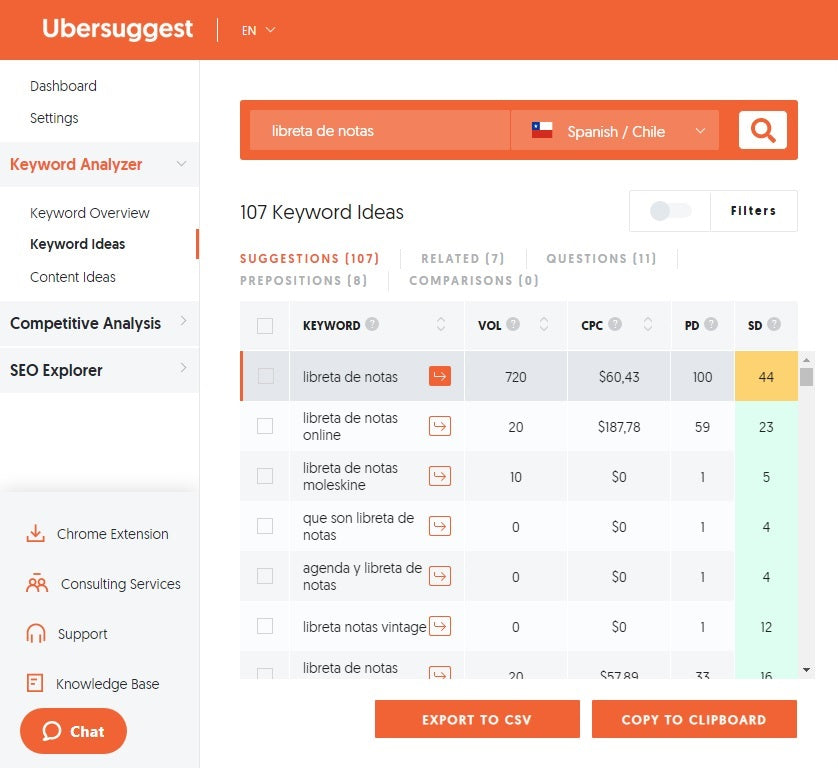
Example of keyword search using the online platform Ubersuggest.
The next step involves explaining a concept: long tail. The idea is not to bet on keywords with the highest volume, as you may limit the visibility of your e-commerce in search results because you will be competing with large businesses that often invest in Google advertising. FREED's recommendation to its clients is to use words with a lower search volume but with very low SEO difficulty. This approach will allow you to find your market niches and focus your efforts on capturing, in the medium term, significant volumes of potential customers who are already willing to buy a specific product.
Now that you have your keywords, select the most relevant ones and use them in your titles, descriptions, URLs, titles, and meta descriptions (we will cover these last three points later).
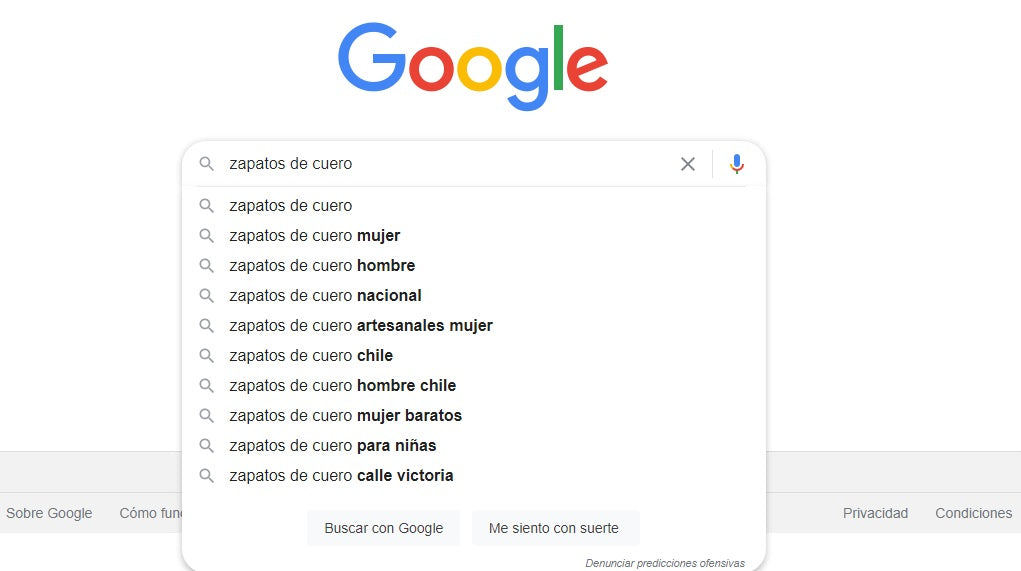
Example of a Google search and the variants it suggests for a term.
Every time you create a new product page, make sure to comply with the following when creating the URL:
- It should be relevant to highlight the product.
- Use keywords.
- It should be easy to read and announce what the page contains.
- It should be as short as possible.
- Do not use words like "that," "and," "with," "your," etc.
- Separate words with hyphens.
- Do not use strange characters or characters not in the English alphabet.
An example: www.yoursite.com/products/men-leather-shoes-black-office
You will find the fields to complete these metadata in your e-commerce site's content manager when creating a new page, and you should know that they are extremely important for your Google ranking. The title and meta description are the first things a person who has done a Google search sees; that is, it is the first call to action for a potential customer to decide to click.
Example of how a page's title and meta description appear in a Google search result.
Considering this, every time you create them, remember the following:
- Optimize your titles and meta descriptions with keywords and calls to action.
- Place keywords at the beginning.
- Use the appropriate number of characters so they read well. Verify this with the online tool Seomofo.
- Each title and meta description must be unique; do not duplicate them even if the products are similar.
- The title should be catchy and explain what the page contains.
- The title should be different from the H1 title.
- The meta description should be clear and descriptive, and, of course, match the page's content.
- If relevant to the offer, include the price, size, colors, or other features in the meta description.
Examples:
Title: Men's Black Leather Office Model Shoes | Your Brand
Meta Description: Men's leather shoes made with 100% natural and premium materials, in black for formal wear. Various sizes. Offer: US 50.
Have you noticed that it's increasingly common for e-commerce site URLs to start with "https"? That "s" stands for security, indicating that the online store has an SSL certificate that guarantees transactions, such as credit card purchases, can be made with the assurance that all data is protected. If your e-commerce site doesn't have one yet, contact a specialized company that issues such certificates because it's one of the most important SEO improvements and will help your Google ranking.
It's already a standard in e-commerce platforms for sites to adapt responsively to computer and mobile device screens, so you shouldn't have to worry about that detail. However, it is important to check that the content looks really good and that all functionalities can be used correctly from a smartphone, considering that the massification of mCommerce or mobile shopping is already a reality.
Customers will be loyal to your e-commerce site if its pages load quickly. In fact, you've probably suffered trying to make a transaction on pages that take a few seconds longer than tolerable to display content and function properly. Remember every online store you've abandoned for this reason. We recommend using Google's PageSpeed Insight to periodically measure your e-commerce site's speed and pay attention to the weight of the images and videos you publish, as part of your ongoing SEO improvement work.

A 404 error usually means that the page no longer exists or that the URL changed and the link was not updated. If a potential buyer finds something interesting, clicks on it, and an ERROR 404 message appears, they will surely feel frustrated and abandon the e-commerce site. Likewise, if you don't pay attention to this aspect, you will accumulate broken links without realizing it, which will result in a drop in your Google ranking. Obviously, errors will appear during a website's lifecycle, and that is inevitable, so we recommend creating a custom 404 error page for your brand.
They mainly impact the mobile versions of websites, especially if the pop-up is very large. The problem is that it will interrupt navigation, causing annoyance to your potential buyer and negatively impacting your Google ranking. The first recommendation would be to avoid pop-ups, but if you need to use one, for example, to promote newsletter subscriptions, pay attention to details such as the following:
- It should not completely cover the screen so that the user can verify that they are still on the same page and that it is a pop-up window.
- Use very clear buttons and calls to action like "Accept" and "Cancel" so they immediately know what to do.
- It must always offer the option to close the pop-up with just one click or by touching an "X" located in one of the top corners.
We hope these tips are very useful for making SEO improvements on your e-commerce site and that your sales multiply. Were you already familiar with some of these actions? What other tips would you give for e-commerce SEO improvements?
1 - Igor Miske on Unsplash
2, 3, 4, 5 and 6 - FREED.
7 - Erik Mclean on Unsplash