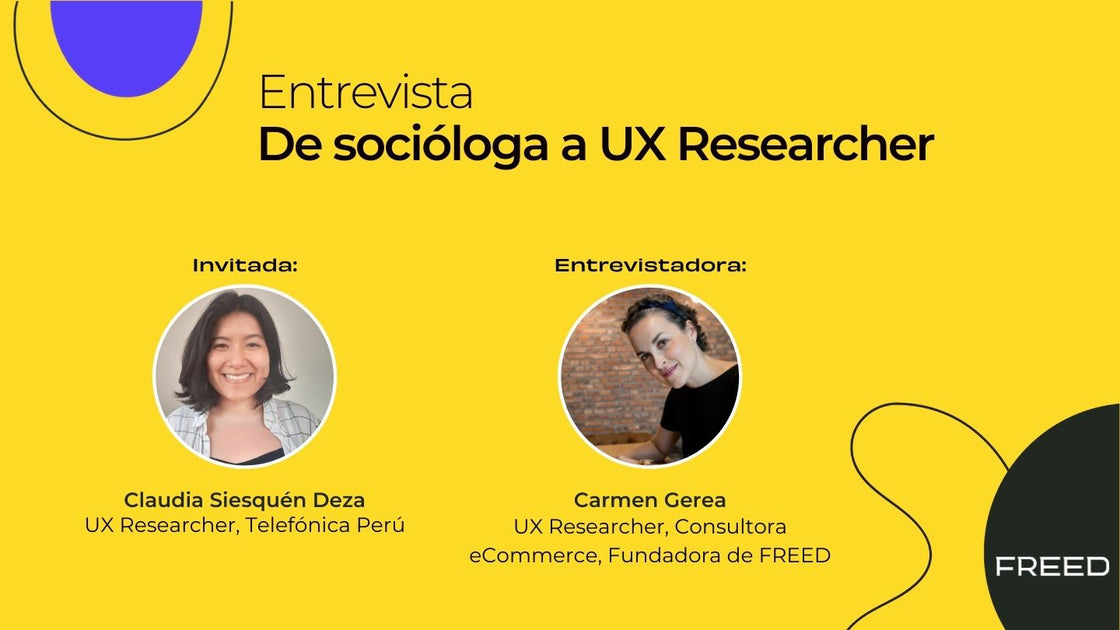
The publication of the article How to become a UX Researcher if you have no experience had such an impact that we later held an online discussion that attracted over a hundred participants, which also resulted in an article: How to prepare to apply for a UX Researcher position. And since we continue to receive feedback on this topic, I now want to share another very valuable resource with you. This is an interview I had with sociologist and UX Researcher Claudia Siesquén, one of the people who showed interest in the topic when we wrote the first article. Here are the opinions and experiences from my conversation with Claudia that stood out to me the most, and if you wish, you can also watch the full interview on FREED's YouTube channel.
Claudia Siesquén graduated from university in 2019 and at the beginning of the pandemic, she transitioned from academia to the world of design and innovation. She has worked on digital transformation projects at the Ministry of Education of Peru and is currently a UX Researcher at Telefónica.
She is also a co-founder and design researcher at CoolK, a socio-environmental initiative that seeks to reduce food waste and democratize access to food preservation for the 50% of Peruvian families who do not have a refrigerator in their homes. This project was among the top ten ideas in OpenIDEO's "Health and Subsistence in the Global South" challenge.
The conversation with Claudia arose from the idea that many university degrees prepare us to work in user research (UX Research) without us even realizing it, a point that was also raised in the discussion.
She told me that she fell in love with user experience research because it allowed her to work outside of academia and carry out more practical, faster projects with a more immediate impact on people's lives.
Her entry into the UX world was "as a researcher, in a digital transformation project, at the Ministry of Education, in my country (Peru)," she highlighted. "It was a very beautiful project, guided by educational themes. I had the opportunity to interview teachers from different parts of Peru, and also conduct usability tests with them. Personally, that completely changed me, in the way I saw things, in the way I saw research, and doing it from the state to the private sector, to a private company, because I work in a telecommunications company," she recounted.
How UX Research crossed her professional path was almost by chance. Her brother worked in a bank and one day he told her that an anthropologist held a position there, which Claudia found very strange. "At least I had never seen anything like it. When I found out and learned about what that person did there, I loved it, I found it very interesting, and I had the opportunity to talk to her, and she was very kind to me, very friendly."
"She explained a bit about what she did, about this world of user experience research, and it was a very beautiful experience," she recalled.
"It was at that moment that I discovered the world of UX, and from then on I said: 'Okay, I like it and I want to get in there. How do I do it?' Because I have all this knowledge that comes from the academic world, but how do I transfer all of this to that other world?"
Claudia started looking for groups and collectives, and that's how she met more women who were already working in the UX world in Peru.
When she took her first course, determined to redesign her professional path, she realized that she already had the skills and knowledge for UX Research.
"I remember the first course I took was called Disruptive Design, at a university here in Peru. It was very interesting and really opened my eyes. I specifically remember being struck by how they applied surveys, interviews, and research methodologies, which was a bit different compared to how I had learned it."
"In social sciences, it was a bit more rigorous, and in this world, I felt it wasn't as much, but then I understood why," Claudia indicated. "In the world of social sciences, we have to be very exact when collecting information, because there aren't many opportunities to do so. In contrast, in the world of UX Research, it's more about collecting information, not as rigorously, but you can test, iterate, and then collect again. So, you have more opportunities to test, go back to your users, your clients, etc."
"I also remember once hearing the term 'Shadowing.' 'What is it?' I asked, and they told me 'it's observing or following the person,' and I thought to myself, 'that's participant observation'," she recalled, and then added: "For me, it was just a change of name, because in some way I already had different ways of collecting information."
In this sense, as a sociologist, Claudia reflected: "I believe that social sciences definitely provide someone who has studied and has this background with the tools to do research in the world of UX Research. I think you have to be a bit more open, but I really liked it."
When asked which of the tools she acquired during her training she has used the most, Claudia commented: "Critical thinking, I think thinking, definitely, beyond what you expect or what is normal, what is seen. That's something that helps you a lot in social sciences, thinking, seeing beyond, questioning why things happen. Not just staying with the reasons that are at the tip of the iceberg, but seeing everything underneath, that structure, because that's where certain social problems occur. I think that critical thinking, that seeing a little further, has helped me a lot in doing UX research as well," she emphasized.
I also asked Claudia if she had encountered difficulties in her professional shift towards the UX world, to which she replied: "Yes, first there was the clash between social sciences and the world of innovation, which then evolved. But also, in finding different ways to collect information, I would say it was a positive clash."
She added: "We use very technological tools to collect information, that also surprised me, like finding other tools like Google Analytics. So, through that, information can be collected, because it's interesting to use technology," she pointed out.
Obviously, after preparing through courses and discovering a new field, such as user experience research, the question is how we enter this world professionally. In her case, Claudia Siesquén fell in love with UX Research during her internship as a sociology student, so I asked her to tell us her story to learn about her experience as a young graduate.
"I looked for a job. The first job I had was closer to a design researcher, at the Ministry of Education. After joining one of the meetings with other women in UX, I met a person who was also a sociologist and super friendly. With all the fear in the world, I remember the meeting ended, it was time to share and talk with other girls who were there, and I said: 'I'm also a sociologist. I'm just starting out.' We connected on LinkedIn and a week later she contacted me because she said they needed someone a bit more junior and asked me 'Do you want to apply?' So I sent my CV by email, then they called me for an interview, and that's how it happened. In my first stage, I looked for it, but it also came to me."

After this first experience, Claudia began to create new plans for her career, resigned from her job, and then the COVID-19 pandemic lockdown was declared at the beginning of 2020. "What do I do? I've resigned from my job, I don't have much experience in the digital world. Because I don't have enough experience to apply, they always look for people with a lot of experience or a master's degree, and I had just graduated from university in 2019. I was down for a few weeks, thinking about what to do, then I said: 'I can't stay like this, I have to look, because otherwise no one will come to give me these opportunities'," she recalled.
LinkedIn became her preferred network, and she applied to all UX Researcher job offers, receiving many rejections. But in the meantime, she was able to participate in an MIT hackathon, an experience that proved very beneficial for her career: "Fortunately, it went well with the group we formed there, it was a very nice experience, we won in our education track. From there we continued with the project, and from this experience, I liked it a bit more. I had supported the research part."
Along the way, she encountered other proposals in different areas to support middle and low-income families affected by COVID-19. "We did well with the idea we submitted, we were among the top 10 winners, and we are still developing it. It's a non-digital product, because it's a food cooler. In Peru, 50% of families don't have access to a refrigerator at home. Because of this, they also have to go to markets, exposing themselves to contagion, so we decided to develop a low-cost food cooler."
It was at that moment that a new job opportunity arose through LinkedIn, for a UX Researcher in Peru. "That surprised me a lot, because the ones I had applied to until then in Latin America were in Mexico, Colombia, Argentina, but not in Peru. I hadn't seen it before, it's not very common. I think in Chile it's much more common than in Peru, and this year I've only just started to see more UX Researcher positions in my country. So I was happy and applied."
Precisely, that opportunity opened the doors to the job she currently holds as a UX Researcher in a telecommunications company. "What I do, basically, I'm on the Research team and I support the different areas of the company, whether with interviews, surveys, A/B testing, web prototypes, app issues, and others," she commented.
Finally, considering her experiences as a social science professional who made a career change, I asked Claudia to offer advice to someone entering the world of user experience research.
"Follow your path. If you want to, I am sure that sociologists, anthropologists, and social critics in general, can generate a great impact in the world of technology, beyond academia. Not because we can't do a lot in academia, because a lot of research is done there and it's very valuable, but personally, I think it doesn't translate much into practical things that can truly reach citizens. I believe that, definitively, the world of innovation, specifically in research topics, is a very viable path for people who have studied sociology. Don't give up, it will surely be a bit complicated to make this connection or dialogue between what we learned before and the UX world, but I believe it can be achieved perfectly, and above all, I believe that good research can truly create a great impact on users' lives."
"Not only with the research we do can we help create better products or better services for people, it also has a positive effect on their lives. What I thought when I started was: 'Okay, how through research am I going to create and positively impact people's lives?' Yes, you can; you have different places, international organizations, embracing new tools, new approaches to act, work in different areas. You have the state area, the private area, the international area, international organizations. Truly, research can be done from the UX world, especially focused on people, in different fields. And sociologists have a lot to contribute there."
I want to thank Claudia Siesquén for her willingness and the help she provided us in developing our research on job opportunities in UX Research for those who still have no experience. And remember that you can watch the full interview on FREED's YouTube channel.
What did you think of her story? Are you encouraged to make the leap into the UX world?
Do you want to learn about UX Research? Here are some references:

 By
By