During the Conversation: How to become a UX Researcher if you don't have experience, held on May 18, 2021, many ideas and tips emerged for professionals like you to design a strategy to enter the UX world. We wanted to capture this valuable material in an article to help you take actions that prepare you to apply for and face selection processes, even if you don't have previous work experience as a UX Researcher.
During the conversation organized by FREED, other topics about existing job opportunities in the market were also discussed, so we provide you with the full video on our YouTube channel.
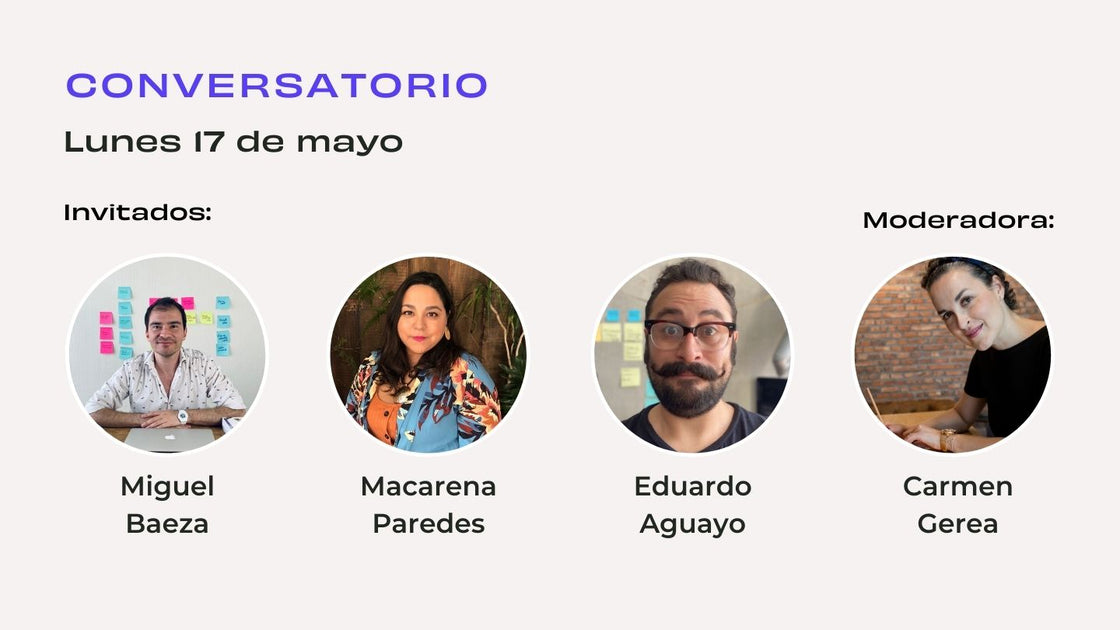
This event was moderated by Carmen Gerea, founder of FREED, and featured:
-
Macarena Paredes: Career coach, expert in employability and professional reskilling. Creator of career and life design programs, and co-creator of the first Career Planner. Contact her via LinkedIn.
-
Miguel Baeza: UX Researcher, has led the UX area as User Experience Director at Wunderman Thompson for 4 years. With over 9 years of experience in the UX field, he has worked in Chile, Peru, and Colombia. Certified by Nielsen Norman Group in UX. Contact him via LinkedIn.
-
Eduardo Aguayo: UX Researcher, mentor, IxDA LATAM coordinator. Over 14 years developing research processes as a consultant and in an agency. Contact him via LinkedIn.
This event arose from Carmen's research into existing job opportunities for professionals who want to enter the UX world and the reaction generated by sharing this information on social media. This material is included in the article
How to become a UX Researcher if you don't have experience.
<p>
To begin, and in case you have doubts about what a UX Researcher is, let's review the definition provided by Eduardo Aguayo.
If we translate literally, it is a User Experience researcher. "Their job is to research to understand the needs, behavioral patterns, and context of users, customers, and anyone who will interact with a product or service. What a UX Researcher seeks is to find out about their needs, applying different methodologies and techniques to understand their ways of thinking and interacting, their needs, what is most urgent, and what objective the user is achieving through the use of a platform, product, or service."
Eduardo explained that the purpose of a UX Researcher is to understand the user and provide that information to whoever needs it, as well as "define strategies to develop a good user experience when using a service, product, or platform."
One of the topics discussed was how to approach career change to make a shift in one's professional career. Macarena Paredes gave us the following tips.
"You always have to do a little personal research on what you want: where I want to work, how, and the hours I want to work. To be able to say, probably, which projects I want to participate in." What she proposed is that we should have a design of two or three lives and see how we project ourselves with all that. For example:
- What if I were hired by a multinational company in experience design? or
- What if I worked as a freelancer for different experience design projects?
"The central question is what do I want and how do I want to live that life? That's the first thing I have to discover," she emphasized.
Macarena explained that there are recruiters with different expertise, but not all of them are knowledgeable about the digital world. Therefore, "you have to explain very well what you do, because think that you will probably sit in front of someone who doesn't know who you are or what you can do," she stated. In other words, it is everyone's duty to tell the recruiter, above all, what we do best.
"Think that they might not understand what you do, because the recruiter is not trained in UX, they don't have prior knowledge, they take an order from a boss and what they will do is try to match the job profile with the CV," she concluded.
In this part of the conversation, it was strongly emphasized that it is up to you to tell the interviewer in a concrete and precise way that what you know how to do is precisely what they are looking for, "so that they can understand how you can help them or what pain you are going to heal. Because job searches, in the end, are that: as a UX, what pain am I going to heal in this project or in this organization?" Macarena pointed out.
She continued by recommending that, as candidates, through our questions we can identify the pains of that management, "because that way of interviewing where only the recruiter asks questions and the applicant gives the answers, and that's it, is over." She explained that as interviewees we must also ask the necessary questions to make the position and the organization's pain very clear, "because if you advance in this selection process, and you have already identified that pain well, you will strike a chord with that management when they interview you." That is, the interview process is very strategic, as Macarena recounted.

For his part, Miguel Baeza told us that in some mentoring sessions he talks to people based on their CVs but also delves into their lives. "Because one thing is what we have studied and how we ended up 'forced' to work in what we work. But if you ask me where any research skill comes from, if I learned it at university, I will tell you no. I did not learn the skills to do the research I do today in either of my two university degrees. I learned the most in art school when I was a child, because there they taught me to observe and that stuck," he recounted.
He told us that over time he learned that the teacher's effort was precisely for him to develop the ability to observe and that it didn't matter if he drew well or badly. Finally, that is what allows him today to "do research, beyond specifically applying the techniques, because that is the main thing," he explained.
Then, Miguel provided a very relevant piece of advice: "If at some point I have to sell myself, I start by saying that and not by saying that I have a certificate issued by an international research organization. The most valuable thing is the ability you have to do things; universities have stopped offering what the market needs."
To illustrate this, he recounted that when he develops selection processes, he looks for that type of experience, "because those are what serve us, people's skills, and I always find something valuable." And he continued narrating a real story:
"Once, I found it valuable in a girl who worked for years as a waitress, and that, of course, was not on her CV, that she always told the owner what changes needed to be made, because of the things she detected. That is, working as a waitress for ten years, she learned to observe people, their behaviors, and their needs. With that, she has enough to start researching and she didn't go to any university to study research."
In this sense, he insisted that you must make your skills visible, because if you are going to be judged by experience and you don't have it, you must compete on something else. "Making your ability visible is telling in your CV, in your LinkedIn profile, and in an interview how you have the ability despite not having the experience," he emphasized.
For his part, Eduardo Aguayo added that, ultimately, more than learning things that an academy can teach you, what you must have "is a set of skills that can often be talents and other times be developed over time." For example, you can recount the experiences you have had in your current job, where you have designed a product or service based on the needs of a group of users or clients. Have you worked on process improvement? "From there you have made definitions and tested, there has been a study, a strategy, and design decisions: that is UX," he concluded.
To reinforce this idea, Eduardo commented that you must "stop thinking that the moment you study UX, you become UX. UX is a technique, it is something we work on, it is not our title. Therefore, if you are looking for a job, all those experiences serve you for a portfolio that you can show."
"It's not easy to say that you're going to reskill, because it's not just thinking that now I want to be a UX Researcher and I'm going to look for a job in that. They ask for knowledge, skills, and years of experience, so one wonders how to get it," commented Macarena Paredes and gave three tips for those who are still studying or have the possibility of doing a professional internship:
- Look for that internship to be directly in research.
- Look for different types of volunteering in NGOs.
- Work on your own on a freelance project.
This will allow you to develop skills and include them in your CV as experience, and it is more feasible than waiting for a company to give you the opportunity. "It can happen, but you don't know how long it will take you to find that job. Sometimes employers want someone who already has experience, so you look for that experience, which will have an opportunity cost, such as dedicating a certain number of hours for little or no pay," she added. As an example, she suggested that there are non-profit organizations that need some type of research to attract contributing partners who pay a fee and thus continue working on their projects. "There you can contribute and you will get something bigger than what they can pay you, because it is experience that will be recorded in your CV", she emphasized.
Meanwhile, Miguel Baeza proposed undertaking research projects in areas you like and then presenting the results to companies in the industry. Around us, there are many experiences and processes that need improvement, such as artifacts that are only developed for right-handed people and are not available for left-handed people, he commented as an example. "Let's not just stay on screens and in the digital. There are millions of things that have design problems and, perhaps, you like to decorate and you could, in that area or in space remodeling, discover a series of products that have design problems and, through that observation and documenting that, show the world that you are capable and have the ability to research and detect problems. And pursue companies that want to redesign that," Miguel pointed out.
What do you think of all these tips for making a shift towards the world of experience design as a UX Researcher? Remember that you can watch the full video of the conversation on FREED's YouTube channel.
Planner to build your professional career: it's time to make a change
Your network: the most powerful tool for job searching
Is it good to expand my professional horizon in the company where I work?
Job searching in times of crisis

 By
By