You can also watch and listen to this article in podcast format
Interviews allow us to connect with people and collect data related to a specific object of study. Along with observation, interviewing is the qualitative method par excellence, and there are different types. Here, we will discuss in-depth interviews, what they entail, and a guide for their design and analysis.
Are you still analyzing interviews with sticky notes? Is it hard to get your boss, management, or the board to "buy into" the results of qualitative studies? Are they still questioning your too-small sample size versus a quantitative study?
With this guide, we want to help you arm yourself with some tools so that you not only demonstrate rigor in the process, from design to analysis, but also earn the respect of your colleagues along the way.
At FREED, we have extensive experience in studies and research, which has allowed us to identify how people interact with a specific brand at all its touchpoints.
Subscribe to the FREED newsletter: applied research, trends and tools.
No spam. Unsubscribe anytime.
1. What is an in-depth interview?
An in-depth interview is a qualitative research technique that seeks to understand the opinions, perspectives, experiences, and motivations of interviewees, in relation to the topics we have defined in our study.
It differs from other techniques mainly because it allows for delving into and understanding the interviewee's experience through a thorough conversation.
The researcher has a general guide, but during the interview, they must be flexible, creative, and approachable enough to guide the responses toward a better understanding and depth of the research topics and interests.
In-depth interview guide.
"Taylor and Bogdan are two recognized authors in qualitative research methods and understand in-depth interviewing as repeated face-to-face encounters between the interviewer and informants, aimed at understanding the perspectives informants have regarding their lives, experiences, or situations, as they express them in their own words."(1)
2. Characteristics
An in-depth interview is a conversation that is characterized by being a dialogue that arises from questions - often exploratory - to achieve a better understanding of people's experiences in relation to the journey and touchpoints with a product or service.
Continuous analysis during the conversation is another important characteristic that allows the researcher to pause and delve into the details that emerge as people answer the questions.
In other types of more closed or structured techniques, the guide and timings are more rigid.
In-depth interviews manage to build a bond with the interviewee through a comfortable, close, and personal environment that creates a connection between both parties.
3. How to conduct an interview
Before conducting an in-depth interview, make sure to design a research plan because the objectives, circumstances, or limitations facing the study will guide the model, techniques, and tools of your qualitative and quantitative research.
In-depth interviews are used when we seek to explore how people interact daily with the object of study, and they begin with the formulation of a research problem.
Below, we share a guide for developing in-depth interviews:
I. Before the interview
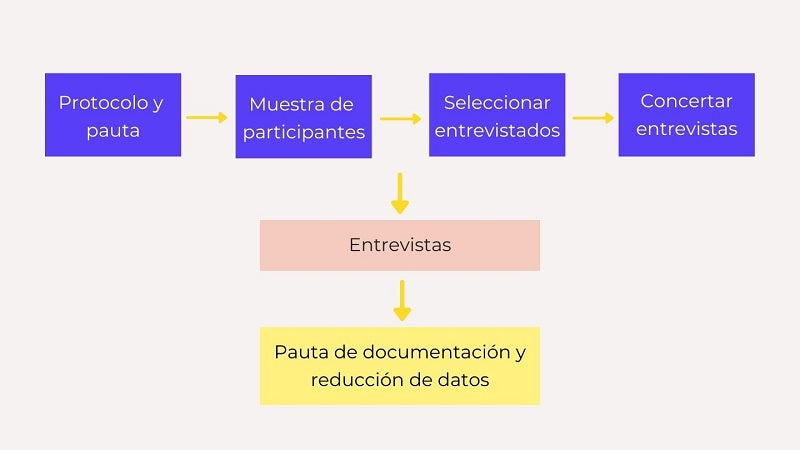
Design a protocol and a guide for the in-depth interview (we'll tell you how later).
Develop a sample of participants based on the study objectives and the problem statement. Not all people or roles meet the characteristics required for a particular study.
Select your interviewees carefully; consider that not all interviews are equally rich in insights. Sometimes we find interviewees less eloquent than others.
Confirm the willingness, time, and commitment of the participants. Whenever possible, you should adapt to them.
Create an atmosphere of trust so that the interviewee can express themselves freely.
Avoid having more than two researchers present, so as not to intimidate the interviewee.
Design a documentation and data reduction guide (we'll tell you what this is about later).
II. During the interview:
Questions should be open-ended, and focus on understanding the why, how, and for what, beyond the what (quantitative).
You should focus on discovering new topics, not just validating hypotheses.
Establish a conversation between equals and don't focus only on your research interests.
Record the conversation because it will later be necessary to transcribe these recordings partially or entirely.
Take note of relevant topics and, during the interview, delve deeper into them.
If the context allows, and it is relevant, save evidence such as photos.
III. Closing the interview:
You must meticulously check the information you have obtained.
Consider that the collected data may be subjective, and in that case, you must have a critical view. If necessary, validate any unclear facts before closing the conversation.
Validate with the interviewee any doubts, scope, or information they deem necessary to add before the final closing.
If the interview has a second instance, commit the interviewee before saying goodbye.
Document the interview and the lessons learned because in a later stage of the study you will need to analyze the collected information.
4. How to design a guide
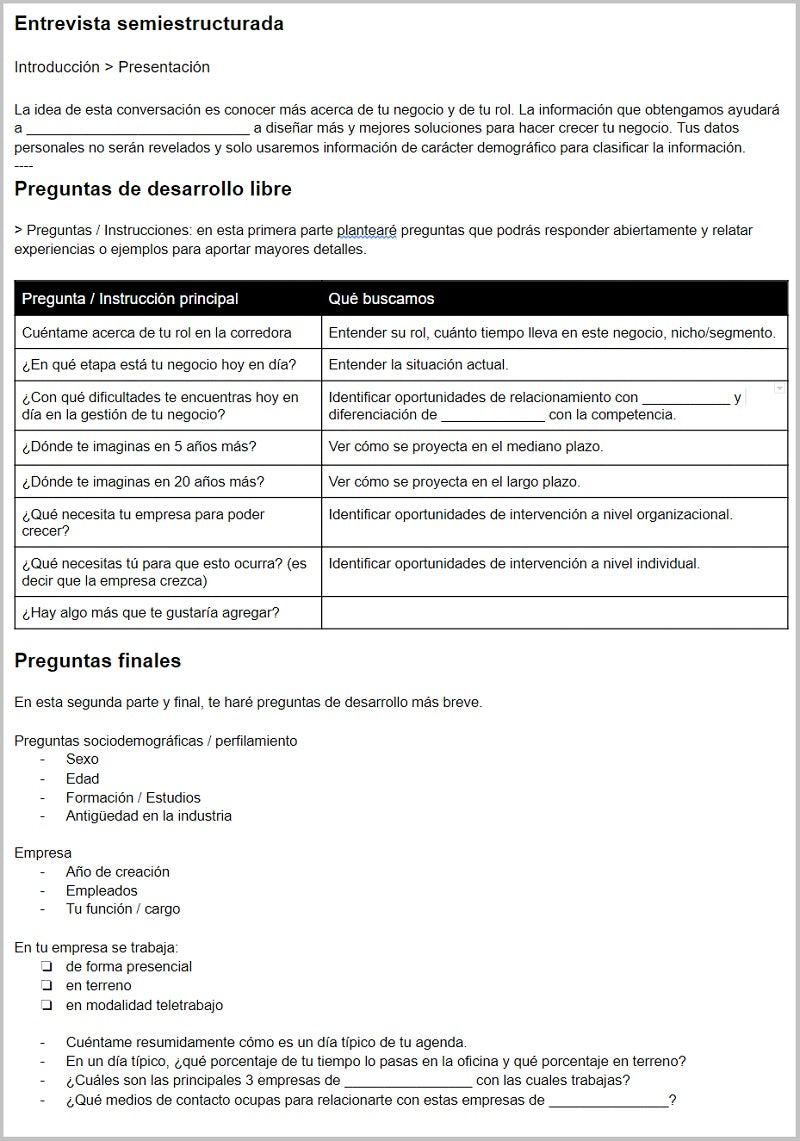
The first step in constructing a guide for in-depth interviews is designing a protocol, aimed in some way at standardizing the interview structure, allowing for a script that can be used and applied by other researchers.
You should consider that a study can be developed by one or several researchers, and together they can conduct interviews and analyses. In this sense, the protocol also helps to facilitate the process of analyzing conversations from the perspective of not making errors in the process, obtaining quality information, and concluding valuable opportunities.
We share an example of how a protocol for conducting in-depth interviews can be structured:
I. Introduction: This first part presents general aspects of the research. It includes:
Researcher's introduction.
Study objectives.
How the information obtained contributes or will contribute to the study.
What type of information you seek to explore from the interviewee's experience.
Confidentiality terms and respective permissions, for example, to record the interview.
Thanks for the interviewee's participation.
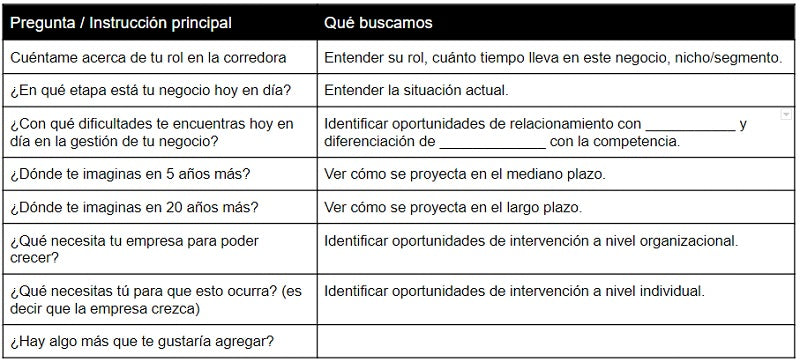
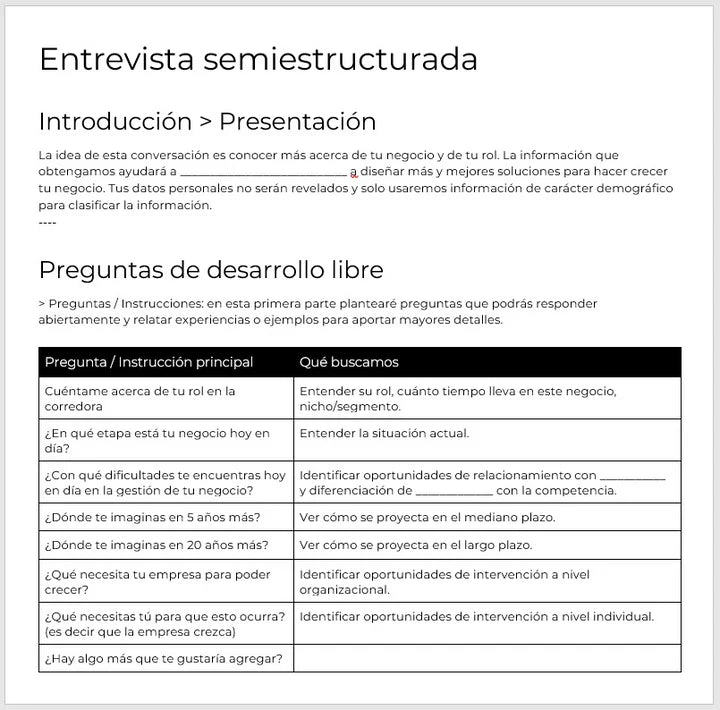
II. Semi-structured questions: These are questions that allow for free responses from interviewees and adapt according to the conditions of the conversation.
They allow for detecting opportunities (not just validating hypotheses), focusing on the root cause.
They allow for discovering topics not mapped in the research.
The question guide should have 3 or 4 questions because this way a greater level of detail is achieved.
It is recommended to have an internal script with more details or explanations of what is sought with the questions; this will help other researchers to better understand the guide (in Figure 1 you can see some examples of questions).
III. Final questions: These are concise questions that seek to gather social and demographic characteristics of the interviewee, for example:
age,
gender,
education / studies,
occupation / position,
work activity and tenure,
other questions about the industry in which their organization / company / business operates,
country or city of residence.
In some research, this type of question is used or answered in the initial presentations.
IV. General tips:
In open-ended questions, avoid asking direct, closed, or ambiguous questions.
In final questions, avoid turning it into a survey.
It is recommended to always keep the objectives in mind so as not to delve into topics that do not relate to the research.
To benefit from an in-depth interview, we recommend prioritizing individual interviews, unless the interest is to investigate group dynamics.
Experience is required on the part of the researcher because they must guide the conversation without influencing the responses.
You should avoid awkward moments or silences; the researcher must be attentive to the responses and achieve a fluid conversation.
The researcher's physical posture should simulate attention to the interviewee and they should maintain eye contact and be willing to listen at all times.
The researcher should never share their opinion on the responses, only make short affirmations, for example: perfect, okay, clear, yes.
In-depth interview guide.
5. How to analyze in-depth interviews
Up to this point, we have discussed the most relevant aspects for constructing, planning, and conducting in-depth interviews. Now we will review how to analyze them and obtain valuable findings for our user research.
To gain more benefits from the in-depth interview process, it is advisable to design and apply a documentation, reduction, and data analysis guide from the outset.
The information we obtain during in-depth interviews is fragile; if we leave all documentation and analysis until the end, we can lose relevant details and the opportunity to improve during the course of the interviews.
We share a simple guide for documenting and analyzing in-depth interviews:
I. At the end of each interview:
Document audio, video, images, and notes in shared spaces with the research team.
Transcribe the interview (there are online tools with artificial intelligence for transcriptions in different languages).
Review the transcription and highlight the most relevant points.
Transcriptions should be anonymized, meaning without the names of the interviewees.
If there is a significant volume of interviews, you can conduct a checkpoint with the researchers periodically. This will allow you to discuss interpretations during the process.
Make improvements to the in-depth interview protocol or guide.
Apply the improvements in subsequent conversations.
II. At the end of the interview phase:
Gather all transcriptions and notes.
Select an analysis method. Generally, at FREED, we use thematic analysis. Basically, thematic analysis allows the data to "speak." How do we do that? By coding the interviews. This point refers to classifying content into categories (there are remote coding tools, such as Atlas.ti and NVivo). Note that this does not mean the tool will do any analysis for you, but rather it will be a support to facilitate this analysis process and make it rigorous. At FREED, we have used Atlas.ti.
As categories (codes) become common across interviews, you can discover patterns among the interviewees.
In the context of qualitative studies for business or brand issues, patterns are often interpreted as problems and needs of the interviewees, and opportunities or challenges for the brand or companies for which we are conducting the study.
Analyze the responses in detail and validate the study hypotheses.
Highlight comments that support each discovery.
Keep the findings that contribute to the study and are relevant for the next design stages.
6. How to communicate the results?
To conclude the analysis phase, you must present the results of your research. Documenting, reducing, and analyzing the information collected in all interviews is not the only step; you must also generate artifacts and different formats to communicate the results. The most common in user/customer research studies is to synthesize the content into:
hypothesis validation, among other artifacts or inputs.
An important aspect to consider when communicating the results of a qualitative study is to understand your audience and know what possible course of action there will be once you present the results. In this sense, if your audience is the board of directors, it may not be relevant for them to explain the methodological aspects in detail (obviously, we always consider them, but the level of detail may vary). However, if your audience is a department head, sub-manager, or another more "technical" person, it may be fundamental for them to understand what you did and how you did it. On more than one occasion, we have had to prepare different types of deliverables for different audiences.
Regarding what will happen next, consider details such as: Is this a report that will be printed in the IT department? If so, a 2-meter-wide customer journey may not be very useful. Whereas if the design team prints it for their agile workspace, they might need a higher level of detail, and the 2 meters will seem small.
7. Tools we use (with and without artificial intelligence)
With the emergence of artificial intelligence, new tools are launched almost daily that can support us in conducting and analyzing interviews. Here, we will tell you what we at FREED have used with good results, but you can continue exploring other alternatives, as there are many.
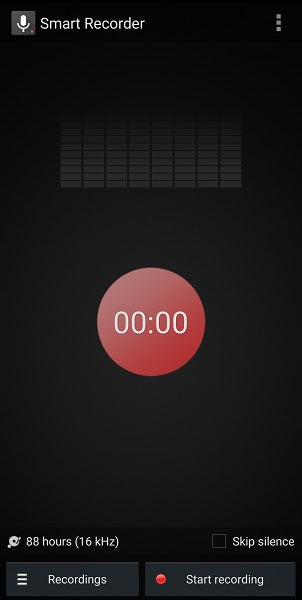
To record our interviews, we have been using the mobile application Smart Recorder (created by SmartMob) for years. Among its advantages are the ability to configure microphone sensitivity and choose recording quality from several options, from audio similar to what a phone allows (lower quality and lighter file) to compact disc quality (higher quality and heavier file).
To conduct and record remote interviews, we are using Google Meet. Note that the session recording feature is available for Business, Enterprise, Teaching, Education, and Essentials accounts. To activate it, the account administrator must go to the menu Applications > Google Workspace > Google Meet > Meet video settings > Recording > check the Allow box. This way, users will be able to record their meetings and interviews.
To transcribe interviews:
For Meet interviews, we use Tactiq, a Google Chrome extension with artificial intelligence that instantly transcribes conversations. It identifies what each person says, and after the interview, you can ask the AI to summarize, perform thematic analyses, and answer questions about what the interviewees have said. However, it is advisable to review each transcription to correct possible errors and take the opportunity to highlight the most important points.
To transcribe interview audio, we have used Sonix. We have also tried TurboScribe, a similar platform but with AI that also allows transcribing videos. Like other web tools, they are not completely accurate, so you must review the texts to adjust the transcription.
To analyze interviews, we have experimented with NotebookLM from Google. This artificial intelligence platform allows you to take several files with transcriptions and perform various actions with them. For example, to perform thematic analysis of different sections of the interviews, to tell us what interviewees have expressed about a specific question or topic, to summarize the most important topics, to propose improvement opportunities, etc. For these types of tasks, we have also resorted to ChatGPT with very good results, providing it with excerpts from the interviews for analysis.
To create visualizations, we have tried Napkin AI, an artificial intelligence platform where you upload your texts and indicate the paragraphs with which you want it to create diagrams.
8. Qualitative data analysis
In the following video, you can watch the webinar conducted by Carmen Gerea, founder of FREED, where she addressed qualitative data analysis, mainly through thematic analysis.
On that occasion, she explained how to perform qualitative data analysis, what simple tools you can use, and, of course, what thematic analysis is, showing real examples taken from projects carried out with clients.
Finally, we can tell you that our UX Research solution considers in-depth interviews as a fundamental technique for building meaningful experiences for people. Additionally, since we have talked about artifacts and inputs as deliverables, at FREED we have often developed user archetypes, such as those we created for mobile banking, and you can discover how we built them in the article we published to launch our study.
Have you conducted in-depth interviews for your projects? Do you have more ideas to contribute? Tell us about your experience.
The in-depth interview guide
Listen to the podcast
You can also download and listen to a summary of the article in podcast format. We created it with Google's NotebookLM.
Authors: Carmen Gerea, Denise Sánchez, and Rafael Baquedano.
If you also want to turn this content into audio —narrated summaries, podcast versions or synthetic voices for prototypes— the tool we use at FREED is ElevenLabs. (Affiliate link: signing up through it supports FREED at no extra cost to you.)
Share this article
Follow us on YouTube
Nuevas Economías, Research Thinking and FREED AI Studio: conversations and analysis on business, technology and human behavior (in Spanish).
Prototyping services in the healthcare sector and options from a user experience (UX) design perspective. Usability and UX Research in a clinical context.

 By
By