We recently presented our findings on the customer journey during their first use of a bank's mobile application. Now we will discuss personas or user archetypes, which are essentially fictional users that embody common characteristics observed in real users interviewed during a research process. Personas are constructed by systematizing research results from real users to represent typical users for whom a product or service is designed. Research can be qualitative and quantitative, and include in-depth interviews, field observation, surveys, and other methods.
While similar concepts existed in social sciences or marketing before the 1980s, the "official" creator of personas as an interaction design tool is Alan Cooper [1]. It is important not to confuse personas or archetypes with customer segments, as the latter are primarily defined using quantitative methods where customers are grouped according to sociodemographic characteristics and/or behavioral patterns identified in data mining analyses. In this sense, the sample size for analysis is much larger when only quantitative methods are used.
Although in practice in service design or user experience (UX) design, personas are primarily defined using qualitative methods, a combination of qualitative and quantitative methods is possible and recommended when resources are available for this type of analysis [4].
One of the characteristics of personas is that the systematized research information is graphically represented in such a way that the design and development team can work with the user "in mind"; that is, this work tool becomes a kind of mental reference.
The visualization can be simple or complex, including relevant variables to understand the user in the chosen context of use. Regardless of how they are graphically represented, the important thing about personas is to support the design process to guide decision-making. Instead of designing for a mass of users with multiple characteristics, when personas are used, design is for a specific user in a specific context.
Ideally, the design and development processes for new tangible or digital services should start with the definition of personas [2] based on what we concretely know as a result of research, and not on what we imagine about the user. In other words, if we are sitting at our workstation and putting on paper what we seem to know, we are not working with archetypes/personas. On the contrary, if we manage to systematize what we have learned from interviews, observation, surveys, etc., that is using archetypes.
When we talk about "systematizing," we refer to transcribing interviews, coding (through methodologies such as thematic analysis, for example), complementing with tangible samples such as images, etc.
Furthermore, for personas not to become "pretty" visualizations hanging on the walls of design and development offices, serving more to decorate than to inform the design process, it is important that team members participate in the research and learn to handle the different instruments. In other words, they must feel comfortable and familiar with the archetypes and integrate these methods into their daily work. [3]
As we mentioned in the previous article, our research process included several methods. To understand the use of Mobile Banking, we recruited 50 users over 18 years old, current account holders in at least one of the 12 banks within the scope. The study considered users who habitually carry out transactions online, regardless of the device (notebook / PC / smartphone / tablet). This excluded those who were not Digital Banking users, such as those who stated that they prefer to go to a branch to carry out transactions.
Initially, we interviewed these bank customers about how they conduct transactions with digital banking and how they use their mobile phone in general, to communicate and transact with the bank.
Next, we tested the mobile website or bank applications, and finally, we asked closing questions, in addition to delving deeper into the experience with the bank and the motivation to use different contact channels.
Some of them were already mobile banking users, having one or more applications installed, or accessing through the mobile browser, while others had never connected to digital banking via mobile.
Users between 18 and 60 years old (inclusive), men (56%) and women (44%), residing in Santiago, Chile, participated.
By systematizing the data collected in this process, we have defined four archetypes or personas that we will present below.
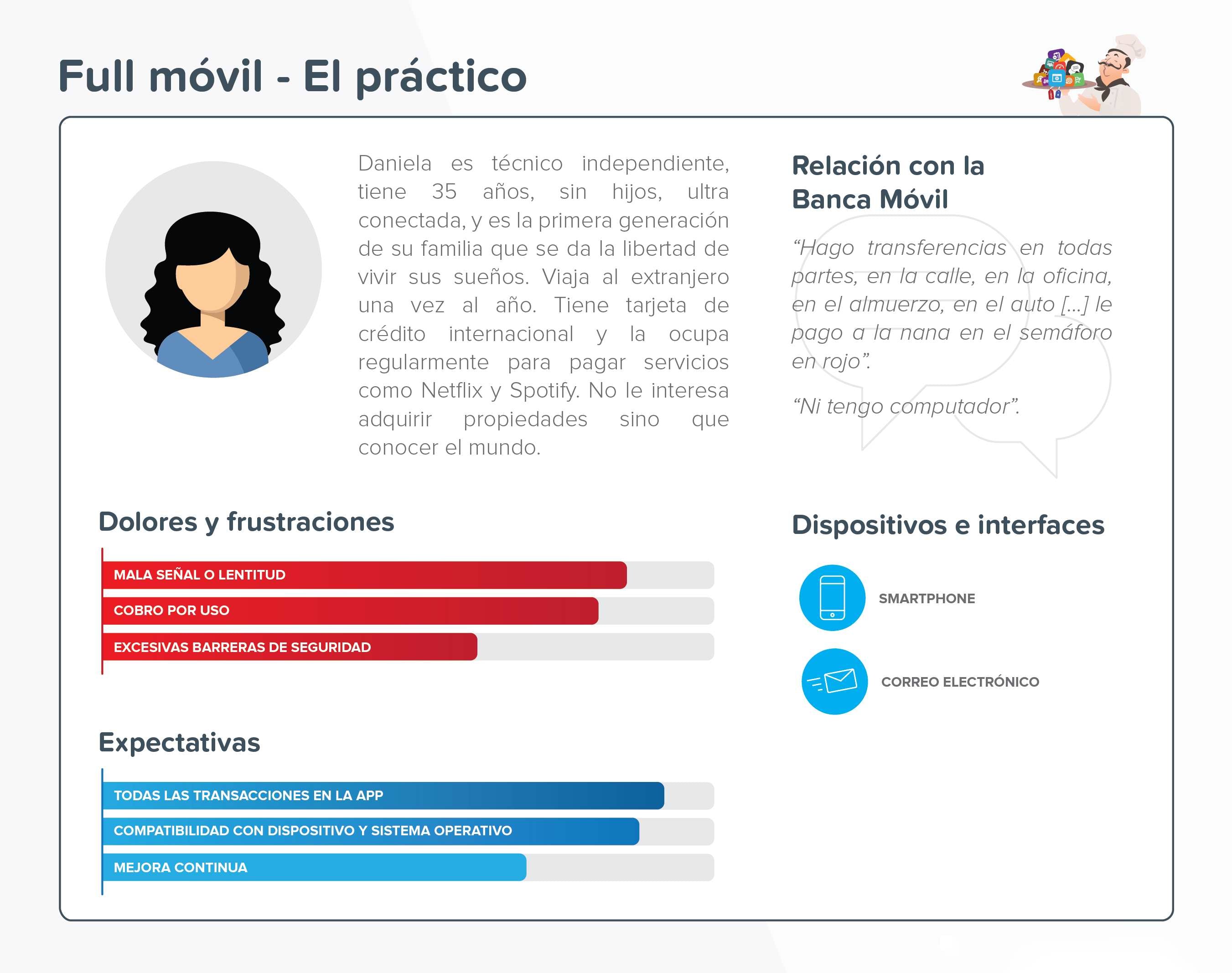
This persona is the user who often made a technological leap, practically going from rarely using a computer, or even not owning a desktop computer, to having a state-of-the-art smartphone that they use to "solve everything." If a digital service is not available via mobile, it's as if it doesn't exist for this user. While they are a demanding customer at first glance, they usually perform simple transactions such as transfers or balance inquiries. For them, everything must be fast, simple, and free.
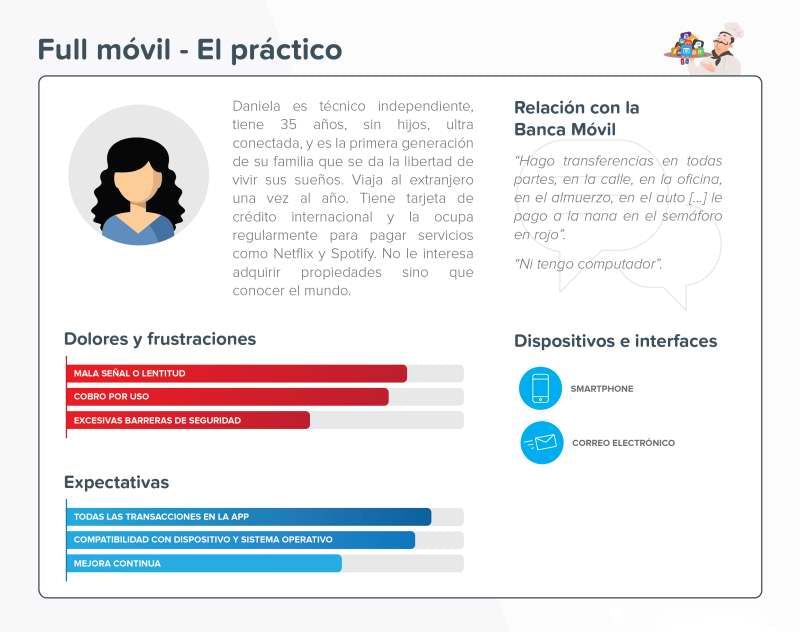
User persona - mobile-first, the practical user archetype. Click on the image for details.
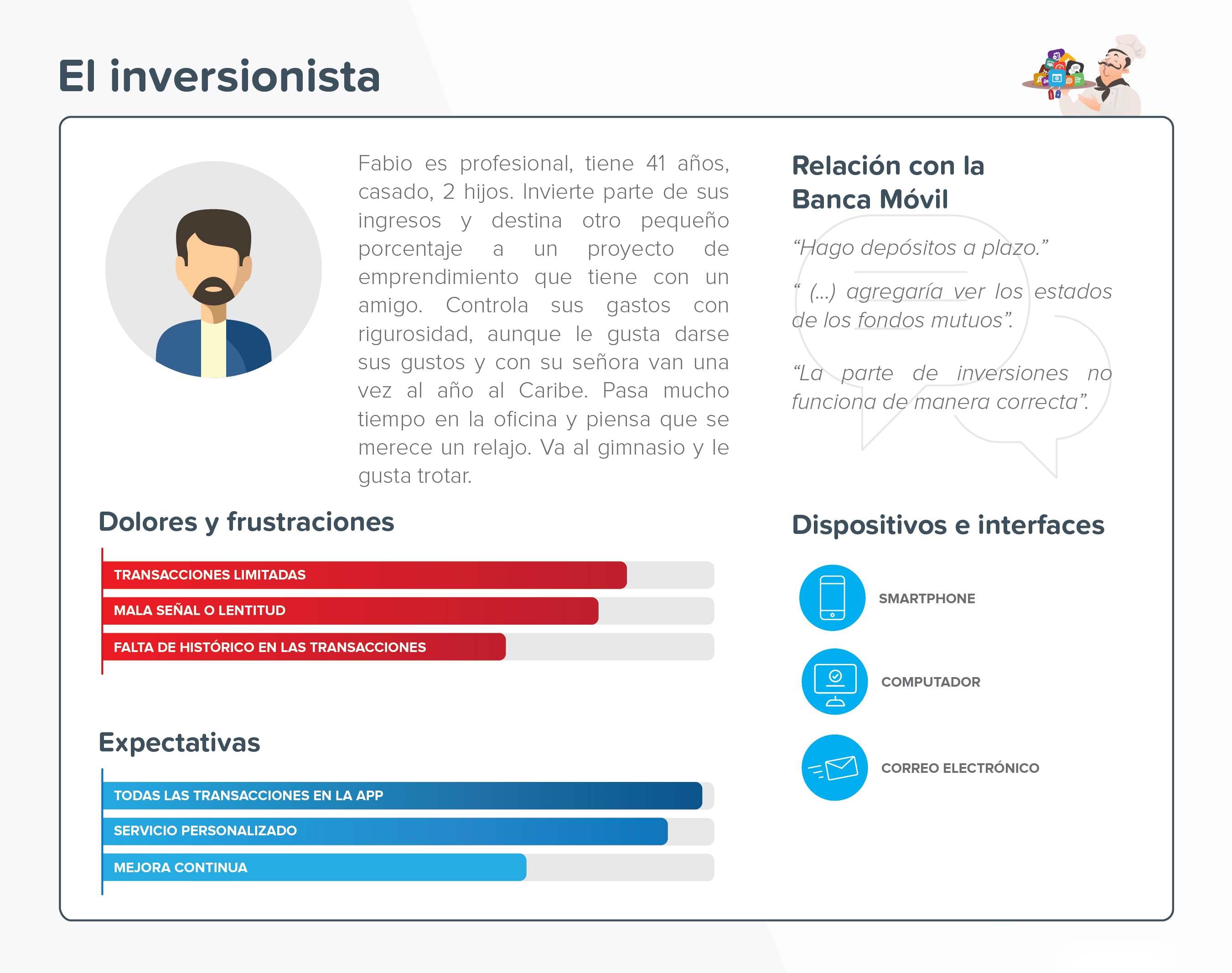
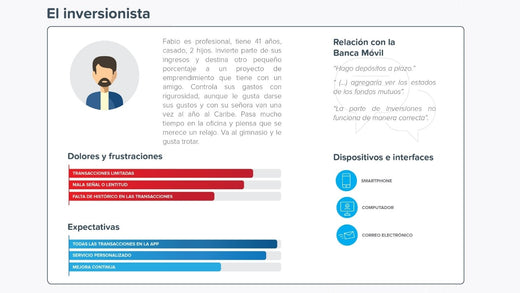
The investor archetype has financial products with several banks, and their use of mobile banking goes beyond the basics, i.e., balance inquiries or transfers. To some extent, they are the expert user, who already knows the desktop website inside out because they are accustomed to performing complex transactions, such as investing in mutual funds, simulating loans, or studying advanced charts. For this type of user, the desktop website is the mental reference. Mobile banking service must meet their expectations and consider their prior experience. If their first contact with mobile banking does not meet expectations, the channel will be positioned as inferior to the desktop website.
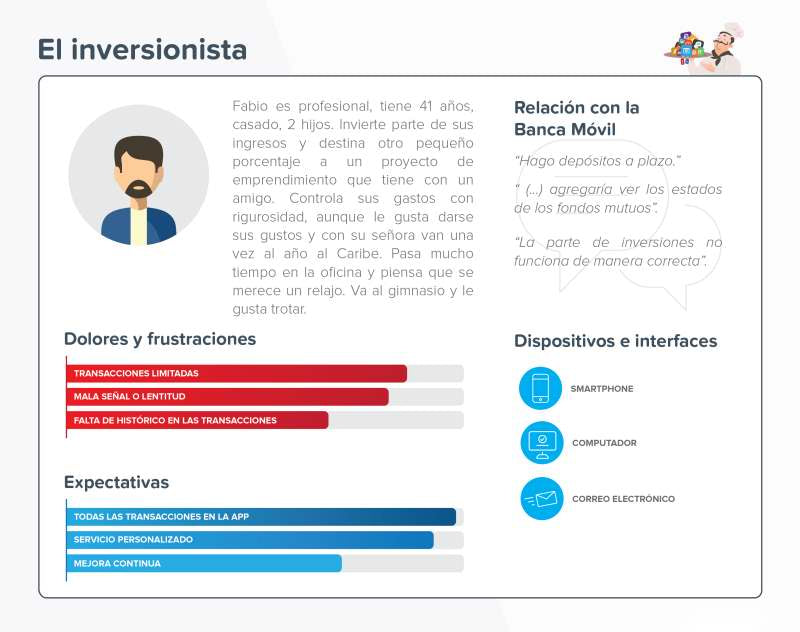
User persona - investor user archetype. Click on the image for details.
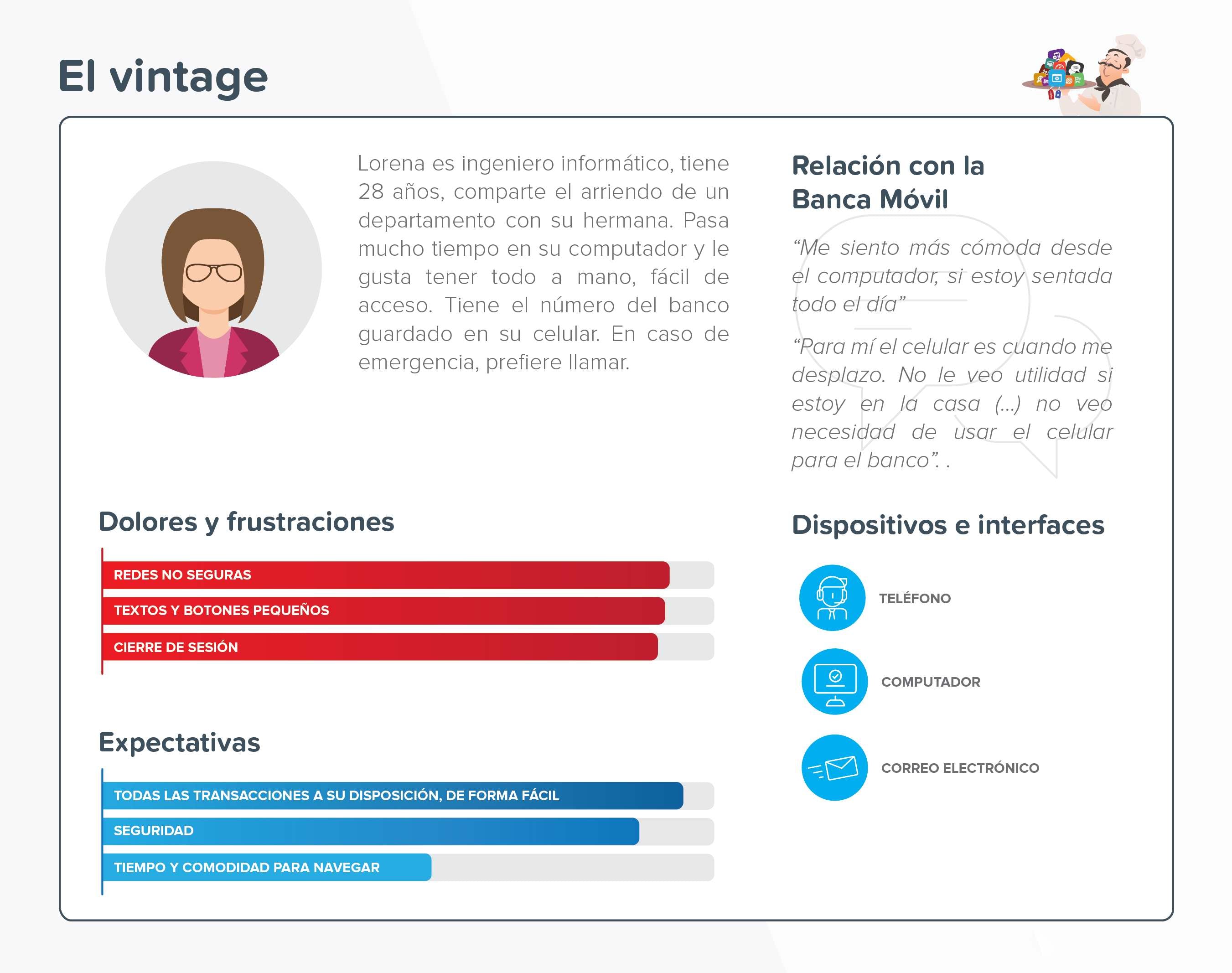
Unlike the practical and the investor, the vintage persona spends a lot of time on their computer, which in a way becomes their private space where they feel comfortable because they "manage everything." In this typology, we found several users who had not used mobile banking before the study, however, some expressed surprise at a good experience during testing and commented that they would possibly continue using the bank's application or mobile site after the study.
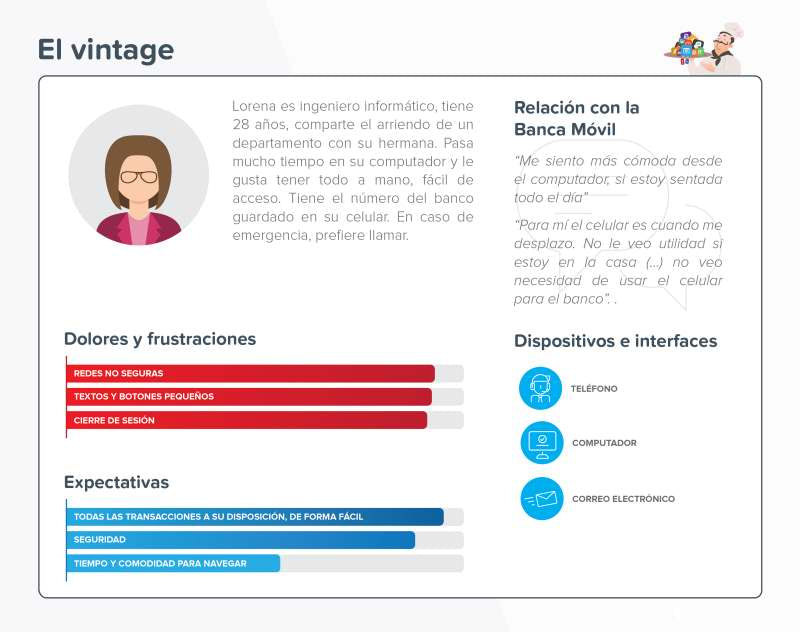
User persona - vintage user archetype. Click on the image for details.
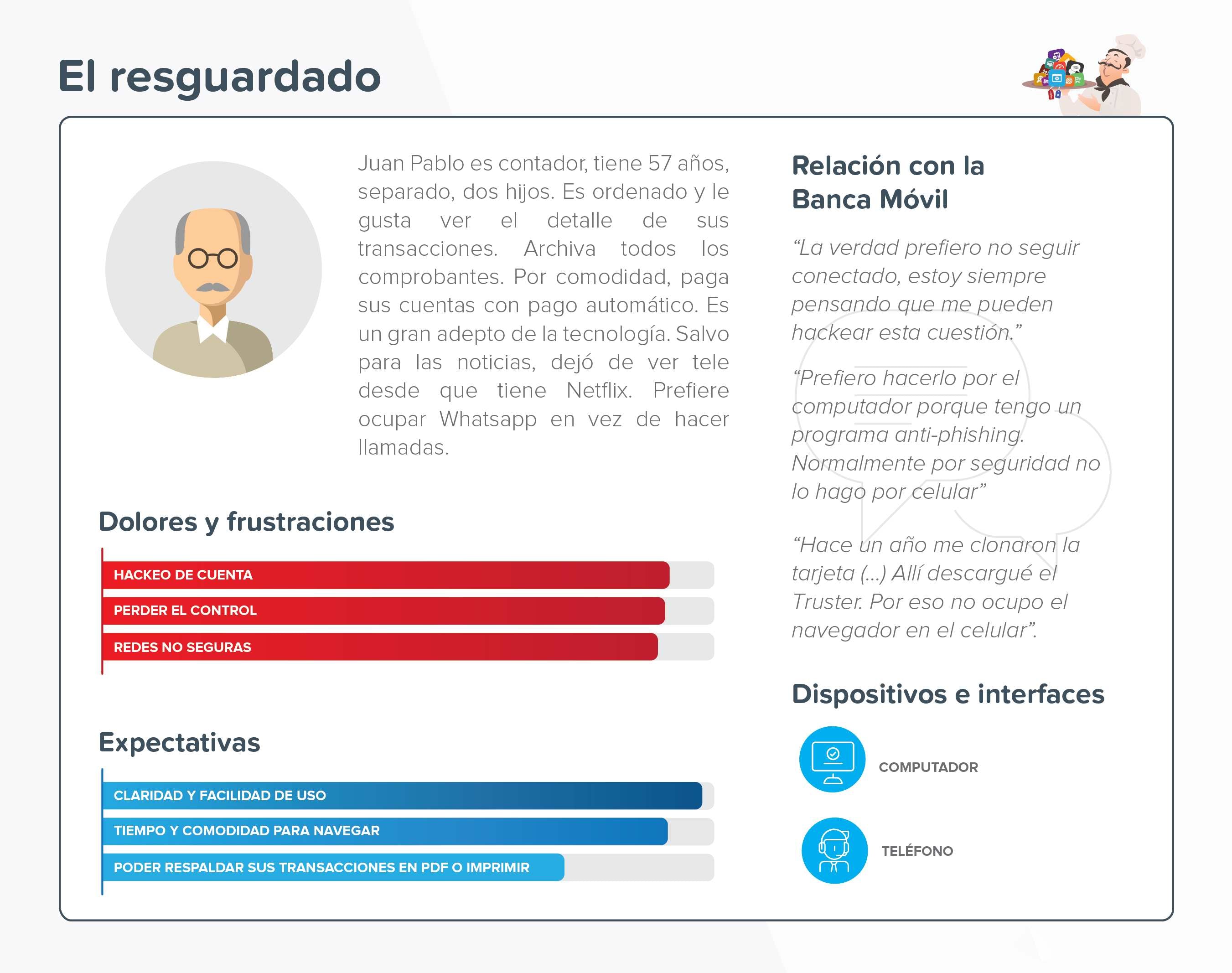
For the cautious, it is extremely important to have access to transaction history and the double-click to view details. They usually back up everything by printing or saving PDFs. For this reason, they feel more comfortable using the desktop website. Like the vintage, they may be a compulsive mobile user for other types of interaction, such as social media, communication with family or co-workers, but they simply do not see the need to use their mobile phone to communicate with the bank or make banking transactions. Unlike the vintage, who prioritizes the desktop website for convenience, the cautious user places great importance on security while browsing and sees mobile use as a possible way to expose themselves to hacking, unsecured networks, and even phone theft (on public transport, for example).
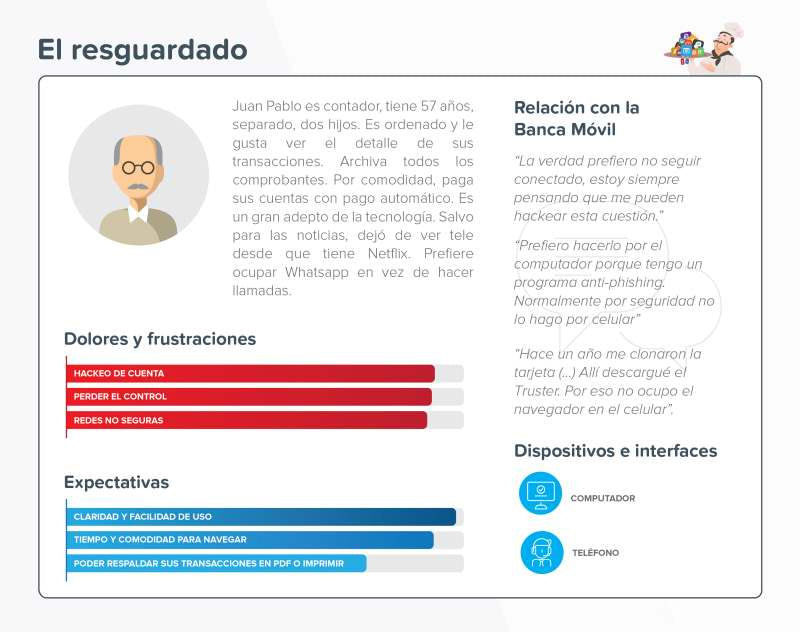
User persona - the cautious user archetype. Click on the image for details.
[1] Bedford, A. (2015). Personas Make Users Memorable for Product Team Members. Available online, consulted on August 5, 2016. https://www.nngroup.com/articles/persona/
[2] Cooper, A. (2008). The origin of personas. Available online, consulted on August 5, 2016.
http://www.cooper.com/journal/2008/05/the_origin_of_personas
[3] Blomquist, A., Arvola, M. (2002). Personas in Action: Ethnography in an Interaction Design Team. In Proceedings of NordiCHI, Oct. 19-23, 2002. 197-200.
[4] Approaches to Creating Personas. Available in PDF, consulted on August 5, 2016.
http://boxesandarrows.com/files/banda/long-live-the-user/Mulder_TheUserIsAlwaysRight_Ch3.pdf

 By
By