Why do you think everything can be solved with a mobile app? Moreover, why should ordinary people download, install, and use your app? In this article, we review data and arguments you should weigh before even thinking about developing a mobile application.
"Let's make an app." It's one of the phrases I've heard most often in the hallways of large companies, and even more so in places where entrepreneurs gather.
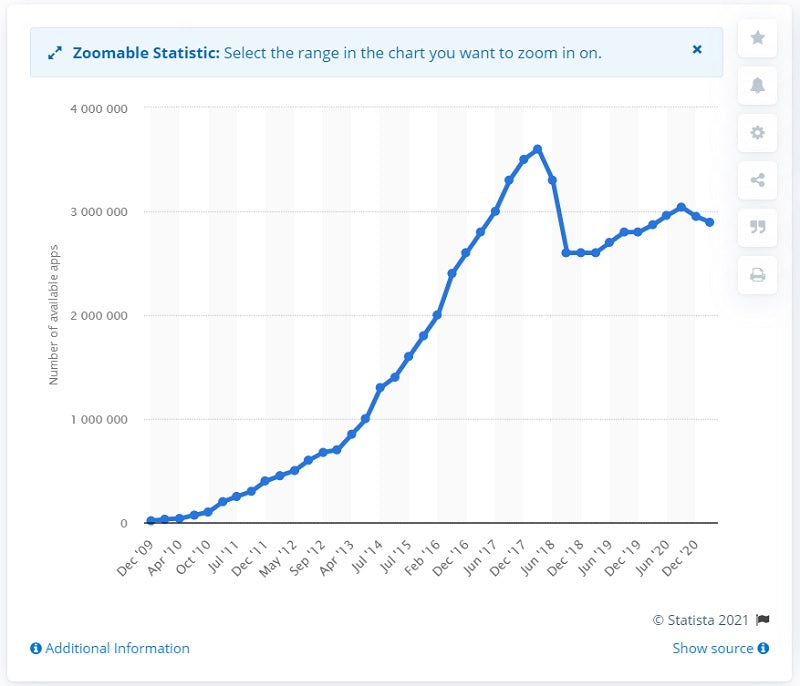
According to Statista data, in March 2018, there were 3,600,000 applications available on Google Play, compared to 450,000 in February 2012 and 2,800,000 in March 2017.
Source: Statista. Number of applications available on Google Play Store from December 2009 to July 2021.
Impressive, isn't it?
On the other hand, of the 22,625 new applications uploaded to Google Play in March 2018, almost 60% were of low quality, according to AppBrain data.
Perhaps that's why, if you look at the Statista graph again, the trend has been downward since then, and by July 2021, that number had decreased to less than 2,894,000.
More data?
The categories with the highest number of competitors are Education, Entertainment, Lifestyle, Business, and Personalization. As a curious statistic, there are over 200,000 applications for personalizing cell phones (ringtones, wallpapers, etc.).
The main factor: the user
Well, even if you think this data is global and perhaps there isn't as much competition in your Spanish-speaking market, there are other factors you should consider, and I think the main one is the user.
If you're in a very niche market and don't have 5,894 direct competitors, you're still competing for the end user's attention over time and for available space on their phone.
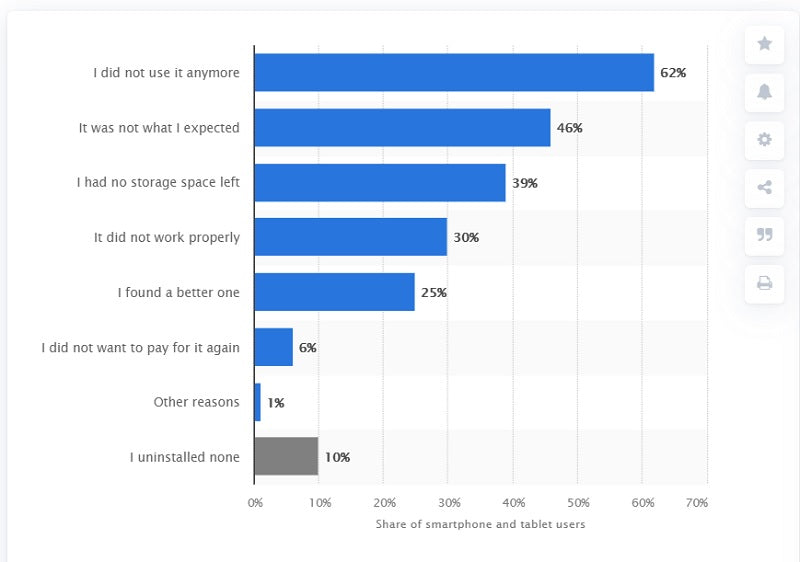
Likewise, according to several studies from the United States and Spain, the main reasons for uninstalling an application are:
The user stops using it (loses interest over time),
the app was not what they expected (in this case, it's likely they will uninstall it shortly after installation), and
the user no longer has available space on their phone.
Source: Statista. Reasons why smartphone and tablet users uninstalled apps in Spain in 2016.
Get our analysis in your inbox
Subscribe to the FREED newsletter: applied research, trends and tools.
No spam. Unsubscribe anytime.
What you should do before developing a new app?
Let's look at some fundamental issues you should consider before even thinking about developing an application.
1- The user and their problem
Wherever you work (a large company or a startup), start by asking yourself what you are trying to solve.
It might sound cliché, but what problem are you going to solve?
Beyond your need to develop something, conquer the world, and become famous, what is the added value of the app you have in mind?
Just because something is technically feasible doesn't mean you have to do it. If you want to create the next Tinder, Uber, or Instagram, remember that there are 15,683 people like you thinking the same thing.
Before jumping into your solution, take time to observe people: talk, try to understand something about the complexity of human beings, and identify a real problem.
Who is your user? Ask questions and listen. Observe.
Also, think about asking the right questions. Ask your friends if they would use an app that... (fill in the blank with your idea). In any case, them saying "yes" is not a form of validation.
2- The market and its size
Once you've identified a problem, the next step would be to estimate the market size or gauge how big this problem is.
Is it a recurring problem? Or, are there enough people with this same problem?
Despite the overexposure to messages like "you have to pivot" or "you have to make mistakes to learn," time is very valuable.
Why waste time developing something no one will use if you can invest a little in getting data to support decision-making?
According to The 2017 U.S. Mobile App Report by comScore, considering the time spent using mobile applications, smartphone users spend half their time on one app – the primary one – while tablet users spend two-thirds of their time on one app.
Meanwhile, most smartphone users access 20 or fewer applications in a month.
In other words, although we live hyper-connected and cell phone addiction is increasingly a problem, a high percentage of adults (45%, according to Deloitte's forecasts) would be aware and concerned, trying to limit cell phone use in different ways.
3- The solution (the product or service)
OK, let's assume you've identified a problem large enough to warrant a solution. Now, on the one hand, is the solution necessarily digital? And if it's digital, does it have to be an application? If it's an app, what about users who don't want/can't download your app? What are they missing out on? What are you missing out on?
If you have a clear and validated problem, why limit yourself to an app? If the only thing you can think of is an application, perhaps you should forget this idea for a moment and think about co-design as a methodology to build other solutions with your potential users.
You can complement this with other methods to generate ideas, and you'll see there's a world of possibilities.
On the other hand, if the solution can be materialized in an app, it's even probable that something already exists in the market, and it will be very difficult to make users change their behavior, stopping their current way of doing things to download a new app, yours.
Here are three examples of "problems" that were solved with existing applications:
a. A professional community in a specific ABC market, with users having varied digital skills and behavior, from novices to experts. According to research we conducted, they are already using WhatsApp. If we wanted to replace the use of WhatsApp, the added value of our application should be superior to what they are currently achieving with WhatsApp. Basically, you have to differentiate yourself, and the user must see that the effort of installing a new mobile app, with all that it entails (time, enrollment, space, etc.), is worth it. This is just one parameter to consider, in addition to development costs versus benefits to be gained, future maintenance, and evolution of the application, etc.
b. A professional community in a highly technological niche, with resources to develop not one, but several apps. What did they do? They used Slack. Instead of spending resources reinventing the wheel, knowing that their main strength is not application development, they dedicated those resources to growing the community and increasing the number of clients.
c. A few years ago, a team of enthusiastic entrepreneurs came to me with an idea for an app aimed at seniors. Although it seems contradictory, because they offered to pay me to work on their project, I recommended that they first validate their idea through a Facebook group, where their potential users already are. Finally, they did nothing because their expertise was not app development (another separate problem) and because they understood that it would be very difficult to find a differentiating element from existing solutions.
And so, we could find hundreds of examples where people don't need another application.
4- Stop being self-centered and thinking everyone wants an app with your brand
If you work in a large company where mobile app design and development are done in isolation from the mobile web, desktop web (or responsive), and other digital interfaces, you should reconsider this siloed way of working.
It harms the customer, your team, the brand, and surely the company as well. In this context, a new service should first be designed as just that: a service, not a mobile app.
In summary... People don't want more applications. People want services, products, and, in general, memorable experiences.
What do you think of this data and arguments? Are you weighing the idea of developing a mobile app?
And if you have already validated your idea and want to build a first prototype or MVP without writing code, at FREED we use Lovable, an AI tool that takes you from idea to a working application in just a few hours. (Affiliate link: if you subscribe through it, you support FREED at no extra cost to you.)
Co-design brings together diverse profiles to collaboratively create solutions. This article covers roles, session formats, materials, and the real-world limitations of the method.
Imagine you've developed a product full of potential, but upon reaching the market, it simply doesn't connect with people or doesn't sell enough. User recruitment for UX Research is key in a human-centered project. Discover the criteria for selecting users.

 By
By