Globally, in recent years, Mobile Banking has evolved from being "an extension of Digital Banking" to becoming the primary focus for banking executives [1]. Similarly, the international study conducted by Forrester in 2015 [1], which analyzed the functionalities of 41 banks (none of which were Latin American), concluded that many of them are strong in transactional functionalities but weak in services and sales.
Locally, a study conducted by a team from the Faculty of Economics and Business at the University of Chile [2], which analyzed the user's perspective on mobile banking applications, observed that while Chilean banks put a lot of effort into app development (some having 10 or even 23 mobile applications), there is still room for services. Indeed, few banks interact with their users by offering support through platforms like Google Play or the App Store, a point that our study also validates.
Across two articles, we share some findings from our study on usability and user experience in Digital Banking. Below, we will provide a brief methodological summary and the first deliverable, which summarizes the learnings about the customer journey with mobile banking.
Study Universe: 12 banks were included in the study (Banco BBVA, Banco BICE, Banco Bci, Banco de Chile, Banco del Estado, Banco Edwards, Banco Falabella, Banco Itau, Banco Santander, Banco Scotiabank, Banco Security, TBanc).
Scope: Mobile sites and main applications for Personal Banking. Secondary apps such as Premium Banking were excluded.
The research primarily consisted of the following three stages:
- Data collection.
- Systematization.
- Consolidated report generation.
For data collection, we used the following sources:
- User comments on Google Play and App Store platforms. Data was initially collected in November 2015 and then again 6 months later, in May 2016.
- Tests with 50 users. Mobile interfaces of 12 banks were tested, including both mobile sites and applications.
- Expert evaluation of interfaces.
In addition to the consolidated report, which, along with the ranking, reflects the state of the art in Mobile Banking in Chile, the study results allowed for:
- Mapping the user's journey with the mobile application during its first use.
- Mapping the recurring user's journey.
- Identifying mobile banking user archetypes.
- Identifying the attributes of mobile applications that users value positively or negatively.
- Observing good and bad practices in terms of functionalities and services, as well as gaps and opportunities for designing user-centric services.
Next, we will discuss the user's journey with banking applications, in the context of first use, meaning download, enrollment, and first login.
The customer journey, also known as the "user journey map," is a visualization that illustrates and describes the stages of a service as experienced by the customer, across all interaction points with the service.
In the case of Mobile Banking, we identified the following usage scenarios:
- The user accesses the bank's mobile site and from there logs into the private area.
- The user accesses the bank's mobile site, downloads the Android or iOS application, registers, and logs in.
- The user directly accesses Google Play or the App Store and downloads the application.
- The user already has the application downloaded. For the purposes of this study, this is what we call a "recurring user," as they were already using their bank's application at the time of testing. In the first three scenarios, the user may or may not become a recurring user later on.
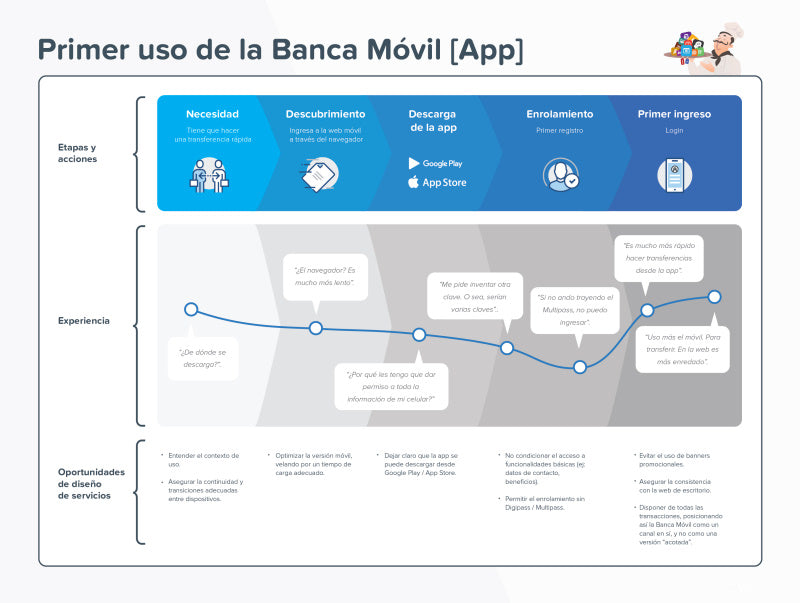
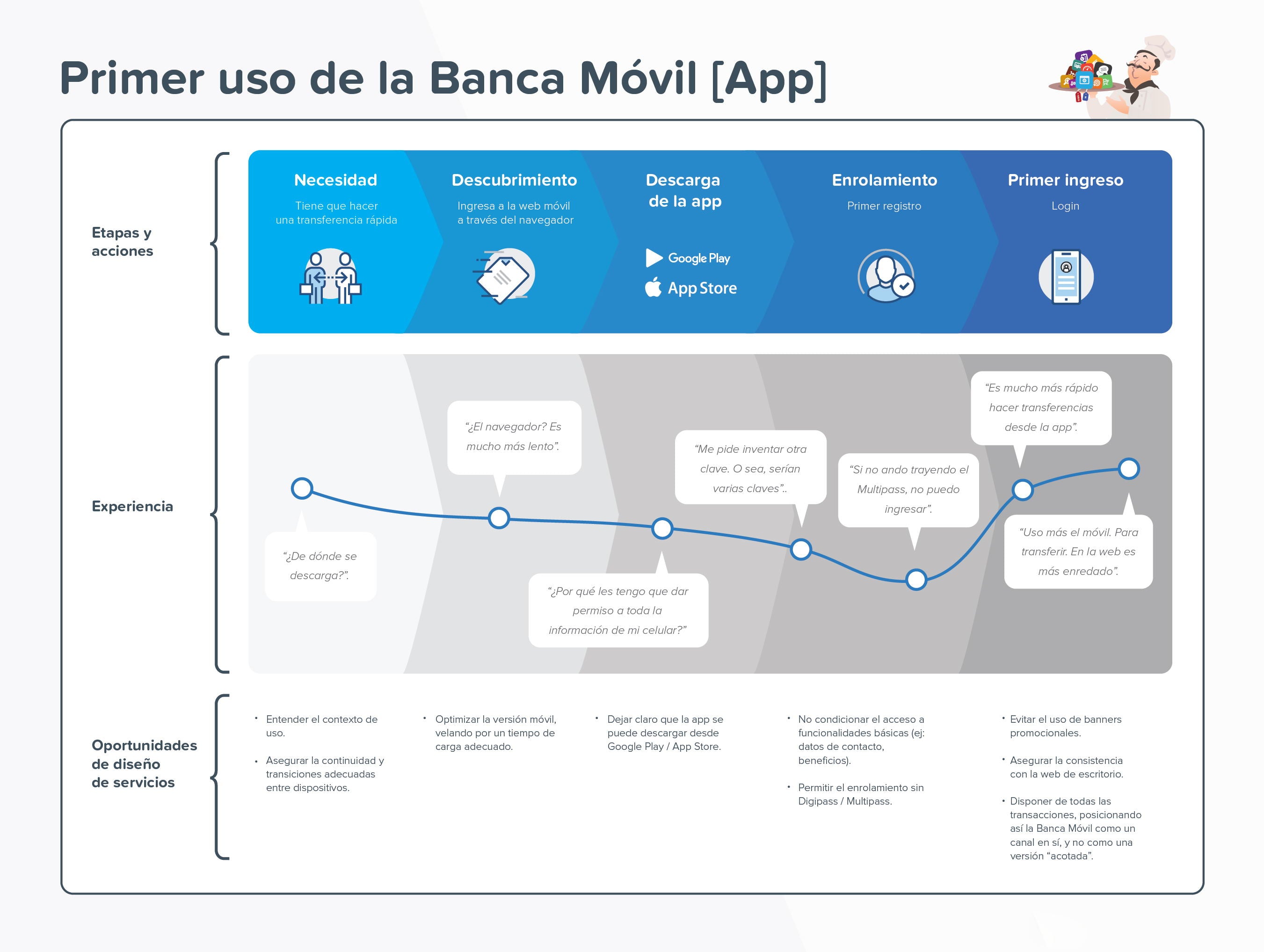
Customer journey in mobile banking: click on the image for details.
The user journey we are interested in illustrating synthesizes the first three scenarios. Based on the consolidated report and in light of the collected information, a *zoom in* could be performed, meaning taking a magnifying glass to see the nuances of each case.
Access to mobile banking is almost always triggered by the need to perform a simple transaction immediately, such as a transfer, a balance inquiry, or a transaction inquiry. While some users have Google Play / App Store as a mental reference and access it directly to download the application, others first go to the bank's mobile site.
From there arises the need to design a consistent, coherent, and continuous experience that allows the user to realize the possibility of downloading the application, having the freedom to do so or not. This is what we call the discovery of the service. As we will see in the final report, some of the users we tested did not realize there was an application to download because the bank's mobile site does not refer to it, or if it does, it is not very visible.
The next stage is downloading and installing the application. Here, we emphasize the importance of ensuring compatibility with different versions of the main operating systems, but also the need to limit requested permissions or, when relevant, explain why it is necessary to grant permission to the application.
Regarding enrollment, or the user's first registration, a gap we observed is the obligation to enter a pinpass / digipass to register. While some users perceive this security requirement as a sign of the bank's concern for information security, others find it an unnecessary step, given that they still have to log in with their RUT and web password. Therefore, the question arises: if the desktop website allows logging in with these two pieces of information, why does the application require additional data?
Another relevant point is the accessible functionalities before login versus after login. Specifically, if there is practical and public information, such as customer service contact details, daily financial data (e.g., dollar value, UF value), or nearby benefits, banks would be interested in making these functionalities available before login.
The first login is usually a positive moment in this initial contact with mobile banking, as the application loads user data faster than the mobile site the user accessed through the browser. In this same context, the first transfer, especially if the recipient is already registered, is usually faster than a transfer on the desktop website. Therefore, the application has the potential to position itself as a superior positive mental reference to the desktop website.
In the next article, we will look at the differences between the journey of a user who accesses the application for the first time and one who already has the application installed, or the recurring mobile banking user.
Between 2015 and 2016, we carried out our largest usability and user experience study project at an industry level. We focused on Digital Banking, one of the most relevant areas of the financial industry in terms of technology, and probably where much of the innovation effort in customer experience (but also in operational efficiency and cost reduction) is concentrated [3]. Mobile Banking is undoubtedly one of the fastest-growing niches and, at the same time, the biggest challenge for teams designing and developing services in the financial world.
This study was not sponsored or requested by any bank. It was an internal initiative by UsabilityChefs (now FREED) aimed at generating authentic local knowledge about usability and user experience.
[1] Forrester (2015). 2015 Global Mobile Banking Functionality Benchmark. Benchmarks: The Mobile Banking Strategy Playbook.
[2] Castro, G. P., Alcaíno, R. M., Arenas, M. V. (2015). Diagnóstico de las aplicaciones móviles de bancos en Chile: perspectiva de los usuarios. Observatorio de Marketing Digital del Departamento de Administración, FEN U. de Chile.
[3] Gartner (2016). Gartner Says Digital Banking Demands New Technologies – and New Vendors. Available online. Accessed on 15/05/2016: https://www.gartner.com/en/newsroom/press-releases/2016-05-03-gartner-says-digital-banking-demands-new-technologies-and-new-vendors

 By
By 



![How to Convince Your Boss to Invest in Usability and User Experience [Updated 2021]](/content-images/331a6776-invertir-usabilidad-ux.jpg)