If you're trying to convince your boss that testing is worthwhile, that investing in a new measurement tool is a good idea, or that a digital interface needs redesigning, you're not alone. Is it a daily challenge, a headache, or the core of your job? Whatever it is, you need tactics to influence others and get them interested in and invested in usability and user experience (UX), especially when it comes to explaining the ROI of UX investment.
Before explaining how, explain why. What do you want to achieve? Perhaps UX, heuristic testing, or card sorting don't sound very understandable, but if you talk about satisfaction indicators, sales, transactions, or even SEO, there's a greater chance they'll understand and listen to you.
Ultimately, while you might be conceptually interested in how you'll move KPIs, what will most catch your boss's attention is the big picture. They also have their own goals, likely similar to yours, but also more "macro" organizational goals. Start the conversation from an emotional perspective; they are also a person, and their success within the organization is related to their leadership and their team's ability to achieve results.
Before thinking about investing in a long and costly testing or redesign process, try to identify if there's a problem and gather evidence. Yes, it's a bit like police work; you need to collect background information. Since "hard" metrics—the numbers—can serve as a bridge to talk to your superiors, Google Analytics will be a great ally in this work.
For qualitative data, learn to test at no cost. Depending on the industry you're in, unless you're in a very, very specific business, you likely have a certain number of potential users within reach. Do you have a meeting with a new supplier who doesn't know the interface? Is your cousin coming over for dinner tonight? Is the bank secretary friendly and seems willing to help? Do your gym friends usually stay an extra 5 minutes at the door chatting? Perfect. You already have some ideas on how to find users and conduct a quick test.
Learn to put together a brief but rigorous protocol and make sure you have recordings of each test. The idea is not to identify all problems exhaustively but to draw attention and raise awareness.
Executives and companies understand the mechanism behind a metric, and even more, they like to see results. A red dashboard turning somewhat green is a good sign. Therefore, even if your improvement initiative isn't part of a specific project, you can surely move the needle with small, everyday decisions.
If you can show results, you'll have a better chance of gaining trust, and in the long run, your credibility will allow you to make decisions without constantly asking for permission.
It's easier, more interesting, and more challenging to converse based on a common level of understanding of a problem than from a position of superiority. In this sense, if you can evangelize the good news within the organization, with your peers and superiors, that's best. It can be something as simple as sharing a study, a newsletter, or giving a short half-hour talk within the organization on introductory concepts like testing methodologies, web metrics, what can be learned from testing, how conversion is impacted, and so on.
Ultimately, the idea is to create opportunities to share, answer questions (often behind a firm NO there are doubts, lack of knowledge, and fear of failure), and also learn from others' concerns.
This is probably the hardest part when you want to change the world and you clearly see at least some of the problems in the digital channel or specifically in the web interface. Time, the daily pressure of KPIs, your passion for simplifying the user's life, and achieving that desired conversion don't always go hand in hand with patience.
One way to actively work on patience is to see things happen, and to see things happen without much wear and tear, start with what's within your reach and doesn't require many resources, is easy to implement, and would generate impact. Achieving results, even small ones, will give you the arguments, the evidence, and at the same time the satisfaction that the needle is moving.
In one of his talks, Eric Reiss said something like, "you've already lost the homepage battle, look for other opportunities." It sounds cruel, but it's true. We know that a carousel is more likely to confuse the user than to generate conversions, but perhaps if we attack it from the beginning, we're already in the toughest fight. Everyone wants to be on the carousel: marketing, sales, branches. Leave them the carousel and focus on optimizing the rest of the site.
First, the homepage is more than a carousel. Second, a website is more than a homepage. While a significant number of users arrive at the site via the homepage, any other page can be an entry point. Identify the relevant pages for different types of conversion and start working on them to move the needle. When you succeed, go back to point #3.
If you've already managed to convince people that a change is needed and now you lack support to take action and implement it, you need a sponsor. What is a sponsor? It's a person with decision-making power and enough influence in the organization to make things happen. In Chile, we would say it's the person who "cuts the cake."
You need to give your sponsor the tools and information so that they, in turn, can justify the investment and thus become your best ally. Ideally, your boss would be a first sponsor. It's all about tactics.
To build beneficial relationships with your stakeholders, you must first recognize who the most relevant or key people are for your UX work. These stakeholders can range from the CEO, directors, and managers to your own boss and colleagues, as well as leaders of other teams who will be involved. Additionally, they can be internal and external collaborators.
It may not seem easy to recognize these key figures, so we recommend you start by asking yourself:
- which person has an interest in your project,
- with whom it is necessary to work to carry it out, and
- who has some power, influence, or control over it.
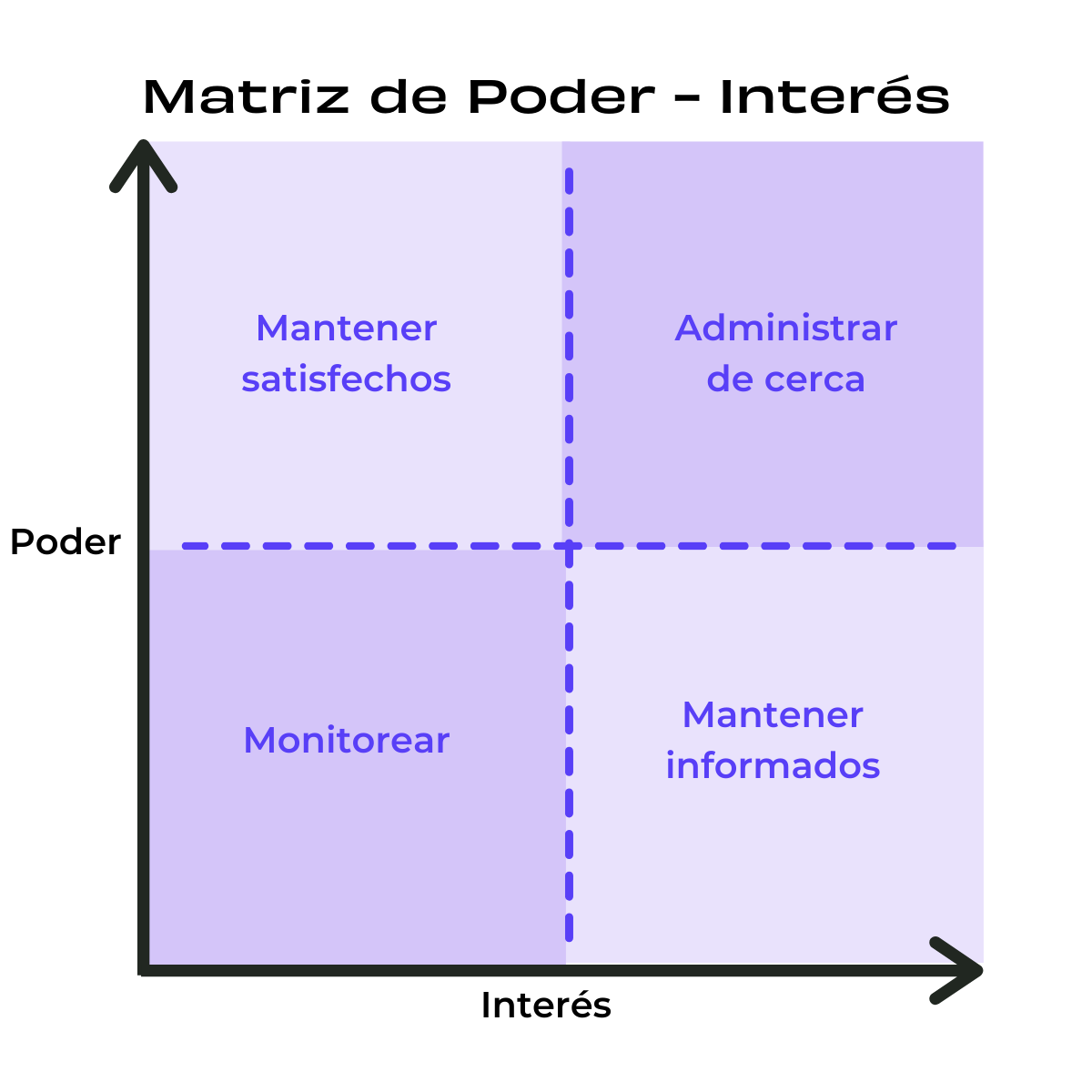
Your list of stakeholders could get very long, so to make the task easier, we suggest using the Mendelow or Power-Interest matrix to analyze your stakeholders.
Mendelow Matrix (the first version is attributed to researcher Aubrey Mendelow).
The idea is to evaluate the potential of each stakeholder to identify what impact they can have on your project, whether negative or positive. Some of these individuals will have more impact than others, hence the importance of identifying them, because you need to apply different management strategies with each of them.
Use the Power-Interest matrix to map stakeholders, placing them along the two axes, from low to high power and from low to high interest. The matrix is divided into four quadrants that require different stakeholder management strategies:
-
Manage closely: These are the most important stakeholders, who are directly interested in your project and exert great influence over the outcome. For example, they make decisions about the resources to be used, the redesign, and contribute with their ideas. You must manage them closely as they have the power to stop or hinder your project. If you manage these relationships well, they can become project promoters and increase the chances of success.
-
Keep satisfied: They are not currently interested in your project but have the power to impact it with their decisions. Make sure to keep them happy, because if they discover that your work affects theirs, they might get involved. Consult with them to ensure they respect your interests.
-
Keep informed: They are interested in your project but have little power over it. Copy them on informational emails and invite them to provide feedback.
-
Monitor: It's not worth dedicating much time or involving them because they have little interest in your work or little power over it. However, remain vigilant because circumstances could change, and they might move to other quadrants.
This stakeholder mapping is not static. Throughout a project, scenarios constantly change, so it is advisable to repeat this exercise frequently and update your management strategies.
What tactics have you tried, and what has been your experience?
(*) Mendelow Matrix and content from "Analyzing the stakeholders in your UX project" translated and adapted from the article Stakeholder Analysis for UX Projects by Nielsen Norman Group.

 By
By ![How to Convince Your Boss to Invest in Usability and User Experience [Updated 2021]](/content-images/331a6776-invertir-usabilidad-ux.jpg)