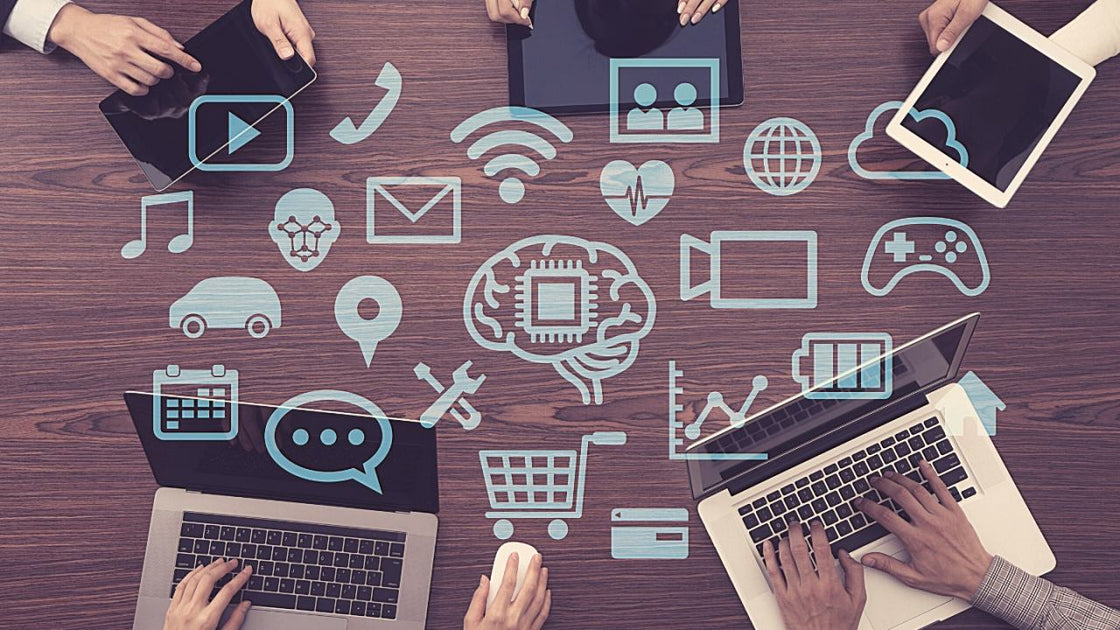
"Wearable" technology is one of the many facets of ubiquitous technology. Ubiquity means being everywhere at the same time. Under this concept, wearables are smart objects that we carry everywhere through microprocessors incorporated into clothing, watches, bracelets, and glasses.
The applications are numerous, from monitoring sleep or cardiovascular rhythm during sports activities, to facilitating work in customer service contexts or improving the lives of people suffering from an illness.
While we have become accustomed to smartphones being omnipresent in everyday life, wearable products promise to change the way we interact with technology, as often there is no permanently present screen, but rather sensors or microprocessors that could go unnoticed. While they capture information about our activities, we tend to forget they exist, so much so that they resemble a simple accessory or a second skin.
The following graph generated with Google Trends illustrates the growing interest in searches for wearable technology on Google in recent years and, specifically, the impact of news about Google Glass and Apple Watch, two of the best-known products: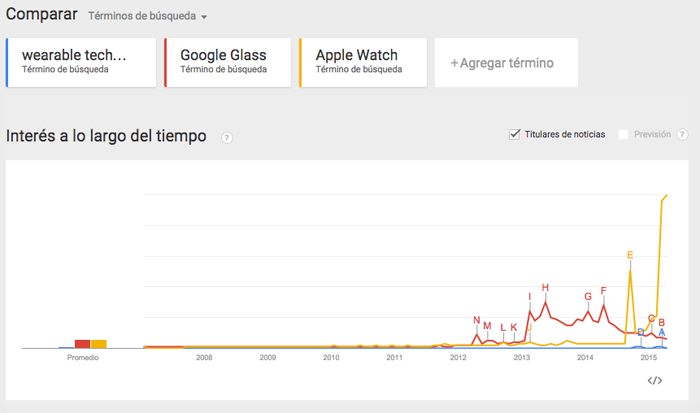
At The Wearable Technology Show in London, we found everything from well-known brands like Google and Apple to startups. Exhibitors presented products with applications mainly for the sports world, health, entertainment, work in special conditions, and customer service. Many of these products are currently on the market, such as sports watches and smartwatches, while others are in the functional prototype, Beta, or other pre-commercial stages.
As for the attendees, in addition to some company representatives looking for opportunities or talent, many early adopters could be seen counting the days until the release of the next smartwatch, trying out augmented reality devices, or simply dreaming of the next activity monitor that would provide them with even the slightest information about their last run.
It is clear that we will see more and more such events, and the number of "wearable" products will increase. More than a trend, it is a new category of products that entails designing a new type of experience.
While the term "usability" is frequently used to talk about technology and interface design, it is fundamentally a concept that applies to products, services, and experiences of all kinds.
Some heuristics to consider in wearable design:
- The ease of use of wearables must be a characteristic not only of the device itself and the application, which is often synchronized via smartphone, but also of the entire process: it must be easy to synchronize with the smartphone. Just as it must be intuitive to synchronize this application with other related ones or link a wearable with other devices.
- The user must have clarity about the system status: Is the activity being recorded or not? Is it synchronized or not? Many wearables do not have a screen, so it is not trivial to design the interaction of a user with an object that apparently communicates nothing and an application that does communicate but is useless without synchronization.
-
Display information from the most generic to the most specific level: The possibilities of capturing usage/monitoring information are endless, so we must focus on the visualization and organization of information in layers to avoid cognitive overload.
-
Learn from user behavior and personalize the experience: If the user daily synchronizes the monitor app with another app, it would be interesting for the system to learn to do it automatically. Or, if the sleep monitor "knows" how many hours of deep sleep the user had, it would be interesting for it to show whether that is a lot or a little according to their activity and profile (age, gender, etc.).
- Consider contextual help: If user research is well done and from testing we know which interactions are more complex, besides improving the interface, we must consider a minimum of help, either with short content, tutorials, FAQs, etc. Always keeping the context of use in mind. If the user is offline (without Internet), they clearly will not watch YouTube tutorials to understand how synchronization works.
Understanding the context of use
It is essential to understand how the product will be used and under what conditions. From climatic conditions (will it rain? will it be cold?), to connectivity (is Wi-Fi needed to use the work glasses?), dependence on another device (does it need to be synchronized via Bluetooth?), to details about the user's clothing or the type of activity they are performing.
A tool like a Customer Journey Map allows visualizing the customer's experience and their interaction with the product/service through different touchpoints. When designing a service that involves a wearable, the entire cycle must be considered, initially as a proposal as part of the prototyping process and then in the testing and implementation stage. What gaps exist? How can we solve possible frictions? At what moments can we modify a small detail to make the experience not just good but remarkable and memorable?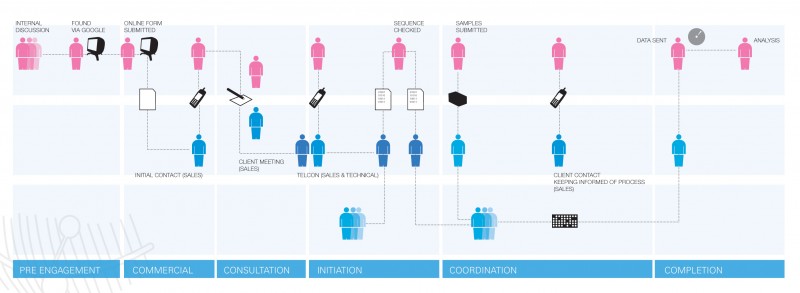
Image source: servicedesigntools.org
To learn more about the history of wearables, this infographic from Mashable is an interesting summary.
What experience have you had with wearables as a user, designer, or researcher?

 By
By 

![How to Convince Your Boss to Invest in Usability and User Experience [Updated 2021]](/content-images/331a6776-invertir-usabilidad-ux.jpg)