Did you also experience anxiety due to the Facebook, Instagram, and WhatsApp outage? It's normal, especially if you conduct business through these social networks. Thus, being cut off from our network had a dual impact: social and commercial, as it affected thousands of e-commerce businesses globally.
Indeed, on Monday, October 4th, in Chile, Colombia, and other markets, CyberMonday campaigns were kicking off, so locally, the social media outage was strongly felt.
Reportedly, it was the worst outage suffered by the social media giant, which, let's remember, controls three platforms, not just Facebook. And as the media tells us, all three literally erased themselves from the internet.
This outage, which lasted about six hours, hit Facebook with losses of nearly six billion dollars in capital due to the collapse of its shares.
But we must also look at what happened to entrepreneurs who rely on Facebook, Instagram, and WhatsApp to run their e-commerce businesses.
For example, the president of the Bogotá Chamber of Electronic Commerce, María Fernanda Quiñones, told Voice of America that the social media outage indeed impacted the development of e-commerce.
She explained that social media has been a fundamental tool in the entire economic reactivation process in Colombia for small and medium-sized enterprises.
In this regard, entrepreneur Samara Yepez, owner of S&Y Entertainment Group in Los Angeles, California, said that the social media outage caused her to lose a day of work that she cannot recover and that resulted in losses of about ten thousand dollars.
Another dramatic case was recounted by Dennys Pérez Silva, a therapist, mother, and entrepreneur, who makes 95% of her sales through WhatsApp Business, Facebook Marketplace, and Instagram feed. Evidently, with this outage, she could not close sales that day.
The solution: many e-commerce entrepreneurs resorted to SMS messages, advertising in online media, and even printing posters.
Carlos Charry, an academic at the Universidad del Rosario (Colombia), explained that this social media blackout highlights "the strong dependence we have built on them. Not only in economic terms but also in terms of political, economic, business, or even family decisions that happen daily through these social networks."
He added that "there are types of work, types of interactions that only flow through social networks, and it practically becomes an extension of ourselves, and if something more serious and definitive were to happen, it would seem as if society could not function without these platforms."
So, if personally it's hard for you to live without social media, at the company level, many have questioned how to avoid depending on the Facebook or Instagram algorithm even before this event.
And we warned about this in our article Digital marketing strategy: mistakes to avoid [Part 1], when we stated that you should not put all your eggs in one basket.
Specifically, we said: "Don't rely on a single social network or a single sales channel." This is because, by not having an alternative source of income or a distinct value proposition, in the face of any exceptional event, such as what happened on Monday, October 4th, the business can go very wrong.
The idea is to diversify to have different means of communication with your customers and tools to position your brand in the market. The goal is for your customers to remember you and reach you without relying on social media.
Let's see what you can do:
In the 21st century, email remains a valid tool for contacting and retaining customers.
Having direct contact with people is best. From capturing data of your potential customers to maintaining active communication with those who have already purchased from you, without a constant bombardment of sales and promotional emails.
Because email marketing is not that avalanche of typical mass advertising emails that arrive without permission to fill your inbox.
Behind email marketing there is a methodology and a strategy, where the customer lifecycle and segmentation are fundamental.
With email marketing, you can perform a series of beneficial actions for your customer:
- Notify the different stages of an order.
- Send different types of periodic communications.
- Send personalized emails.
- Communicate offers and news about your brand.
- Build a relationship and foster loyalty.
- And, of course, sell your products and services.
And, perhaps the most interesting thing about this, all that customer experience through email can be automated through a platform, configuring your message flows with specific objectives that will be sent at specific moments of the customer's lifecycle.
Setting up an e-commerce requires more than just publishing an online store with many products. Behind it, there must be arduous work in various aspects, and one of them is your brand.
As an online business owner, you must focus on creating a brand and connecting it with people, because after achieving that, it will be easier and less costly to sell your products or services.
And the brand is probably the most important intangible asset of a company, because it remains in people's minds even before they consume a product or service.
So, your mission is to emotionally involve your brand in customers' lives, and for that, you must:
- Create a brand.
- Design the basic elements of a brand.
- Develop a branding strategy: manage your brand to make it desirable.
To bring such a broad concept as a brand down to earth, you must focus on maintaining omnichannel communication, that is, consistently articulating communication across all channels and touchpoints.
Do a small exercise: go to Google Analytics and check the participation of direct traffic in the total web traffic and sales of your e-commerce.
By direct traffic, we mean people who arrive at your website directly by typing the domain name into the browser. If they remember the domain name by heart, it means they remember your brand.
But they can also search for your brand on Google, which leads us to the next point.
If you create content that solves people's needs and also understand how Google's algorithm works, you're already on the right track.
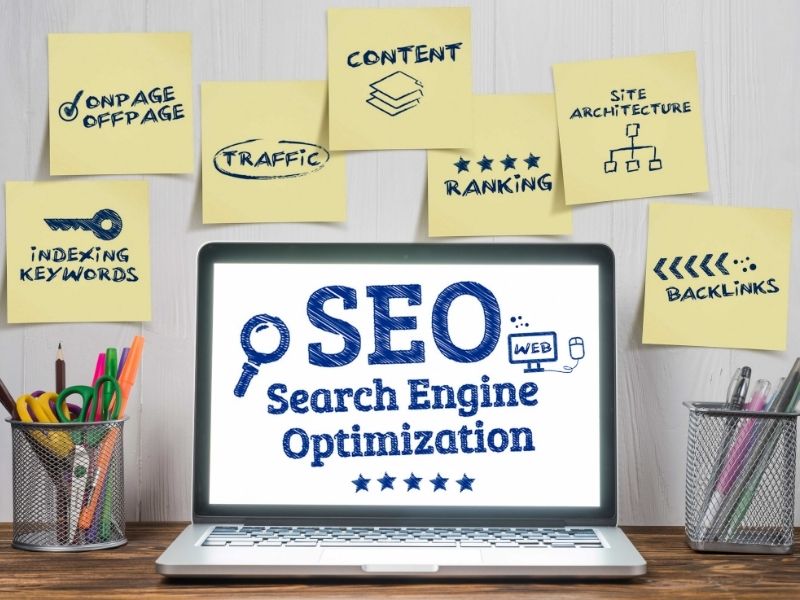
The work you need to do for your e-commerce website is organic positioning, meaning optimizing your content so that Google finds it and displays it prominently in search results.
That's SEO, an acronym for Search Engine Optimization.
You must do this work on every page and product listing:
- Using keywords significant to the search intent each page of your e-commerce site aims to resolve, from product pages to category pages and blog articles.
- Enriching content to reach about 600 words. It's not about writing for the sake of writing; the content must be relevant and pertinent.
- Optimizing the SERP (Title, Meta Description, and URL of each page).
- Optimizing photographs.
We have performed these types of tasks with several of our clients, and here are two examples; one from a B2C company and another from a purely B2B business:
In the following Google Analytics examples, you will see that e-commerce businesses that are adopting these strategies and do not rely heavily on social media for their sales did not suffer a significant impact during the Facebook, Instagram, and WhatsApp outage.
Here we show a site that does not depend on paid traffic and clearly was not affected by the outage on October 4th:
Another one that was also unaffected:
In contrast, this site does depend heavily on paid traffic:
However, when we filter and look at only organic traffic, we see that it has even increased:
Here the message is to diversify traffic sources.
While paid traffic can be interesting, as it could immediately translate into sales, in the medium and long term, SEO is a good investment that will yield positive and steadily growing returns.
Now, to invest in the future, one must be able to pay the bills in the present.
No matter where you start, do it now. The big lesson from what happened on Monday, October 4, 2021, should be: be careful about putting all your eggs in one basket.
Are you adopting the measures we proposed? Did your e-commerce suffer any impact from this widespread outage of the main social networks?

 By
By