International SEO is the process of optimizing a website to achieve organic positioning in the different countries it aims to reach with its content, products, or services.
In other words, it involves a series of SEO factors you must meet to provide information to Google and other search engines about the countries where pages should be classified and ranked, and the language used, for example.
If you intend to internationalize your e-commerce business, these factors must be part of your SEO strategy because they will help your company gain organic positioning and reach customers in other markets who are searching online for products or services like yours, but in a different language.
You should not forget the usual SEO factors for Google positioning and, in addition, implement a specific strategy for each region or country where you want to expand your online reach. For this, consider both technical aspects and an analysis of the competitiveness level of each market you will be working in.
And with the following actions, you will be prepared to cross borders.
The first step in an organic positioning strategy is to conduct market research and keyword research, which must be specifically targeted at the country you want to reach with your website. Through this work, you can analyze the interests, search intentions, and search terms used by potential customers in relation to your products or services.
What's different in international SEO is that you must focus on adapting your search terms and content to the language of the target country. For keyword research, we have recommended free and paid SEO tools, such as Ubersuggest and Ahrefs.
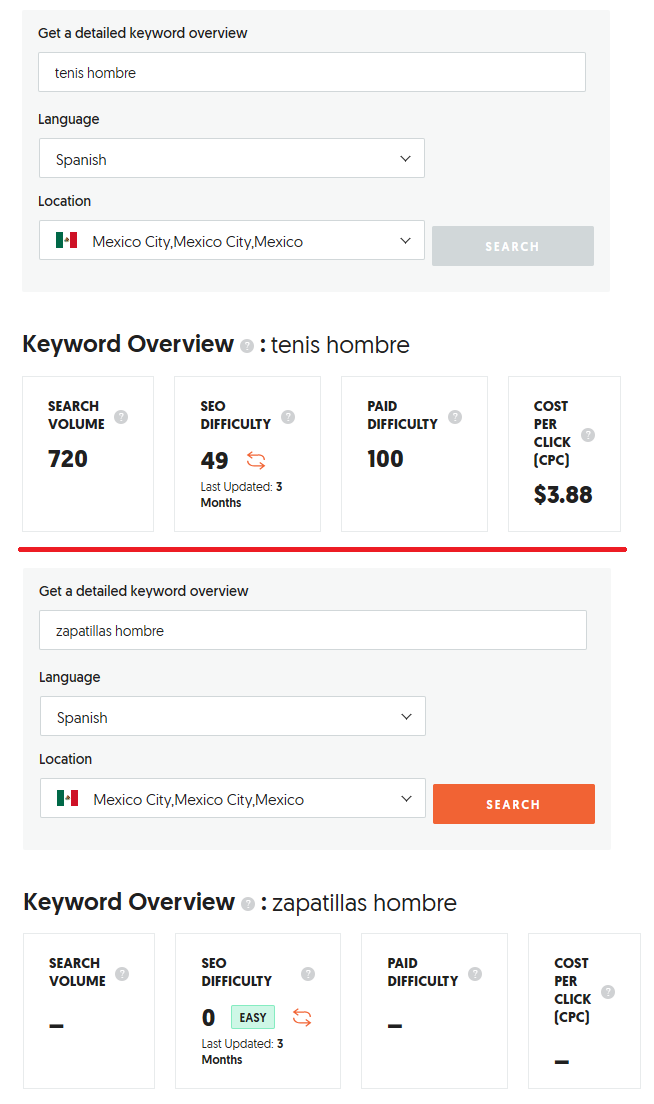
The country where we will conduct the research is Mexico City. The search we will perform is "tenis hombre" (men's sneakers), a term that in other countries like Chile would be "zapatillas hombre" (men's sneakers).
As you can see in the images, the search volume for "tenis hombre" in Mexico is much higher than "zapatilla hombre" for its Google positioning.
Another useful option is to change the location and language directly in the Google search engine to analyze the results when performing different searches.
Should content strategies be different?
You must decide this based on user behavior and the budget you have available for your SEO strategy. Remember that creating differentiated content will require more effort, so you have two options:
a) Translate texts directly from one language to another, which is not considered duplicate content.
b) Create personalized content for each market. This is the ideal option.
As we mentioned, both searches and content must be translated into the language of the target country. But be careful, it is better not to use automatic translations from marketplaces or browsers, because if you fail to use the appropriate terms or to develop sentences satisfactorily, you could affect the quality of your content.
It is important that the content is personalized for each region, understanding the behavior of potential customers in each country and considering that there may even be a variety of particular terms within the same language.
For example, "cartera" for some target customers means "wallet" and for others "women's handbag," so you must adapt your content because "100% natural brown leather wallet" will not be the same for both audiences. Just as we saw the difference between "zapatillas" and "tenis" above.
3. International or regional domain?
-
International domains: .com, .net, .org, among others.
-
Regional domains: .gt, .pa, .sv, .es, .cl, .ar, .co, among others.
The choice will depend on whether you want to ensure brand protection, and for this, you will need to buy the domains for each of the countries where you plan to expand and redirect them to the central domain, which could be .com.
And if the site is very large and you won't offer the same products in all countries, it would be a better option to consider regional domains. Additionally, you should ask yourself which countries generate the most sales and if they are collectively from a specific region.
There are three ways to organize content in different languages:
-
One domain for each language: .es for Spanish, .com for English, .fr for French, etc. However, since each domain would be a distinct project, the organic positioning effort would multiply based on how many languages you need to use.
-
Subdomain for each language: You can integrate language subdomains (.en, .fr) into the main domain (.com). But this would cause the domain's authority to be lost in the eyes of search engines.
-
Using subfolders: www.domain.com/en/ (English), www.domain.com/fr/ (French), and so on. This is the option we at FREED recommend, as the site's architecture will be on a single domain that will receive all the authority.
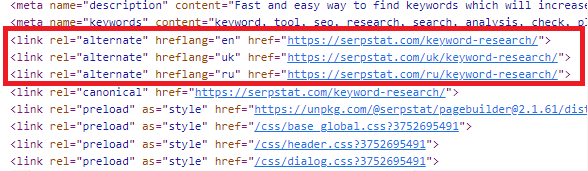
This is a tag you must integrate into all pages of your website if you want to develop content in multiple languages. The hreflang tag allows the search engine to understand:
- The language of the developed content.
- How to read it.
- That it should not be considered duplicate content.
There are two ways to add the hreflang tag to your website pages:
a) Add the following to the HTML Head of the page, modifying it with your site's link and the language to be recognized:
<link rel=”alternate” hreflang=”en”
href=http://www.domain.com/en/>
b) If your website uses an external platform like WordPress, Prestashop, or another, you can add a Plug-In to do that work for you.
Additionally, it is important to notify Google of localized versions of your page.
Your website's loading speed is an important factor in a potential customer's purchasing decision. This will depend on their geographical location, so you should contract hosting in the country where you have the highest number of sales.
On the other hand, you should purchase an exclusive IP address for your website, because if it is shared with other clients and one of them suffers a malicious attack, Google will penalize everyone sharing that IP.
Finally, remember that the important thing is to look for opportunities or niches that allow your website to compete and also be relevant.

 By
By