As I promised in the previous article, Rebranding: what it is and how to know if your brand needs it, I now want to share with you our experience working on my company's rebrand, with the advice of an expert, of course. Now that you know what rebranding means and are possibly thinking about making some changes for your brand, it's important to get an idea of how it's done, to understand some concepts, and to prepare yourself for this rebranding process.
Stage zero, or the beginning, involves deciding if a rebrand is necessary. In this sense, if your brand meets one of the 12 points we discussed in the previous article, that's enough to consider undertaking a rebranding process. If you identify more than one reason, perhaps you not only have to do it, but you also need to prioritize it. If in doubt, consider a diagnostic assessment of your brand's current situation. Seek support, conduct a diagnosis, and make informed decisions.
Very briefly explained, brand renaming is the change of name.
Speaking of my experience with FREED, there was a parallel renaming process, that is, a name change. Not all rebranding projects go hand in hand with renaming. But if your brand needs a name change, it is essential that it be done before modifying the other elements of the brand, as this impacts the rest of the process.
I won't dwell much on this point as it is not the purpose of this article and renaming is a topic in itself. I just want to leave you with the following thought: how do you know that renaming is necessary for your brand? If you are an entrepreneur, you will know how to apply something that entrepreneurs have: intuition. If you work in a company that is not yours, and moreover, it is medium or large, you will probably do a study first. And that's fine, as that is the usual path. In fact, in FREED's research and consulting projects, on more than one occasion we have concluded with our clients that a renaming and rebranding effort was necessary.
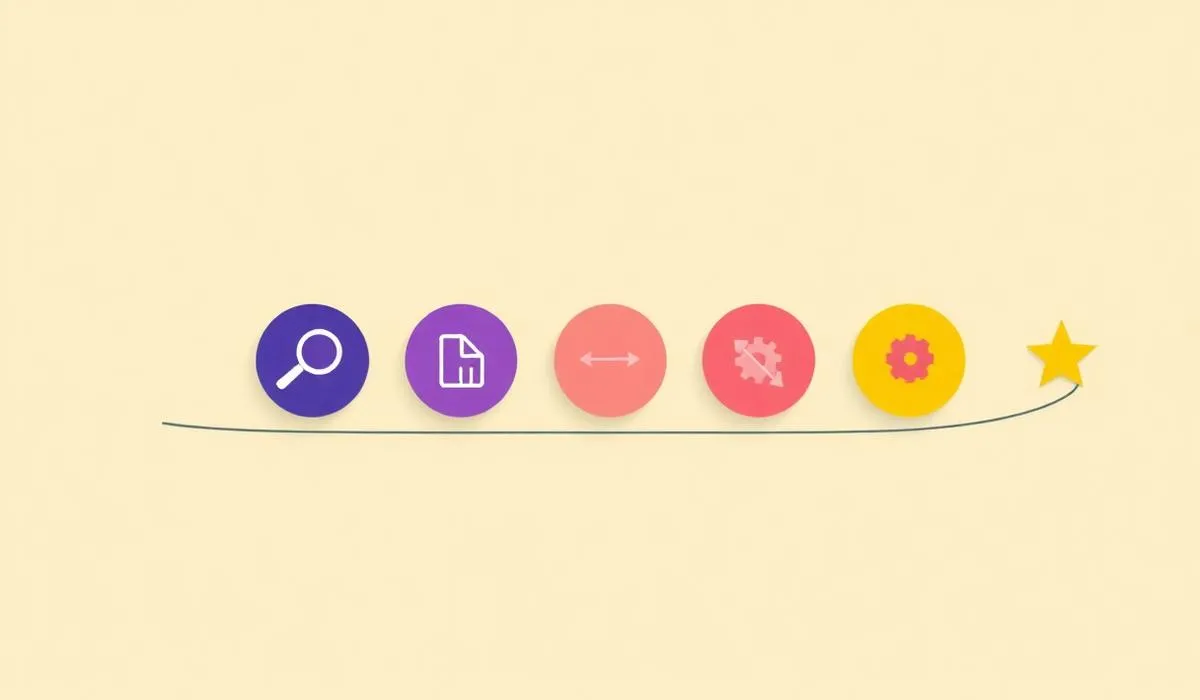
Once you've made the decision, you need to plan the rebranding process. Next, I'll continue from the perspective of a business owner and would like to share how we've done it at FREED:
-
Start with the business purpose: Why are you in the market?
-
Conduct a diagnosis of the company's current situation (unless you did it in stage zero): Who are your customers? How do they perceive your brand? If there are target customers you're not reaching, you should also consider this variable. What's important to these potential customers? What are their current benchmarks? That is, the brands they work with. What kind of content do they consume? Where are they connecting with brands? At this stage, it may be necessary to sit down and talk to your customers and systematize those findings. One way to do this is to ask 10 people how they would describe your brand, asking this question to your customers, suppliers, and also to members of your team to identify gaps.
-
Understand the market: Who are your competitors, what is their positioning, and how should you differentiate yourself?
-
Define the strategy: From business strategy to brand strategy, it is essential to define how you will generate value for your customers.
-
Define your brand's new positioning: From the value proposition to the brand's differentiating elements.
-
Design the brand identity: That is, the logo, typography, colors, etc. At this stage, you should also include a brand manual, mini-manual, and/or brand kit. This document will contain the guidelines that must be respected in the future, either by your direct team or service providers you may hire.
-
Apply the new brand identity to the website or e-commerce site, social media, business cards, presentation templates, etc.
-
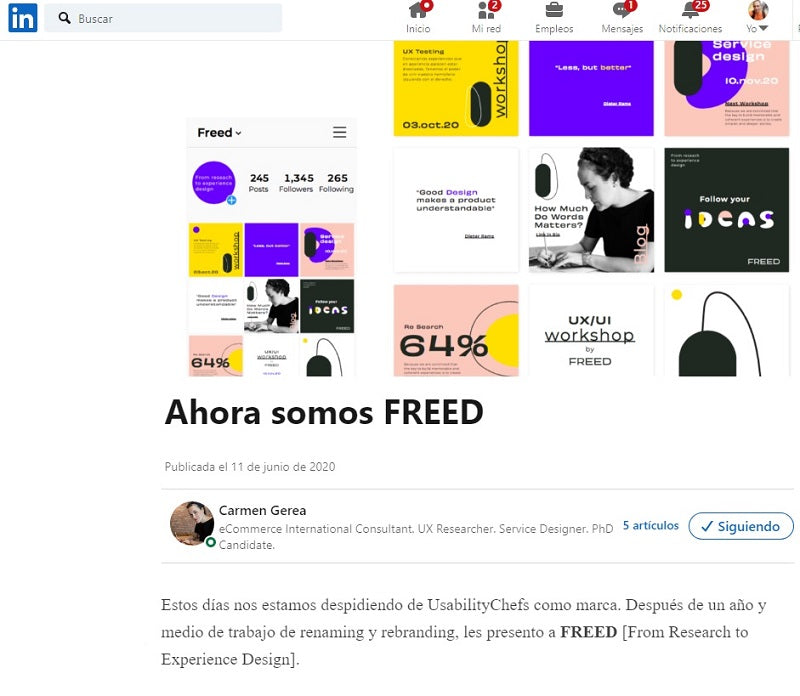
Communicate the change: Communication is a process in which you must consider your work team and current clients, suppliers, and the rest of the ecosystem. The change may be gradual and not a big blackout. Not all brands have the budget to change everything overnight. The important thing is to be consistent and have a plan. For example, at FREED we started communicating the change to current and recent clients, then I published a post on LinkedIn, while the website and email change took a little longer. In fact, we still use the old UsabilityChefs email to receive communications and, when pertinent, we respond to the sender from the FREED inbox to make the transition more friendly. It wouldn't be very kind to have an email inbox that bounces. Is it necessary to launch the new brand? It's not always appropriate to do it with great fanfare. At FREED we didn't do it because just (without wanting or having an official launch date in mind) we were "ready" at the beginning of 2020, when the pandemic arrived and, in this uncertain scenario, it was obvious that our new brand was not very relevant on a planetary scale. Therefore, the announcement on LinkedIn came later and at a moment of respite.
-
Create a branding plan: because rebranding is just the first step. Now that you've launched the new brand, how will you become a top-of-mind reference for people? I can't show you the behind-the-scenes of this part yet, as it's a work in progress; I can only tell you that, after a great, somewhat invisible effort that has us very excited, the launch of the new brand marks a before and after. And now that the new brand is live, the fun part begins: designing and implementing a branding plan.
In the cases we mentioned in the previous article, there's a mix: Burger King's rebranding was done by an agency, while in Gusto's case, it was the internal team. Whichever path you choose, consider that the internal team must be heavily involved. Even if you delegate the work to an agency or consulting firm, you and your team must be part of this rebranding process. No delegating and forgetting; it's an eminently co-creative effort.
What did we do? We took the middle road. We did the internal tasks, delegated the visual identity with 250% involvement, and since the launch, we continue to rely on the brand expert we work with.
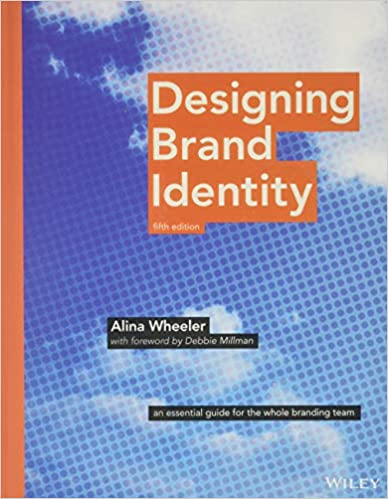
At FREED, we're quite diligent, so one of the first ways we prepared was to read a lot to truly understand what rebranding means and how to carry out the process. For this, I bought Alina Wheeler's book: “Designing Brand Identity: An Essential Guide for the Whole Branding Team” (it's the 5th English edition). Rafael, for his part, reviewed a ton of blog articles and case studies. This way, we started working as a team even before our first meeting with the expert who supported us.
This is how we conducted an internal mapping, considering:
-
Digital and analog brand assets: website, social media, design kits, business cards, among others.
-
Team: who we are and what we represent.
-
Clients: who they are and what kind of solution they are looking for.
-
What we do: what solutions we provide, what solutions we want to continue providing, and what we want to stop doing.
-
Competition: direct and indirect. Who they are and how they position themselves.
-
Development potential: what we can do in the near future.
-
References: brands from the not-so-immediate environment that we find interesting for their positioning and the way they communicate their message.
As we have already mentioned in this article, this aspect is fundamental. At FREED, once we had made the diagnosis and selected the references, it was time to move on to the visual identity. The visual identity of a brand is a vital stage of a large process, so it was important to seek expert help.
How did we do it? We used our network of contacts. When I thought of rebranding, I immediately remembered a former master's classmate who, for me, is a great reference in brand matters. I contacted him and, for various reasons, he couldn't work on the project, so he gave me the contact of a colleague. I wrote to him, we agreed on a meeting, I saw his portfolio, he generated trust, and that was it. He sent me his proposal and I accepted it. I knew immediately that we were going to work with him. Beyond this project, Juan Pablo López has since been part of the FREED expert network, professionals with whom we collaborate on our clients' projects.
How much does a rebrand cost? Like any project, the budget factor is important. To avoid wasting my time or anyone else's, the best advice is: have a budget in mind when talking to a professional. If you have no idea what you're willing to invest or reinvest in your business, it will be difficult.
Some factors to consider:
-
Available budget: regardless of the specialist/agency/consultant who can assist you, be clear about what is available from your budget. How do you know if it's realistic? Ask for advice, ask your colleagues, peers, and friends who have experience in this. And apply common sense because rebranding is a relevant task in the life of a company. The new brand will accompany you for years, so it's important to invest.
-
Who you will work with. Rebranding is not mandatory. Generally, your customers don't ask you to change the brand, so one of my best pieces of advice is that if you decide to go for rebranding, do it conscientiously, with time and professionalism. If you don't have the budget to hire an expert to rigorously accompany you, don't do it and wait. Don't delegate it as a task to an intern; it's very likely that everything will go wrong.
-
What the proposal includes. Basically, if you want to make a decision, and even more so, compare, you have to compare apples to apples. Make sure you understand what the proposal includes. For example, the initial budget for FREED did not include:
- Purchase of fonts or photographs.
- Illustration system (if necessary for each path).
- Iconographic system (if necessary for each path).
- Prints and/or mock-ups.
I believe this gradual approach allows for progress, building on a strong foundation (visual identity), and at the same time, getting to know the professional or team you will be working with.
Some sources speak of an amount between US$50,000 and US$150,000 for a rebranding; or between US$1,300 and over US$6 million for a logo. I recently heard a podcast by Vilma Ñuñez, a reference in digital marketing in the Hispanic world, who paid around US$5,000 for a rebranding of several brands within an architecture (or set of brands).
I haven't yet calculated the total cost of this rebranding process for FREED, but I believe that for a small company, you should consider between US$1,000 and US$5,000, depending on the scope (visual identity, i.e., logo, typography, brand photographs, website redesign, social media, templates, etc.). Obviously, this budget is highly variable, and I also think the time division is variable. Let me explain: it's different to pay US$5,000 all at once (for many small brands, that's impossible) versus paying US$5,000 over a year divided among several deliverables. It also depends on what you know how to do yourself that can lighten the external professional's workload. Be careful, knowing how to use Canva doesn't make you an expert.
Juan Pablo's proposal included visual identity design work, and more specifically, the following stages:
-
Discovery: diagnosis and benchmark of references.
-
Concept: proposal of two creative concepts.
-
Design: development of one of the chosen creative paths.
-
Delivery: editorial with the graphic standards manual created for the new identity.
Juan Pablo guided us along the way and we managed to define the differentiating attributes, the keywords/concepts we want to be associated with or not, as well as the brand's personality.
Subsequently, he presented us with conceptual proposals until we arrived at two very different paths, which we debated internally with Rafael until we selected one of them. As there were two of us, the choice was going to be complex. We tied, and finally, as the founder, I had to make a decision.
At FREED, we conduct studies with users and clients, so testing the new brand was something we knew we could do internally. The biggest challenge was to limit biases. In the past, we have hired a fellow consultant to test FREED products, precisely to limit biases. This time, we developed the interview guide, I conducted them and made a partial transcription, and Rafael listened to the recordings to reduce bias.
Some of the questions in the in-depth interviews were:
- What does the Freed consultancy convey through its colors?
- What does the Freed consultancy convey through its logo?
- Do you know other consultancies with a similar image?
- Which one does it resemble?
- In what ways is it similar?
- What do you think are the elements of Freed's image that differentiate it if you compare it with other consultancies you know?
- How attractive is Freed's image?
- Why?
- A typography expert who knew UsabilityChefs, because he saw the brand born as my professor in the master's program.
- A client particularly concerned with design (the family perspective).
- Another recent client, who didn't know much about the background of UsabilityChefs (the newer perspective).
- An expert professional with whom we collaborate on several projects and who is part of the FREED network. He also lives abroad, which also gave us a point of view we were looking for.
-
On-screen readability: It's important that the typography allows text to be read easily. At FREED, we selected two fonts that coexist, and we realized that one of them doesn't adapt well to reading on a website, especially in headlines. As a result, the use of that font was reserved for small communication pieces and social media (short texts in general, not web headlines).
-
Printing: Even if you are a digital company, sooner or later you will have to print something (cards, credentials, a sticker, templates, reports, etc.). Include print tests in the rebranding process.
As with any project, in a rebranding process you should consider variables such as:
-
Urgency: How urgent is rebranding for your business? This will mainly depend on the stage you are in. If your sales have stagnated, it is probably more urgent than if your business is growing.
-
Importance: This is also very relative and somehow relates to the purpose and projection of your business. If you are looking for long-term projection, there is no doubt that the brand is a very important aspect that you should be concerned about.
In this sense, and to give you an example, when we started the rebranding process for UsabilityChefs, we were very clear that it was important but not urgent. This means that we really took the time to do things well (or at least we hope so).
At FREED, it took us exactly one year and 5 months between the first contact with the branding specialist designer and the first communication of the rebranding on LinkedIn. As I mentioned at the beginning, this communication stage was voluntarily postponed because we considered it inappropriate to discuss this topic in the context of the pandemic. Since then, we have not stopped working on the new brand.
Have you ever wondered if a rebranding process would be relevant for your brand? Has your company gone through a rebranding or renaming process? How did you do it?

 By
By 


![Customer Journey: What it is and How to Map it [Complete Guide]](/content-images/6b03118e-portada-user-journey.jpg)