Social media for businesses has proven to be very effective in attracting potential customers and retaining existing ones who have already experienced a brand. However, as in any business, for things to work well, it is essential to apply certain tactics. In this article, we will discuss tips that will help you start working with a user experience design strategy on your social media for businesses, whether it's Facebook, Instagram, LinkedIn, etc.
To briefly review the concept, user experience, known by its acronym UX, refers to creating a design focused precisely on the experience people have when using or interacting with a technology, platform, website, or, in this case, a social network, considering principles such as value, utility, usability, accessibility, and credibility.
When we refer to experience design on social media for businesses, we are inviting you to think of a first-class service channel in terms of relationship building, branding, and emotions, where you demonstrate that you care about your users' experience.
From this perspective, we have prepared some tips for you to work on experience design on your social media, and we suggest that if you are not already doing what you are about to read, you start today.
You can find this out by asking people who have already bought from you, through surveys using your customer databases. The idea is to commit to deploying your experience design strategy and developing your brand on the platform that will bring the most benefits to your business, and then experiment with what content works best, instead of spending time and energy where you won't get the expected reach.
While what we are looking for is to connect with an audience and not to do something for an algorithm, it is important to know that understanding how it works is a way to achieve our goal: to relate to people. You can try to ignore it, but what's the point? It would be like visiting someone's house and ignoring the host, even though when you go to someone's house, you have to abide by their rules. Taking this analogy to social media, it is increasingly clear that the purpose of their algorithms is to keep people on the platform; therefore, in some cases, publishing external content (such as links to your website) may not work as well, for example.
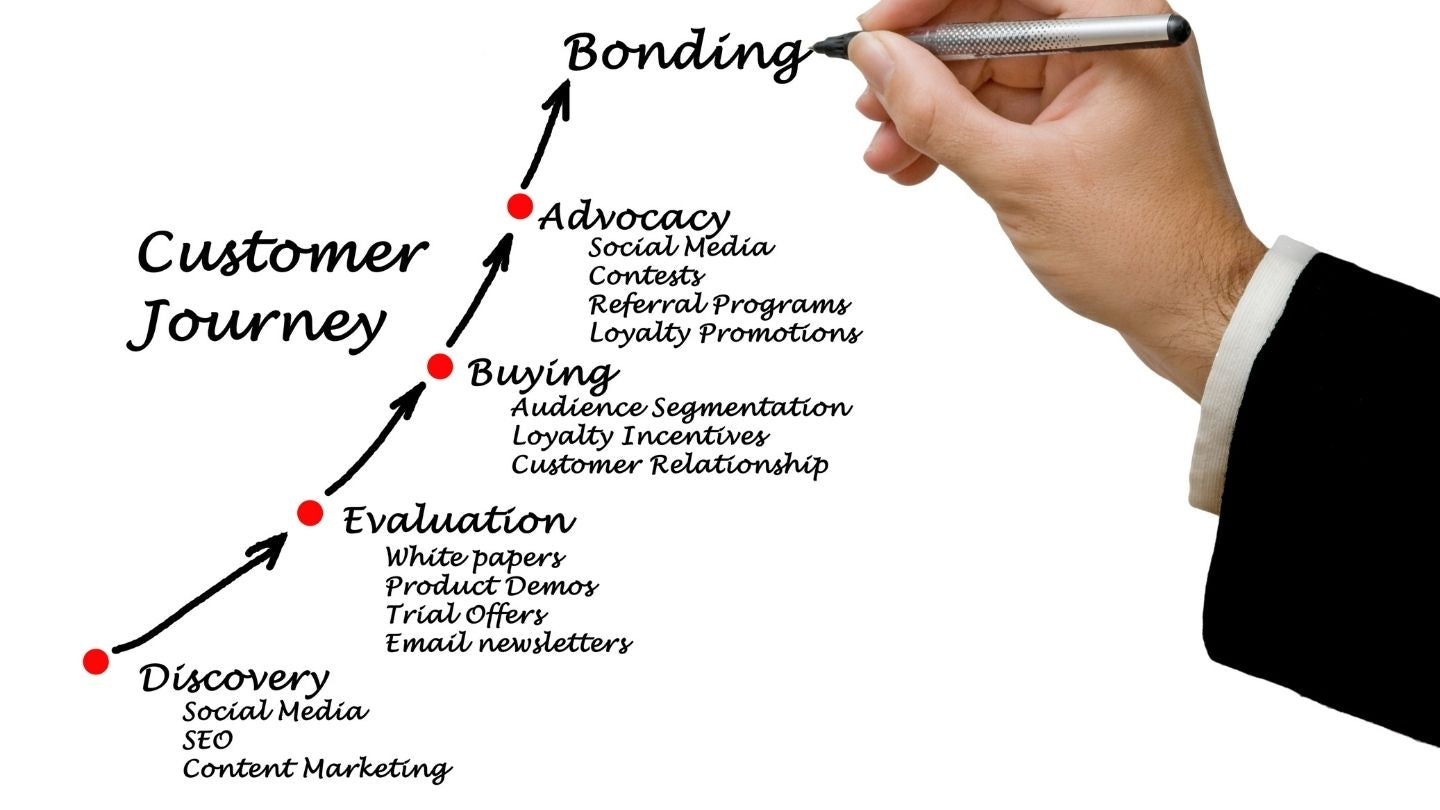
If you are more experienced, you can use a service blueprint to define the necessary processes behind each customer action and the visible line. For example: if in your experience design you defined that the standard is to respond in less than 2 hours, what do you need to do to make that happen? Who will attend to people? With what language? What tone of voice will be used? Will it be a personal, friendly, or more corporate approach? Will they sign with their name or will it be a generic message from the team? These are all questions you must answer. Based on this ideal journey map (or service blueprint), you will have to define the service protocol at each touchpoint, and you must consider that there can be several touchpoints on a social network. For example, on Facebook we have:
- Direct messages,
- comments on the brand's posts,
- people's comments on the brand's wall (if you defined that this space will be open for people to post),
- recommendations / reviews (how will they be answered? what happens if someone leaves a negative review? what happens if someone leaves a very good review?);
- will you have a chatbot? what kind of attention will you answer automatically in the chatbot? when will you escalate to a person?
At FREED, we believe that there is no manual of written rules that work for every brand, and even less so, forever. Therefore, it is essential to cultivate a mindset of constant experimentation. What does experimentation mean? If we talk about social media for businesses and user experience, you can experiment with different:
- Content types,
- formats,
- posting times,
- calls to action, etc.
You can even experiment with the quantity and reach of each touchpoint with your brand. Of course, it is essential to analyze the results and make decisions constantly. If a social network does not allow you to reach your audience adequately, why make a superhuman effort in that direction?
Pay attention to details and use elements that identify your brand:
- the color palette,
- the typography,
- the photographs, and
- the tone of the message.
The goal is for your followers to recognize your posts without even looking at the account name and associate them with your brand. In addition, being consistent will give it identity and authority, and will generate trust in customers. Remember that we are talking about customer experience design, where this aspect is very important.
6. Be consistent in the type of posts
Do not make personal posts or posts that do not fit the style of your business on your social media for businesses. Manage your business as big brands do. See what the most important brands are doing to manage experience design with coherence and consistency in their posts. But never forget that on your social media accounts for businesses, you should only talk about your business, your brand, the people behind it, your products, and your customers.
Your followers, users, and customers will expect your posts. Your audience will get used to a frequency and even the days and times you launch your messages on social media. In addition, if you disappear, they will think that your business is no longer operating, or those who visit for the first time will not trust a brand that is not consistent in its dissemination and information work. Maintaining an editorial calendar to manage your content is vital.
Never forget: on social media, the hook is the image. Only publish images that are impeccable in terms of design and quality. If they include text, use colors, fonts, and a font size that are very easy to read.
9. Spice up your posts with videos
79% of users prefer to get information by watching a short video rather than reading text. Likewise, there is a growing trend among users to prefer video as a platform for discovering new products. And if we talk about live streaming video, it is an ideal medium for sharing multisensory and collective experiences.
This resource has evolved from merely presenting data to more creative and playful uses. Add color to your messages, but don't overload your graphics with visual information. People tend to scan more than read everything, so make sure your texts and images are easy to follow and understand.
Let your audience know that they are important to your brand, a vital aspect of user experience design. Turn your customers into ambassadors and protagonists of memorable experiences when interacting with your business. In addition, being aware of what they think will provide you with very important feedback on the quality of your work, satisfaction with your products and after-sales services, identification with the brand, etc.
Ask interesting questions to stimulate conversation and get feedback on their interests, experiences, and needs. But be subtle, don't directly ask for comments so it doesn't sound forced, and look for ways to stimulate interaction naturally, for example, by developing a story that itself invites conversation. The idea is to discover what they think of your brand and to make decisions accordingly, and the key is to know your users to design better online experiences. Another way to stimulate interaction is to organize contests with prizes such as discounts, exclusive trials of new products, and items from your own stock.
Basically because the social network is not a space that belongs to your brand. At any minute, the rules of the game can change, and just as Facebook's organic reach has decreased over time, tomorrow Instagram's effectiveness could be diminished or Tiktok could disappear (who knows?). Therefore, you should not depend on a third party to ensure a level of experience for your customers. The ideal is that, while ensuring the correct articulation of all channels and touchpoints with your customers, your strategy is focused on your website (whether it is an e-commerce or not) and on growing a database of customers and prospects.
What is not measured does not exist. You can carry out many actions as part of your experience design on social media for businesses, but if you are not measuring your results, you will never know what you are doing wrong and what you have hit the nail on the head with. In addition, you must familiarize yourself with the numbers, even if this area is not your strong suit, and be aware of the metrics and how they are measured (conversion rate, engagement, etc.). Finally, keep a cool head and do not get carried away by personal preferences or passions, because not everything you like will also satisfy your audience.
Having an experience design strategy is a way to care for your current customers and attract new ones who will come when they see the positive experience your brand has built on its social media. Are you already carrying out some of these experience design actions with your social media or have you tried others? We are interested in hearing your opinion.
Authors: Carmen Gerea and Rafael Baquedano
1- NordWood Themes on Unsplash
2- Canva.com
3- Eaters Collective on Unsplash