As a UX/CX Researcher, on more than one occasion, I have questioned the language we use to interact with our study subjects: people. How do we ask questions in quantitative studies (e.g., surveys) or qualitative studies (e.g., interviews)? How much do people understand the questions we ask? How complex are the terms we use to express ourselves?
We could extend the conversation to other topics such as biases, heuristics, or the difference between what people declare or intend to do and what they actually do. The topic of language comprehension seems interesting enough and potentially problematic to pause for a while.
What does this have to do with omnichannel, and why am I talking about language on an omnichannel website? It has a lot to do with it because language is everywhere. From the need to know our customers and, in general, the users for whom we are designing experiences with our brands, to the experience design itself:
- How do we ask questions in a survey?
- How do we write an article title?
- How do we describe a product?
- How do we formulate usage instructions?
Language follows and pursues us.
<p>
Some time ago, in an experience design project for entrepreneurs, I realized that more than one person answered anything in an initial questionnaire. This questionnaire aimed to describe the participants in terms of their performance level in e-commerce and digital marketing. Basically, we were asking them what they did and how they did it: if they had a website, did email marketing, social media campaigns, and so on.
So far, so good. The questionnaire had free fields for them to write their website URL and leave their social media accounts. I don't know if it's my procrastinating side, my innate curiosity, or the reflexes of a researcher who triangulates every piece of data they find, but I started clicking on the links. Obviously, I was surprised to see that the landscape was not so pretty and that clearly not everyone did email marketing as they said they did.
What insights did I get? Probably not everyone understood the questions and answered anything, or perhaps the questionnaire was long, and to answer quickly, they said "yes" to everything. There's also the option that they overestimated their level. At first glance, more hypotheses than conclusions emerged, except for some questions where it was easy to triangulate: for example, in the question "Does your website have a shopping cart with a payment method?", I simply went to the website to see if it was possible to complete a payment.
On other occasions, I have seen studies asking questions about companies' "channels" or "touchpoints," when we know that both are concepts created within companies to group administrative and management roles and functions. People do not communicate with a channel or a touchpoint; they communicate with companies. In marketing jargon, people communicate with brands. Nobody goes through life with the mental separation that the chatbot is a touchpoint of the website (a channel) while the call center is a channel and web messaging is something else. People communicate and expect a response or for someone to take charge and solve their problems.
So, when we ask them about a channel or touchpoint, it is very likely that they will use a mental heuristic (i.e., the shortest and simplest path to answer a complex question) and think of a communication channel. They might refer to the website and include the chat or contact form or a virtual branch (private site) there.
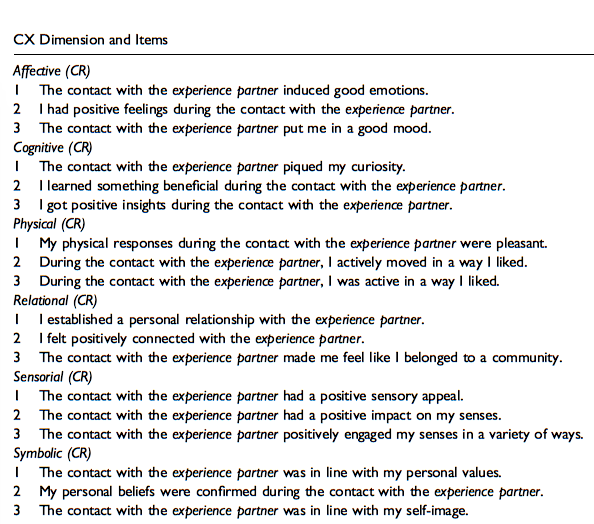
These days I was reading a paper with a customer experience (CX) measurement model in the context of omnichannel, based on a questionnaire with different dimensions and each dimension with its statements. As I reviewed it, I couldn't help but mentally translate the phrases and wonder if the average person in the country where I live, Chile, would understand what we are telling them:
Source: Gahler, M., Klein, J. F., & Paul, M. (2023). Customer Experience: Conceptualization, Measurement, and Application in Omnichannel Environments. Journal of Service Research, 26(2), 191-211.
My hypothesis was: they probably wouldn't understand all the statements.
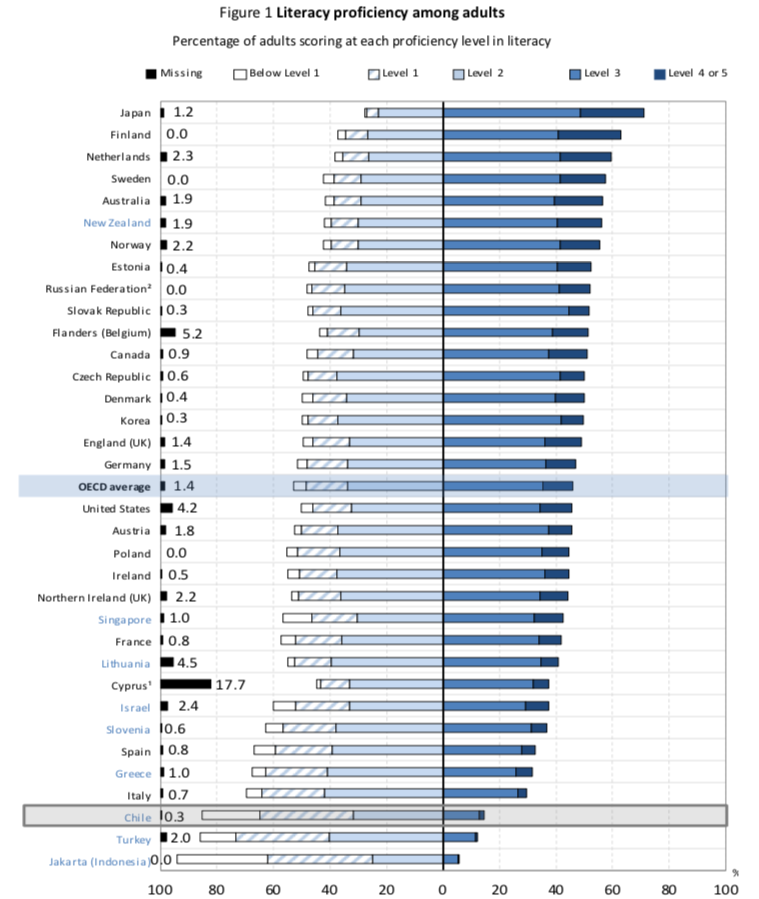
According to the PIAAC survey, only 1 in 60 adults reaches a reading comprehension level of 4 or 5, meaning a high level (OECD data, 2016). The international PIAAC survey of the "Programme for the International Assessment of Adult Competencies is an OECD-led study applied in 32 countries to understand and monitor the skills required by adults to succeed in the 21st-century economy and society" (ref.: MINEDUC).
The results of the latest measurement reveal that the level of adult reading comprehension in Chile is low and below the average of OECD countries. Mexico, the United States, and Turkey are also not spared.
Which countries have high performance levels?:
- Japan,
- Finland,
- Netherlands,
- Sweden,
- Australia…
Where does the research team that proposes the aforementioned CX measurement model come from?: The Netherlands.
Source: OECD (2016).
What does that tell us? That we have a societal problem, a lack of education, but we are not going to fix this issue now; I just wanted to bring it up in this context to remind you that we must be careful when designing our study instruments.
As researchers and professionals in the UX/CX world, we need models and measurement instruments adapted to our (harsh) Latin American reality. Furthermore, for rigor, we must triangulate, just as I did in the first example with the entrepreneurs.
Returning to the initial question (How do we ask questions?), as a UX/CX Research instructor, I tend to remind my students that it is not always appropriate to ask people questions, or at least not as a first resort. Perhaps we should be ingenious and find other ways to answer our research questions, either through objective data or previous accounts (for example, collecting data through netnography).
Objective data is obtained through observation or measurement with a system or device, such as temperature, distance, or waiting time. Subjective data is what we usually collect in qualitative interviews, such as perceptions, attitudes, and expectations.
If we add other factors such as decision-making complexity, cognitive biases, and heuristics to the language factor as an enabler or obstacle in customer studies, it is clear that we need to be strategic, creative, and realistic when designing a research methodology.
If you've made it this far, it's because you're interested in omnichannel customer experience management. Then, you could evaluate your company with our online maturity model.
The original version of this article was published on LinkedIn for the Omnicanalidad en español Newsletter. You know, you can also follow me on that platform.

 By
By