This time, I'm going to delve into my experience testing Abbott's Freestyle glucose sensor. I used the product for personal purposes; that is, no one hired me to do it, but I acquired it out of my own interest.
Everything you read here is narrated from my perspectives as an amateur athlete and as a user and customer experience researcher (UX / CX Researcher). If you work for a company that develops monitoring devices for health, sports, and well-being, what you'll see below may be of interest to you. It can also be useful for people with diabetes or insulin resistance, or for those who want to improve their diet.
What does this have to do with omnichannel? Quite a lot, as you'll realize that, in addition to the device itself, my user experience with the product and the Abbott brand involved different devices, channels, and touchpoints, both physical and digital.
I lead a very active life that includes physical training and practicing various sports, including running, sailing, SUP, and swimming. That's why I decided to venture into a low-carb, anti-inflammatory eating style, following a protocol designed by a health professional.
Aware that my body would require an adaptation period to learn to burn fat, in addition to glycogen (in search of metabolic flexibility), and also wanting to understand how my body reacts to different foods, I decided to use a continuous glucose monitoring sensor.
After a few weeks using Abbott's Freestyle glucose sensor, these are my observations.
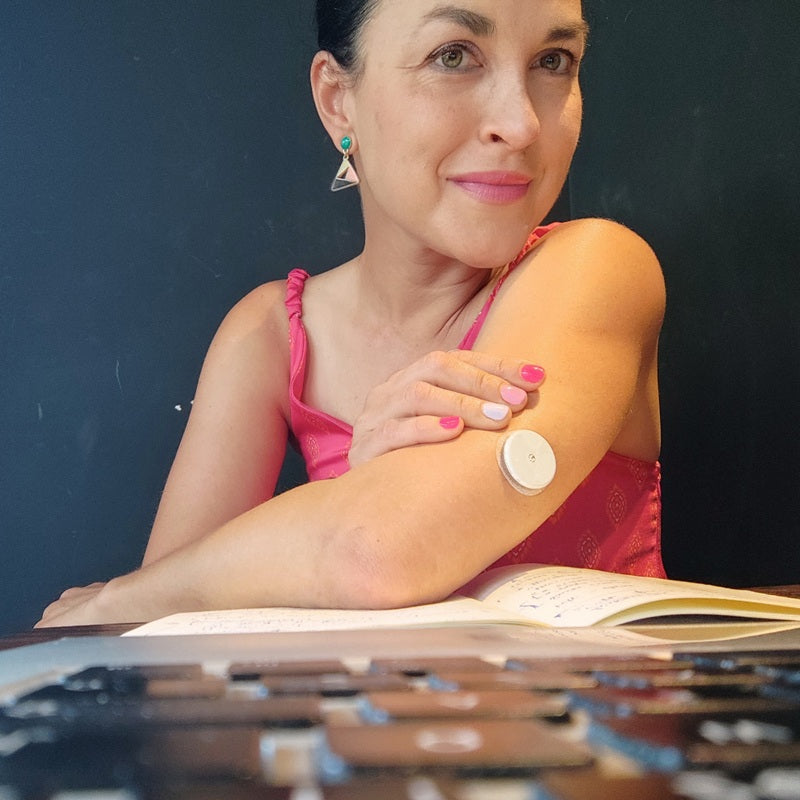
Personal photograph: the sensor applied to the arm.
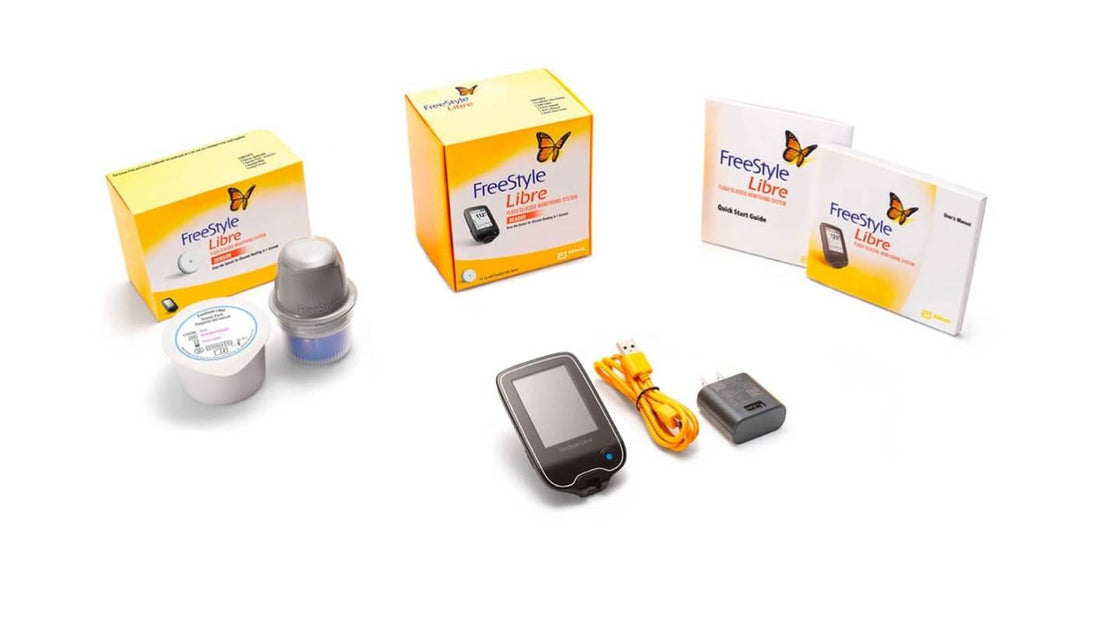
First, I'll explain what the sensor does, according to Abbott's product website:
- "Lasts up to 14 days, takes glucose readings every minute, and stores up to 8 hours of data."
- "The part of the sensor that inserts under the skin is less than 0.4 millimeters wide."
- "To take a glucose reading, simply scan the sensor with the reader, a quick and painless process that takes only one second. This reading provides more information than monitoring done through blood glucose test strips, without the need for routine finger pricks. The FreeStyle Libre system also offers LibreView, which generates a comprehensive report to aid in the analysis of glucose data."
- "The Freestyle LibreLink app is free and allows you to enjoy the same features as the reader but on your smartphone."
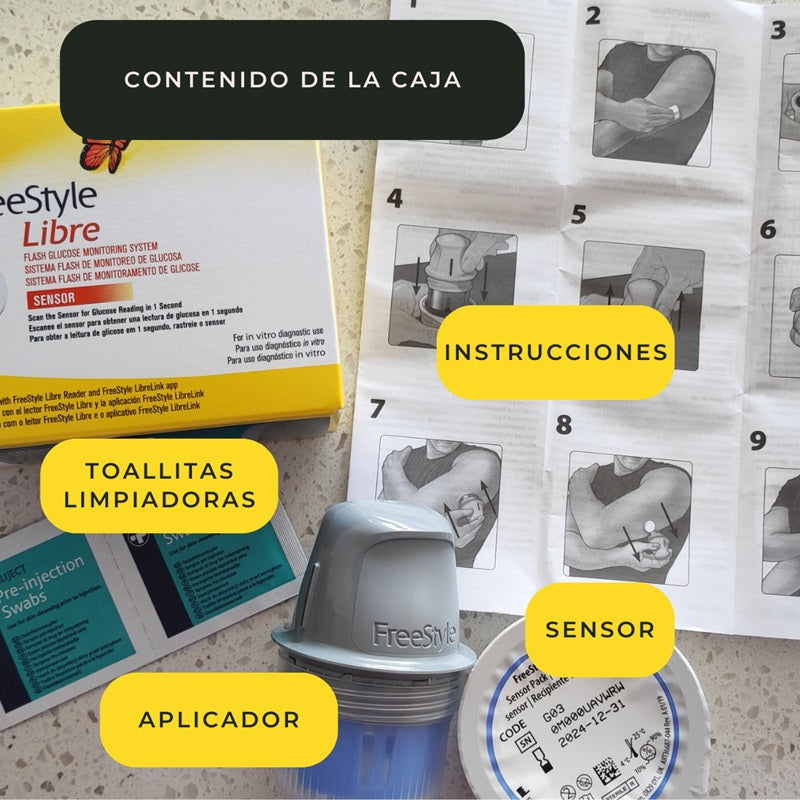
Personal photograph: the contents of the sensor box.
Knowing what it's about, let's look at the benefits or "pros":
- It's very easy to apply by following the instructions. I emphasize that this is very important, considering that not a few people hate reading manuals. Specifically, the sensor is applied to one arm and is quite thin, so you can wear it constantly.
- Blood glucose monitoring is continuous.
- It's very practical because you don't need any other device, except the sensor and a phone with NFC (technology that most smartphones already include). You can also use a reader sold separately.
- Scanning is quick and you don't need to prick yourself, thus avoiding the eventual discomfort of a typical procedure to extract a blood sample.
- For physically active people, it's doubly practical because you don't need to carry other materials and devices while training. Nor do you have to stop your activity to prick yourself.
- You can scan the sensor with your mobile and view the data in the application, even if you don't have an Internet signal. I highlight this because other mobile wellness, health, and nutrition applications (like MyFitnessPal) do need an Internet connection to add data.
- Some health insurance systems may partially or fully cover the purchase of Abbott's Freestyle glucose sensor if prescribed by your doctor.
- You can add notes about your diet or physical exercise. You can also share reports with your health professional. Some notable advantages over the typical finger prick, although keep in mind that the classic device also has software that allows tracking and sharing reports.
- In some countries, the app has alerts (not in Chile, I imagine due to regulatory issues), which seems remarkable to me since you could have potentially dangerous low or high blood glucose levels, which would require immediate medical attention.
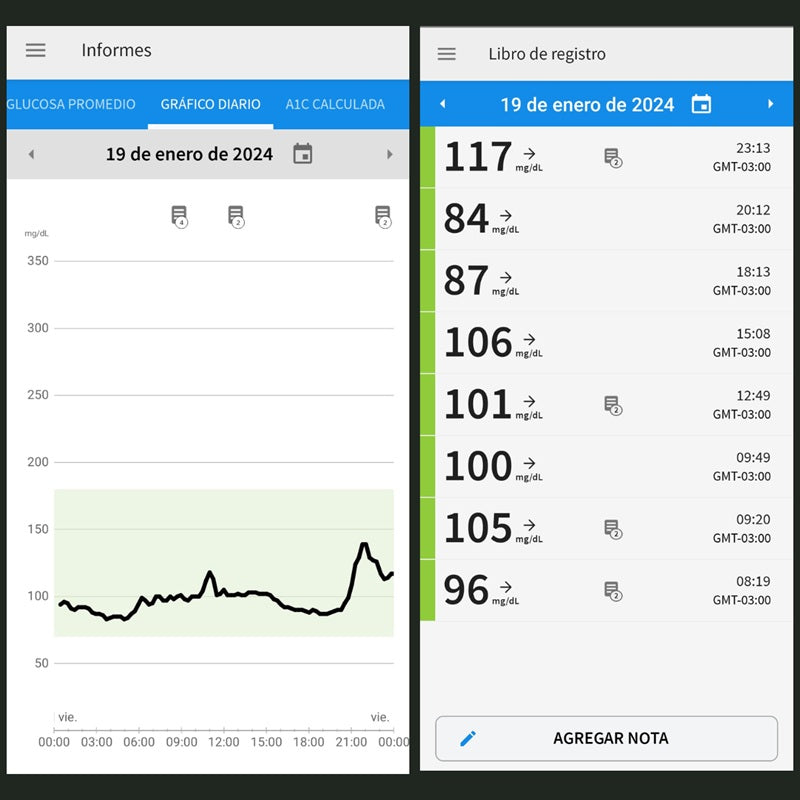
Personal image: example report.
Now let's review some weaknesses or "cons," because nothing is perfect in life:
- The sensor has a very limited lifespan, only 14 days. That is, it's a disposable device.
- The cost can be high, though not necessarily for all users and depending on how often they monitor their glucose levels with other devices that use traditional strips. There's probably a point where the cost of measurement is exactly the same, regardless of the method (sensor vs. glucose strip measurement).
- The water resistance of the sensor is limited. Be careful with that because, according to Abbott's terms and conditions, you can shower and swim but for no more than 30 minutes. I mention this because, in my case, the sensor came off after a few days and had to be replaced at no cost. Therefore, one idea is to cover your arm with plastic wrap (cling film) or another system to make the area waterproof. That's what I did with the second sensor since the first one came off.
Remember that this review was conducted by a user and UX / CX Research professional, not by a healthcare professional. Therefore, my observations are focused on the user experience, not on medical aspects. For any questions and recommendations, you should consult your doctor.
From my position as a UX / CX Researcher, I will comment on the most important points of my evaluation and redesign opportunities to improve the product experience.
I bought the sensor at a pharmacy. For this testing, I analyzed the following channels and touchpoints:
- Abbott's Freestyle glucose sensor.
- The LibreLink mobile application.
- The packaging where the sensor came.
- The reader device (my smartphone).
-
The product website.
- Emails sent by Abbott.
- The people who assisted me at Abbott's call center.
- The pharmacy where I purchased the glucose sensor.
The tasks analyzed were:
- Application of Abbott's Freestyle glucose sensor.
- Initial setup of the LibreLink mobile application.
- Recurring scanning of the sensor to obtain data.
- Annotation of the obtained data.
- Reading of the data provided by the sensor.
As a researcher, consultant, and academic, I highlight the following:
- The importance of testing a device in real-world conditions, because it's super valuable to see how the user behaves in real life, outside the lab. And what are real conditions like? Well, a normal day-to-day that also includes doing physical activities that can be delicate for the sensor (like swimming) or being offline during a flight or when passing through an area without internet while running.
- In conditions like those described, I can say that Abbott's Freestyle glucose sensor and the LibreLink application performed well without internet.
- However, I found the handling of the sensor in contact with water complex. As a hypothesis, I think it could also be complex for people who sweat a lot or wear tight clothing.
- The idea of generating so much medical waste also caused me a bit of "noise," although glucose strips are also waste. Perhaps the lesser evil is to look for a clinical waste bin, which I understand exists in certain communes in Chile. I would be interested if Abbott told me what to do with such waste. I don't rule out that the information is somewhere, either in fine print or a note on the website, but among all the communications I was exposed to, I don't feel that the brand designed this moment. Let's remember that everything is designed, including what happens with a product once used.
- Looking back, a recurring issue is the error the app throws when scanning the sensor, although after a maximum of 2-3 attempts, it always ends up scanning. Other users have reported the same in the app's reviews on Google Play.
Without going into detail about each specific touchpoint, as each would warrant its own review, I would like to "zoom out" on the overall experience.
1- Service at the point of sale
When you have points of sale and service (pharmacies, eventual e-commerce websites or marketplaces), even if they are not your own, you must take responsibility for the complete experience. I understand that it is a complex world in which you do not have control, but I think there are ways to prevent incidents that could affect customer satisfaction, such as buying something unnecessary.
An example of what needs improvement are the available images, so that the person can make a more informed purchase. Let's start from the premise that service at the pharmacy is very necessary, but what happens if they don't proactively inform you about the product's features and operation?
Curiously, at the Salcobrand pharmacy (where I bought the sensor and reader), when I went back to try to return it, they asked me if I had asked before buying. It's as if they had scolded me for not asking enough questions; I found it absurd and inappropriate. It's utopian to think that a customer will ask all the necessary questions, just as it is to think that people read all the instructions.
2- The packaging
From what I just mentioned in the previous point, the packaging, as the first point of contact after purchase, is fundamental for the person who will use the glucose sensor to be sure that they have all the necessary information to understand how it works. I understand that it would be counterproductive for the sale of the reader device (which cost me a lot and I have it lying in a drawer of my desk) but one is left with the feeling of having bought something unnecessary. The sensor packaging could highlight that it is the only thing you need since you can use your own smartphone as a reader.
3- Onboarding
When you create an account in the app, Abbott gets your email address. They could perfectly send a sequence of emails to educate you about using the sensor. This way, they could have prevented me from entering the pool with it unprotected, for example.
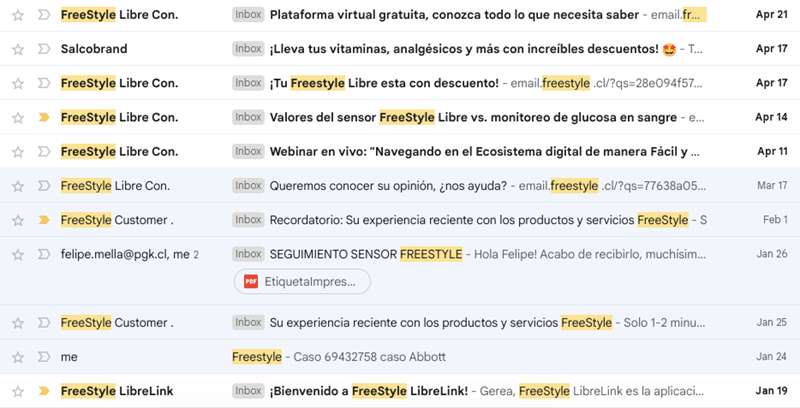
However, I started receiving emails from Abbott more than 3 months after I activated the first device: I activated it in January and started receiving emails in April...
Personal image: screenshot of emails received from January to April 2024.
4- Integrations with other nutrition, sports, and wellness applications:
I mention this aspect because it is important to be able to correlate the glucose curve recorded by the glucose sensor with food intake and exercises performed. As a reference, the Abbott application could integrate with MyFitnessPal for food tracking and the Garmin application for physical activity. Both (MyFitnessPal and Garmin) already integrate with each other.
1- Beyond a single user, we need a very specific use context.
It is essential to test with the following question in mind: Why and for what purpose will our product be used?
For example, here I can call myself an expert user since glucose monitoring is familiar to me. I am not diabetic but I did have insulin resistance for a while. After serious changes in my diet and physical activity, I no longer have this condition.
Additionally, for many years I lived with a diabetic person (my ex-partner) so I learned a lot about glucose monitoring and data reading (at a user level).
My use context - the need to understand how my blood glucose level behaves under certain conditions (food, physical activity) - is particular and different from that of a person with insulin resistance or type II diabetes.
As an extra fact, a few years ago I had to help an Argentine family transport literally a suitcase of sensors and a reader device from Chile to Argentina for their daughter who has type 1 diabetes. It turns out that this device is less invasive for children than the traditional method as it avoids pricking themselves several times a day. If you've read this far, you'll understand that there are many more types of users and use contexts.
2- We need more longitudinal research
Both in industry and academia, longitudinal research – that is, tracking the use of a product or service over time – is often complex because people have low adherence to research processes. Following a group of users over months or years is not a trivial task.
In this case, we see that over 2-3 months I was able to cover the following stages of the customer journey:
- Pre-service: information search about the product, discovery, and purchase.
- Service: applying the sensor and performing the first scans.
- Post-service: contacting Abbott's customer service when the first sensor came off.
However, there is a more relevant stage for this recurring-use product: continuous use and recommendation. Scanning the sensor during the first week is not the same as after a year.
In fact, I stopped using the sensor and have not received any notification from the app, nor an email from Abbott, beyond some content and promotional emails. No one has asked me why I am not continuing to scan the sensor. This type of product seeks adherence, and its use should become a habit, if we look at it from the brand's perspective.
In this context of continuous medium-term use, things can happen such as:
- The person buys a sensor again after a period of pause.
- There is a significant change in behavior patterns or lifestyle habits.
- The mobile device changes and the application must be installed on the new device.
Undoubtedly, when you design this type of product and want it to grow, whether you are a multinational company like Abbott or an innovative startup looking to solve a relevant problem, you have to embrace design as a discipline and particularly experience design.
As a researcher, I always hope that these reports are useful for users of these types of products or others, as well as for designers and brands that create and launch products to the market.
Have you tried these types of devices? What has your experience been like?
If you've made it this far, it's because you're interested in omnichannel customer experience management. Then, you could evaluate your company with our online maturity model.
The original version of this article was published on LinkedIn for the Omnicanalidad en español Newsletter. You know, you can also follow me on that platform.

 By
By