If there is one object that has revolutionized human behavior in recent years, it is the smartphone. The drastic impact of its use on our lives has been studied by sociology, medicine, computer science, and other fields. In this article, we will not discuss "dangers" such as addiction and personality disorders, but rather the virtues or possibilities that smartphones open up for research and industry, which help us know our customers better.
Social computing is the area of computer science dedicated to studying the "computational capacity to facilitate social studies and the social dynamics of people, as well as the design and use of ICT technologies that take into account the social context" [1].
In simpler terms, it's about leveraging the technology around us (mobile devices, social networks, messaging systems, etc.) to study people's behavior as individuals and social beings, in order to identify patterns and predict behaviors.
In Semantics in Mobile Sensing, the authors describe how interest in mobile sensing emerged and its evolution to the present day. Since the 1980s, an entire area of mobile computing and wireless has been dedicated to developing sensors and sensor networks to measure and monitor phenomena [2]. This is what we call "mobile sensing."
In the 1990s, interest in wearable technology grew. But since the mid-2000s, the line between mobile sensing and wearable technology has become blurred, mainly due to the development of smartphones.
Today, these devices have greater processing power and, at the same time, have multiple integrated sensors. Meanwhile, we as users give them access to an unimaginable amount of data about our behavior, especially through social networks and mobile applications.
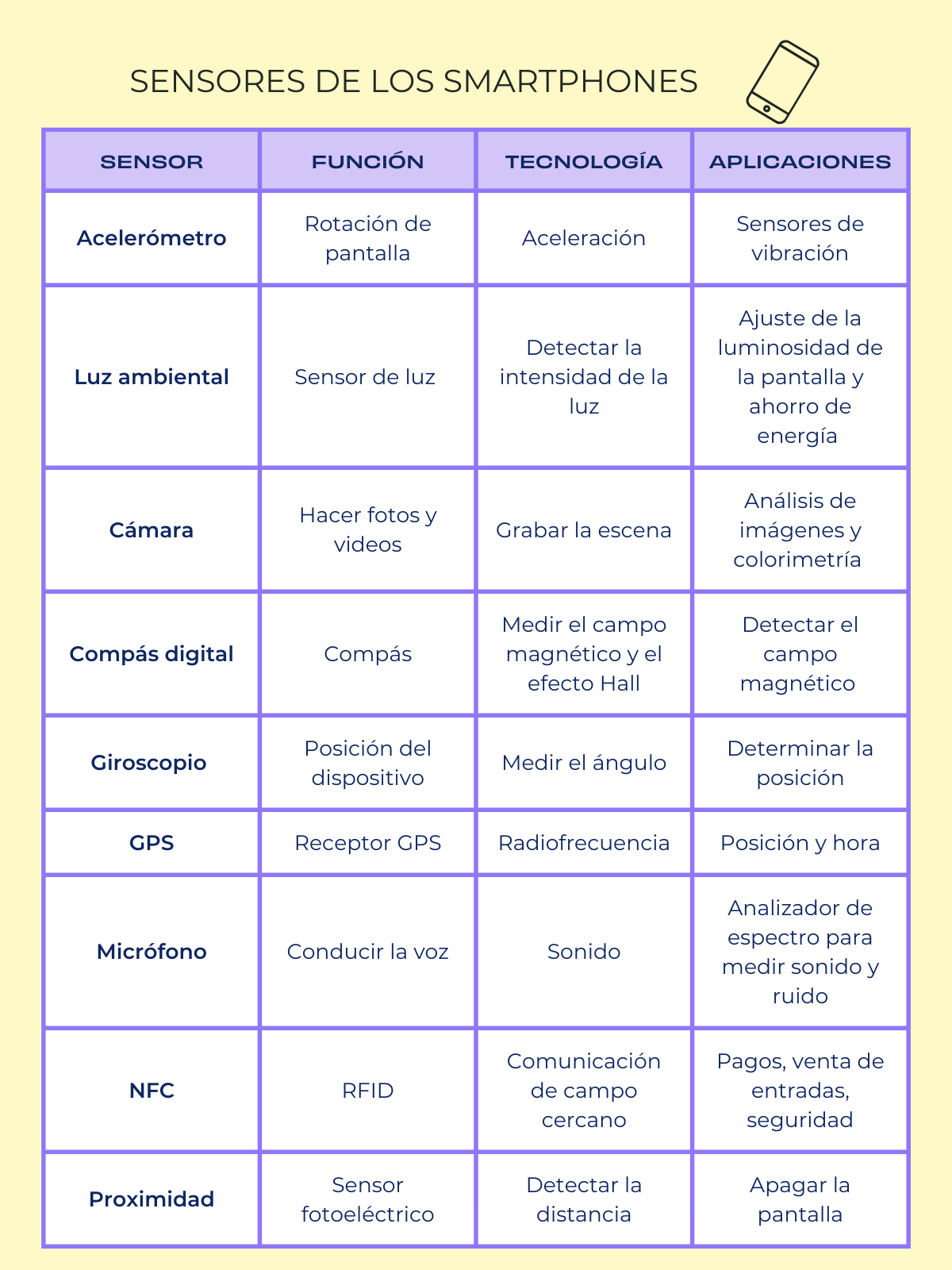
The following table [3] presents some of the most frequently incorporated sensors in smartphones:
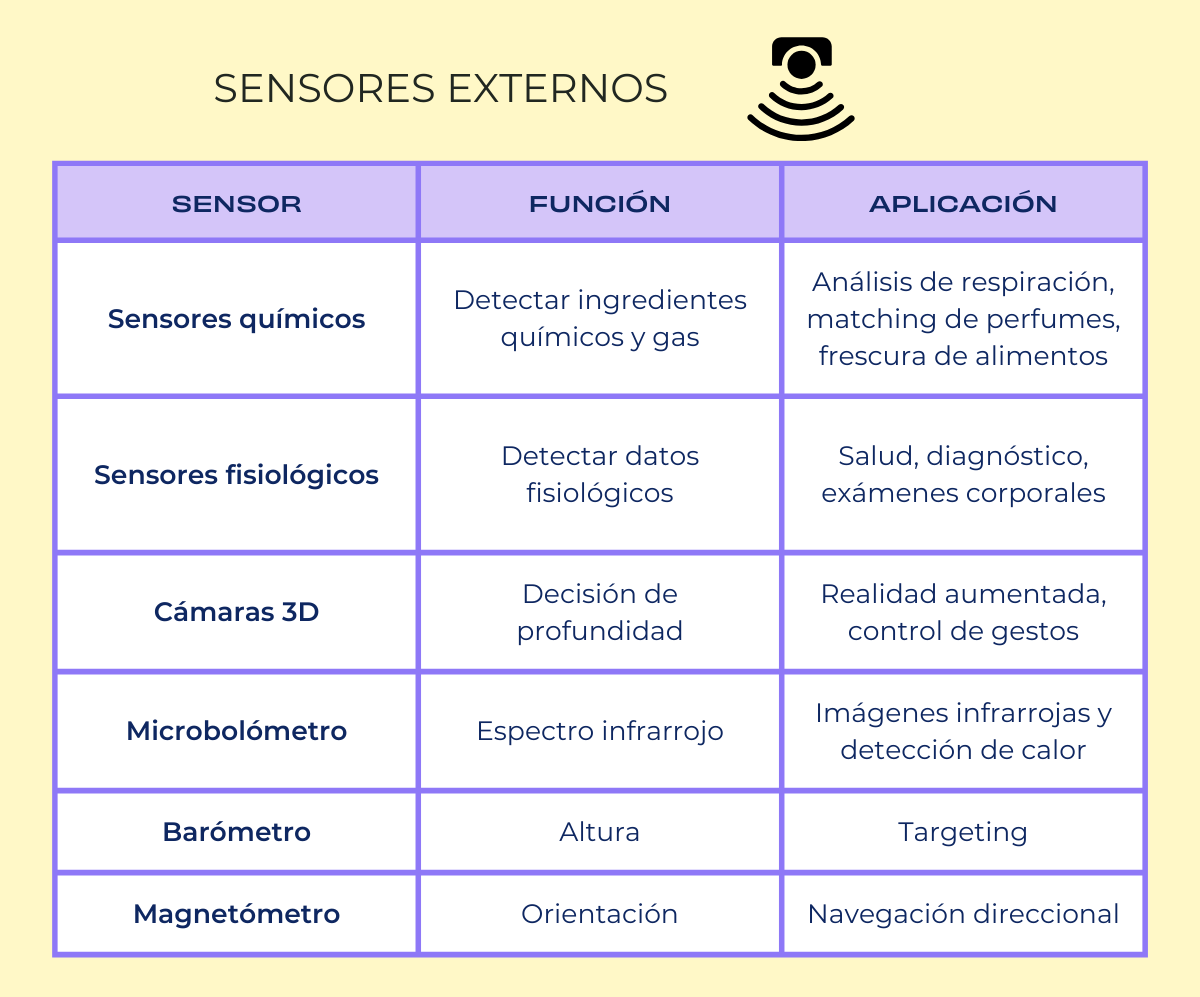
The smartphone's capabilities can also be extended thanks to external sensors that allow measuring and monitoring additional variables. The following table includes some of the most common external sensors [3]:
In another categorization [2], sensors are classified based on their observational properties:
- Spatial and temporal properties.
- Behavioral properties.
- Physiological properties.
At a scientific level, it is already being suggested that these sensors have "the potential to become important allies for data collection during a researcher's work" [4]. In the article Potencialidades de los celulares inteligentes para investigaciones biológicas (Potentials of smartphones for biological research), the authors state that these miniaturized sensors integrated into our mobile phones, which are highly precise, "have not yet been sufficiently exploited."
Although all their advantages and potentials are still unknown, they assure that they can provide important data for studies in medicine, social sciences, environmental monitoring, transportation, and industry.
To these physical sensors or small hardware elements are added "human sensors," which are much more powerful in terms of accuracy and the ability to provide behavioral information, using the social networks we are using, such as Facebook, Twitter, or YouTube.
If you work in marketing or customer experience, you have probably had to carry out quantitative and qualitative studies through in-depth interviews, focus groups, surveys, or by befriending someone from the business intelligence area to analyze large amounts of customer data until late at night. Or perhaps you even thought that neuromarketing would help you understand what is happening in your user's or customer's mind.
Next, we will see some examples of what a cell phone can say about people's behavior.
Let's take a case from the financial world. Understanding how people spend and how couples spend is relevant for marketing, from the point of view of customer acquisition and retention [5].
In a year-long study with 52 people (26 couples), researchers compared the ability of a model based on mobile sensing parameters with a model based on personality traits to predict financial behavior.
For the personality trait-based model, the Big Five questionnaire was used, widely employed in psychology. Previous studies cited by the authors showed that some personality traits, such as introversion, emotional stability, and emotional responsibility, are related to financial decisions.
For the construction of the model, the authors focused on exploration, loyalty, and overspending, and to quantify them, they used the following variables:
- Exploration: they calculated the diversity of brands or places where participants shopped.
- Loyalty: they calculated the frequency of purchases at favorite stores.
- Overspending: they calculated the percentage of expenses made versus the discretionary budget that participants had reported in an initial questionnaire.
On the other hand, for the model based on social interactions, they considered:
- Co-location, which they identified through a Bluetooth scan.
- Call logs.
- SMS logs.
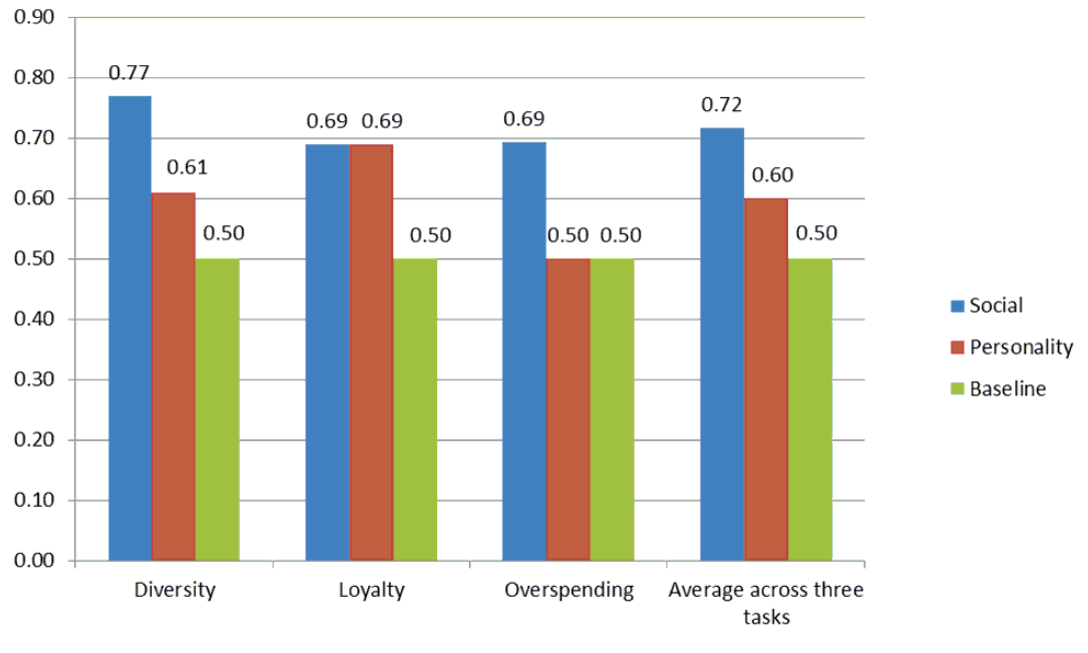
The results show that the model based on social variables captured by the cell phone predicts our financial behavior more accurately than the personality test (72% versus 60%).
"These results suggest that models based on socio-mobile features could capture behavioral traits that go beyond personality variables to explain spending behavior."
As we can see in the following graph, personality variables are even less accurate in predicting overspending (50%), compared to the model based on social interactions (69%).
Source: Classifying Spending Behavior using Socio-Mobile Data. [5]
A practical consideration: to carry out such studies, it is essential to be concerned about privacy, information security, obtain informed consent from individuals, and, obviously, motivate them to participate and share data about their behavior. Interestingly, although in surveys people tend to say they are concerned about privacy, in practice it seems that we are much more generous with our private information [6].
As an anecdote, there is or was a common belief about the number of friends and followers on social networks as an indicator of success (or at least in the restricted circle of marketers) and financial well-being. If this is something that keeps you up at night, you should stop worrying because researchers at MIT Media Lab [6] found no correlation between financial status and the number of unique contacts on social networks and the time spent on social networks:
"Our study shows that, counterintuitively, wealthier people do not necessarily spend more or less time in meetings and calls, nor do they necessarily have more friends or contacts."
That is, if you have better financial status, you do not necessarily spend more or less time in meetings, talking on the phone, and you do not have more friends or contacts.
Taking advantage of this brief overview of mobile sensing, my intention was to remind us everything our cell phone "knows" about us and, in this context, to put into perspective what we already know about the difference between what a person actually does and what they say they do.
Studies on financial habits and our cell phone's ability to predict our behavior are just some examples of practical applications and the possibilities that mobile sensing opens up for us, as researchers and professionals.
What do you think of these findings? Had you considered that your smartphone can say a lot about your behavior?
[1] Wang, F., Zeng, D., Carley, K. M., & Mao, W. (2007). Social computing: From social Informatics to social intelligence. IEEE Intelligent Systems, 22(2), 79–83. Retrieved on November 21, 2023.
[2] Yan, Z., Chakraborty, D. (2014). Semantics in Mobile Sensing, pp. 14. Retrieved on November 21, 2023.
[3] Chen, C.Y., Chen, Y.H., Lin, C.F., Weng, C.J., Chien, H.C. (2013). A Review of Ubiquitous Mobile Sensing Based on Smartphones, International Journal of Automation and Smart Technology. 4 (1). 13-19.
[4] Denis, D., Flores, D. D. C., & Tamé, Y. F. a. F. L. F. (2021). Potencialidades de los celulares inteligentes para investigaciones biológicas - Potentials of smartphones for biological research. Revista Del Jardín Botánico Nacional, 42, 77–91. Retrieved on November 23, 2023.
[5] Singh, V. K., Freeman, L., Lepri, B., & Pentland, A. (2014). Classifying Spending Behavior using Socio-Mobile Data. ResearchGate. Retrieved on November 21, 2023.
[6] Pentland, A. S. (n.d.). Fortune monitor or fortune teller: understanding the connection between interaction patterns and financial status – MIT Media Lab. MIT Media Lab. Retrieved on November 21, 2023.
Dinev, T. (2014). Why would we care about privacy? European Journal of Information Systems, 23(2), 97–102. Retrieved on November 21, 2023.
Pearson, C., & Hussain, Z. (2015). Smartphone use, addiction, narcissism, and personality. International Journal of Cyber Behavior, Psychology, and Learning, 5(1), 17–32. Retrieved on November 21, 2023.
Wang, T., Chen, W., Wang, X., & Fan, X. (2023). Smartphone use increases the likelihood of making short-sighted financial decisions. Journal of Pacific Rim Psychology, 17, 183449092211477. Retrieved on November 21, 2023.

 By
By