Developing an e-commerce business doesn't necessarily mean creating your own website. For many years, almost since the dawn of the internet, marketplaces have existed. They started as retailers selling products acquired from suppliers and then began to host entrepreneurs who wanted to set up their online stores, as we explain in our guide to selling on marketplaces.
You can also watch and listen to this article in podcast format
At FREED, we have supported clients who needed to improve their positioning on these platforms, which are almost a world apart, as we explained in the article Local marketplace: what you should demand as a seller. Now we want to take a more global look at marketplaces and analyze their advantages and disadvantages, in order to guide you if you are thinking of starting an online business and are not yet convinced by the idea of setting up your own e-commerce site.
Additionally, I have created my own stores on marketplaces, so what you will read here is my perspective as a seller, as a mentor who has supported entrepreneurs in Chile, Peru, and Central America to create their own sales channels, and also as a consultant.
Get our analysis in your inbox
Subscribe to the FREED newsletter: applied research, trends and tools.
No spam. Unsubscribe anytime.
What is a marketplace?
Perhaps you're not entirely clear on what a marketplace is, so let's start with the basics and look at a simple and clear definition: a marketplace is a space where supply (sellers) and demand (buyers) for products or services meet through a third party, the marketplace.
In other words, the marketplace creates a space where basically anyone can open an account to start selling. Although it's not that simple in reality, marketplaces have indeed lowered the barriers to entry for e-commerce by not requiring significant investment, for example, in developing one's own site and integrating it with services and payment methods, because the marketplace handles all of that.
Today there is a wide variety of marketplaces, and undoubtedly the most well-known globally is Amazon, which has 12 of its own marketplaces, over 120 logistics centers, and millions of customers in more than 180 countries. Likewise, in each country where it has a presence, it operates as a semi-independent platform.
But there are also Ebay, Etsy, AliExpress, Alibaba, etc. There are many B2B marketplaces that offer their products and services to businesses, and there are others for services like Airbnb and Upwork. I haven't forgotten Latin America, where we have our star marketplace: Mercadolibre, which has exceeded all expectations, especially since the COVID-19 pandemic. Today it handles practically the entire purchase process, including logistics, and now it's time for it to take the leap to incorporate more services in Central American countries, such as online payment.
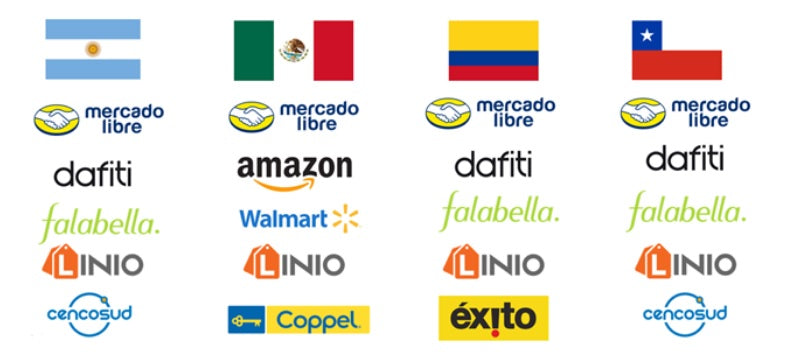
And there are many more marketplaces at the local level, in each country:
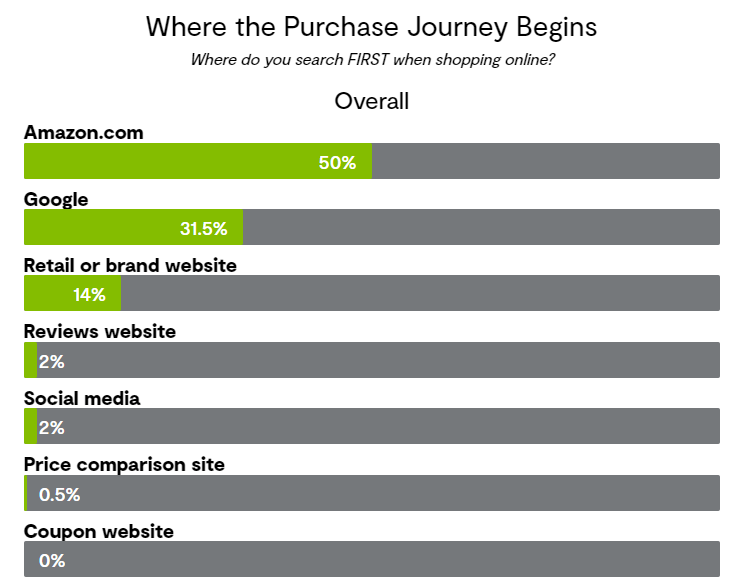
In general, when it comes to purchasing a product online, most shopping journeys begin with a search on a marketplace, far surpassing Google. This is shown in this chart from a survey conducted by PowerReviews in the United States in March 2023, which represents people's responses to the question "Where do you first search when shopping online?". Amazon is the starting point for 50% of respondents, followed by Google with 31.5%:
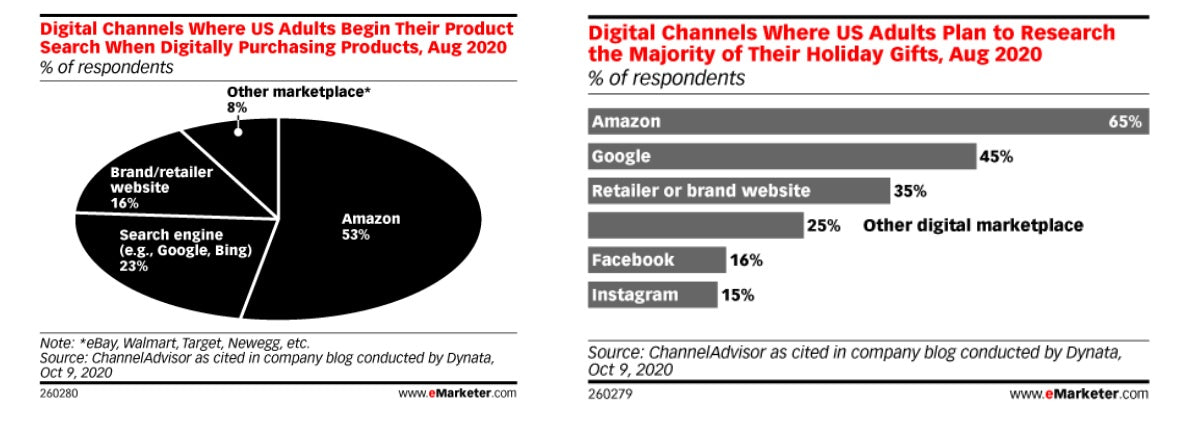
Another Dynata study cited by eMarketer showed that 53% of searches for purchasing a product online in the United States begin on Amazon, and for holiday gifts in late 2020, this preference rose to 65%.
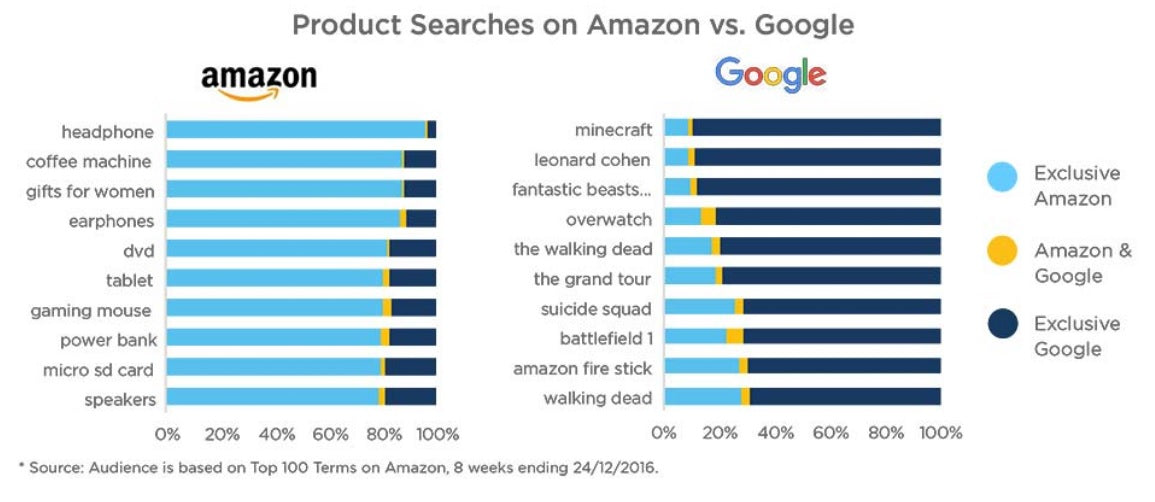
Now, this is quite relative, which is why we want to emphasize something we already said: the market share of searches depends on the product category. That is, Google dominates in other areas, as we can see in these comparative graphs. It is evident that Amazon captures most searches when it comes to certain technology products, home appliances, audio, etc. For its part, Google has a greater share of the search market in other categories, and there are also some that are shared.
When we say it's exclusive, it's because the journey begins and ends, for example, on Amazon. But there are also experiences where there's a mix of channels because not all shopping journeys are linear, given that the customer doesn't always decide immediately and chooses to visit other sales channels.
And this relationship in product searches between both giants has been constantly evolving if we compare 2015, where Google concentrated 54% and Amazon had 46%, and 2018, where everything was reversed, leaving Amazon in the lead with 54% and Google with 46%.
Pros and cons of developing a presence in a marketplace
It is true that thanks to marketplaces, there are more market opportunities to launch a brand and grow an online business. However, as in everything in life, there are pros and cons to developing an online store to have a presence on one of these platforms.
Let's start with the positives. This is what's interesting about being on a marketplace.
Pros of marketplaces:
They invest in marketing and branding.
They have a recognized brand that generates trust.
They attract a high flow of customers, including from other countries if they are international marketplaces, because they have been operating for a long time.
They are well-positioned in search engines like Google because they have a lot of content and products published. So, if you search for a particular type of cushion, for example, it will surely appear high in the search results.
There are few barriers to entry for a new seller to:
create a store,
add payment methods,
start publishing their products,
manage orders,
serve customers.
If you want to start your own e-commerce site today, even on a hosted platform like Shopify, WooCommerce, or Jumpseller, it would at minimum require design, development, adaptation, and service configuration work. In other words, even if you use a basic template, it's not enough to just put your logo, upload your products, and publish some content. And on a marketplace like Etsy, for example, those barriers to entry don't exist because you don't have to create the technological infrastructure to launch your online store, and that's very valuable.
But, obviously, there are some disadvantages to being on these marketplaces.
Cons of marketplaces
Lots of competition. This is the most significant disadvantage because when you open your online store on any of them, you immediately enter into competition with many other brands, of all sizes and from different parts of the world. This is reflected in the fact that when a customer performs a search, they will find many results showing similar products. In other words, the supply is very large.
Commissions. One thing compensates for another: you don't have to invest in developing the platform, but a marketplace will charge you a commission on the sales you make, for monthly subscriptions, per product, etc.
Risk of cannibalization of your own sales channels. If you put your online business's products on three marketplaces, when a customer searches for them on Google, all those options will appear because they will be well-positioned. The dilemma is whether this adds up or creates competition between your stores.
The marketplace may have its own products that add an additional level of competition. This is a criticism especially leveled at Amazon, which, upon seeing a product that works well, releases its own version, usually at a lower price, because it has greater negotiating power than a small brand to obtain good rates. Incidentally, they will work to position their product on their own platform, so when customers search, they will likely see the marketplace's own offers highlighted more, because that's where they earn the most profit.
As a store owner:
You don't have full control over data, such as traffic (where visits come from, what they do, where they get lost in the conversion funnel, etc.). Large marketplaces do give us traffic and conversion data, but it's more limited than what we would get if we had our own e-commerce site.
Sometimes you can't contact customers directly or put your brand on the packaging. They might prohibit or restrict it. This happens because the marketplace owns the data, and although it sounds harsh, that's business, and data is valuable.
You cannot integrate some external services, such as Instagram Shopping.
You have no control over the design, functionalities, and checkout of your online store. You can put your logo and your photos, but you must comply with the marketplace's guidelines. And you couldn't make modifications to the checkout to make it simpler, for example.
If you are new to it:
It can create a false expectation that it's easy, that you just have to publish the products and customers will come on their own. While large marketplaces have their own audiences, in the end, you compete with many other brands and must make continuous efforts to make your products discoverable within the category, through the internal search engine, so that customers reach your brand.
You may find management complex (but what isn't in e-commerce?). It's a matter of discipline, of familiarizing yourself with the particular operation of the platform and its concepts. Even if you want to sell on Amazon's various marketplaces, many of them are not merged, so you have to upload products multiple times, serve customers through different contact points, etc. And if you also have your own e-commerce that is not integrated with the marketplaces, it obviously requires more time to manage each sales channel. Today there are platforms for multichannel management, but that comes at a price, and you must first validate whether the increase in operating cost translates into more efficient work for your online business.
Local marketplaces
Pro: They are recognized in the local market. People know them, trust them, and have local payment methods, versus an international marketplace that may not be well-positioned in that area. In other words, they help capture local demand.
Cons:
If they are new, they may not have a real technological advantage. Especially amidst the COVID-19 pandemic, many marketplaces have emerged, some niche (only for home, food, children, pets, etc.) and many of them, being new:
do not yet have a high degree of maturity and
do not offer metrics.
They may not have a marketing and commercial advantage:
Being new, they generate little traffic.
They need many sellers and buyers to reach a critical mass of transactions. If a customer enters a category and sees little variety of products to choose from, they will not trust the platform as much.
The customer experience is not refined.
Other complexities
In managing several national and international sales channels:
Price transparency: It becomes complex to sell globally at a higher price than locally. With more and more people connected to the internet and social media, it's very easy to see price differences. If you like to browse and compare prices, it's very easy to find the cheapest option. Therefore, you need to know how to manage, for transparency reasons, if you want to have a lower price locally and a higher price internationally. For example, you could manage this through discount coupons for local customers or with shipping costs.
Stock management. If you have few units of a product and offer it on different channels, you run the risk of selling units you don't have available.
Content management in multiple languages. While there are automatic translation options, it is always preferable to do them manually and keeping in mind that you are addressing people from different cultures. Having to translate your product sheets into two or three languages implies more work.
Management time. Especially considering that you have different sales channels that are not connected: a physical store, your own e-commerce, stores on marketplaces, etc. You must take your time to integrate and optimize management, especially in your online store, which is what works best right now.
These barriers add to the typical challenges of e-commerce in Latin America:
Logistics:
Long distances, few and poor logistics solutions.
International shipping services:
slow and with poor or no tracking (national postal services),
high rates (international providers like DHL, UPS, Fedex).
Possible solutions:
Include the shipping cost in the product price to be able to offer fast shipping with tracking,
Use services like Amazon FBA, where the marketplace stores our product in its warehouses and handles shipping. But this is recommended once the market-product fit has been validated; once you know there is a market for your online business, a segment of customers willing to buy the product.
Payment methods:
While there are more and more electronic payment methods locally every day, it is difficult to find solutions for cross-border e-commerce:
Solutions that easily integrate with international e-commerce platforms. There are countries where you can easily withdraw your earnings from PayPal, while in others the costs are high, and local payment methods that cannot be integrated into some platforms like Shopify, for example.
That work at a local and regional or international level. In the end, you must have several payment method providers to cover as many customers as possible.
Possible solutions:
Virtual accounts or cards through providers like Payoneer. This way, your earnings reach your local current account through this other cloud-based account.
Opening an account in the United States (a more complex option).
I tell you all this so that you consider it as part of an online business; I am not saying that you should not open your online store on a local or global marketplace. It is necessary to know in advance what can happen to have adequate measures to counteract the limitations and disadvantages.
How to select an international marketplace?
Understand how the marketplace works. For this, I recommend that you first try it out as a potential customer. Browse its categories, see how the search engine works, and try to understand what criteria it uses to suggest product options.
Study the product categories according to your brand and research the existing competition. Some platforms allow you to quantify this, what it means to have 5,000 products, is it high or medium competition, etc.
Experiment and take some time to analyze the results achieved versus the effort dedicated: if you have made continuous improvements and your effort has been sustained, if you have carried out digital marketing actions, if you have measured the effects of your actions, evaluated areas for improvement, paid attention to your competition, etc. After that, combining data with intuition, you must make a decision:
continue adding products and developing the brand,
change direction (you are in an unsuitable category) or
withdraw.
You must give yourself space to open these cycles and close them with a conscious decision. Don't let your products expire on the platform or your subscription end; you must stay on top of it, don't forget about the business once you've created your account, and evaluate after a period of three or six months or a year, depending on your journey.
What to do after validation?
If you've done well and there's a future for your products and brand within this market, the next step could be to create your own e-commerce to diversify sales channels. Companies that successfully validate market-product fit usually do this: continue with the marketplace and generate their own sales channel, or close the online store on that platform to focus all their efforts on the brand's e-commerce site.
For example, if you have 300 products and see that 50 are doing well, stick with them on the marketplace and continue with the others on your own e-commerce.
Do you have your online business on a marketplace or are you just considering opening an online store on one of these platforms? Do you prefer to have your own e-commerce or do you think it's better to bet on a marketplace?
Share this article
Follow us on YouTube
Nuevas Economías, Research Thinking and FREED AI Studio: conversations and analysis on business, technology and human behavior (in Spanish).
We teach you how to publish on a marketplace by improving your titles, descriptions, and photographs so that potential customers can find your products.

 By
By