Continuing with the idea of exploring the application of usability tools and techniques in a clinical context, this time I want to tell you how to approach a user experience investigation or UX Research. If you want to go back a bit, in the article Usability, design and user experience (UX) in healthcare you will find concepts and also the importance of design and usability in the development of technological solutions for this sector. So, now we can see how to design and implement people-centered technological solutions, continuing our guide to UX and usability in healthcare.
The process of designing and implementing technologies for people is a continuous and evolving one, where three main stages can be identified:
- One is before designing or implementing. Before starting, for example, to make the first prototypes or write the first lines of code, things should happen to ensure we are on the right track, and for that, we must involve users.
- Then, during the process, we should also continue to involve the user.
- And finally, after launch, any solution is subject to evolution because it should continue to adapt to people's needs and adjust to a new context of use, such as a new team of users joining different realities.
Let's analyze each stage:
We need to start by identifying users and mapping the relationships between them. Basically, this process involves understanding the types of users in each target group.
For example, if our system involves nursing assistants (Tens) and administrative staff, clearly not all Tens are the same or will behave in the same way; nor is all administrative staff the same or live in the same context of use, nor will they behave in the same way. Therefore, it is important to identify these patterns.
We will almost always start with an exploratory study or a hypothesis or problem validation. For example, if we think a process is complex, this is a hypothesis until we can prove that it really is complex.
Now, how do we carry out this first stage of information gathering? We usually use qualitative and quantitative methods. Qualitative because we are interested in understanding how things are, why they happen, how relationships between people are articulated, and quantitative because we will also want to quantify how important something that is happening is.
At this point, we will want to deepen our understanding of the tasks of each of these types of users we have identified, both their current tasks and those we want them to perform in the future with the system we are designing.
For this, we will prototype and test with our prototype. Eventually, we could do holistic analysis or expert analysis; the latter would be in the case that we need to improve an existing interface and not create something from scratch.
This means that, in addition to testing with the system's users, we will ask a user experience and usability expert to review the interface, in order to identify gaps. In addition, they will be able to conduct usability tests with current users, considering that some may already be accustomed to the system or that the system must also be used by people who will join the team in the future.
This is a way to balance use between old or recurring users and new users.
Once the system is up and running, we will want to evaluate usability or user experience over time. This includes satisfaction and the degree of adoption of the new service by the target user, as well as the impact generated. It all depends on the system's purpose, but this impact can be related to, for example:
- reduced waiting times,
- a drop in the error rate,
- greater proximity to the patient,
- less staff fatigue,
- less management time, etc.
Typically, any project of this nature starts from a problem or a problem hypothesis, or it begins in an exploratory manner. This means we have research questions, things we would like to validate.
Based on the research questions, we will define the methodology, that is, how we will investigate; basically, how we will approach people.
And from the methodology, we will define the methods, instruments, and tools. For example, what suits us best:
- conducting interviews,
- on-site observation,
- consulting clinical records,
- conducting a case study,
- analyzing transaction logs,
- analyzing user comments and complaints, etc.
Understanding people and context
To design, we first need to understand people and the clinical context: their routine, contextual factors, what system they are currently using, what is important to them, what motivates them, and what they expect.
Therefore, when defining for whom we are going to design this new solution, we need to identify the users and the relationships between them. In this sense, we usually work with what is called user persona or user archetypes or user profiles.
You will see this tool in different bibliographic resources or use cases with some of these names, but basically, it is a way to systematize characteristics of real users.
They are not imaginary users; they don't arise because we believe that a certain patient profile meets a specific group of characteristics; they are the result of the research we conduct with people and the systematization of the findings, data, and information we have collected in the field by observing, surveying, interviewing, etc.
This work is usually ethnographic and, generally, has a good part of qualitative components. Why? Because we are interested in understanding the differences that arise between people.
Let's do an exercise. If you thought of:
- A man born in 1948,
- raised in Great Britain,
- married,
- successful and wealthy,
- has at least 2 children,
- loves dogs,
- loves the Alps...
Who could that person be?
If we rely solely on quantitative data, these two people meet the characteristics I just mentioned:
Source: This exercise comes from This is Service Design Thinking, Stickdorn & Schneider, 2011.
However, it is obvious that in their daily lives they will have different needs, different behavior, and different mental frameworks.
That's why we can't put everyone in the same basket, and generally, when we do very quantitative studies, where we talk about sociodemographic profiles, ages, and this type of segmentation, many important attributes are often left out.
For this reason, we use this systematization through user personas or archetypes.
Let's look at their definition: user personas or archetypes are fictional users that gather common characteristics observed in study subjects during a research process, and serve as working tools for designing people-centered product and service solutions.
In other words, they help us always keep the user in mind and direct the functionalities of a product or service we are designing towards the specific needs of people and according to their context of use.
Archetypes can come from a process of systematizing qualitative or quantitative data, or both.
However, it must be very clear to you that they are not customer segments as traditionally defined in marketing, i.e., with more sociodemographic criteria.
So, who are these users? Beyond identifying the user archetypes for whom we are going to design, we need to map all the other stakeholders who interact with this user. For example, think about the different roles of:
- nurses,
- nursing assistants (Tens),
- doctors,
- those responsible for purchasing supplies,
- the technology manager,
- the patient,
- the caregiver,
- the main user's closest networks, such as their family, etc.
Often, the users considered by a technology provider are not only the end-users of a solution, but also people involved in its design, even if they are not the ones who will use it.
Therefore, what we seek with design is to take care of the end-user but also to understand their entire circle and map the other stakeholders who have some influence.
In practice, how will we research users?
By employing a qualitative method such as:
- In-depth interviews.
-
On-site observation, participant or non-participant.
-
Shadowing: basically means following a person for a certain period of time to understand their actions, role, and daily routine. For example, if we wanted to develop a solution for someone who makes home visits, shadowing would involve accompanying this person for a certain number of sessions, from when they get in their car, while they drive through the city to reach their patient, being present during the visit, and finally, going to the car to see if they need to do any tasks like taking notes or communicating with the hospital. And so on, following the user to another patient's visit.
-
Artifact analysis: taking photos, showing how the person organizes their desk or, in the case of a home visit, how their car is, the quantity of supplies they need to carry, how many documents they have to fill out, etc.
Obviously, we also have quantitative methods such as surveys or transaction log analysis.
Regarding the latter, it is worth explaining that there are systems where a certain amount of information is entered during the day, and from there, data can be extracted that allows us to understand user behavior, how much time is required for each task, which steps people get lost in those flows, etc.
The ethnographic method in human-computer interaction and collaborative systems explores the nature of work to support system design, with a focus on how people characterize their work.
It also pays attention to the language used in interaction, re-evaluating invisible work. Often, when we conduct this type of on-site data collection, observing people's actions, we realize that there is much more work and many more roles than we initially mapped.
That is, behind certain types of services, there is an articulation between people who are sometimes invisible to those managing a project or a hierarchical superior, or to those who generate reports in different institutions. There is always much more behind what one perceives.
Next, let's look at some design methods and tools that help us systematize what we learned in this information gathering stage, before designing a solution.
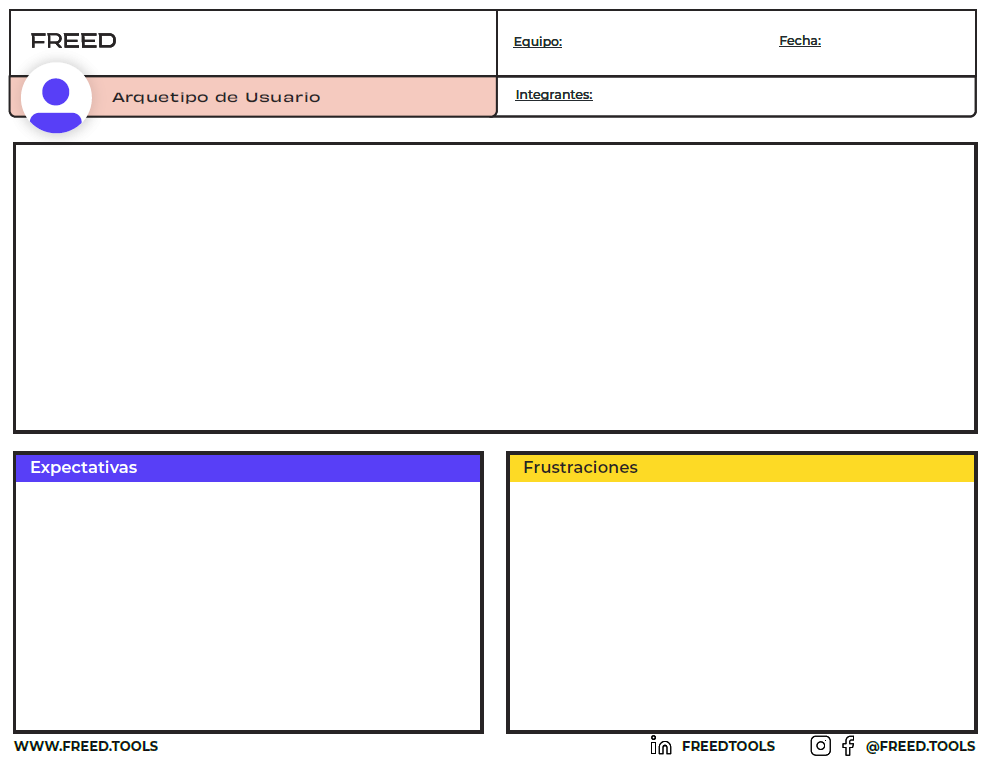
One way to systematize the characteristics gathered about user personas or user archetypes is through these cards:
These cards collect people's characteristics and help us identify them, so that in the future we design our products and services with this user in mind.
It's good not to rely on more than five user archetypes, because if we were to characterize ten types of patients, it can be very overwhelming to use during the design process.
It is difficult to make ten micro-segments with different characteristics, so we have to try to group them, looking at parameters that go beyond sociodemographic variables, such as their objectives, their relationship with technology, their habits, etc.
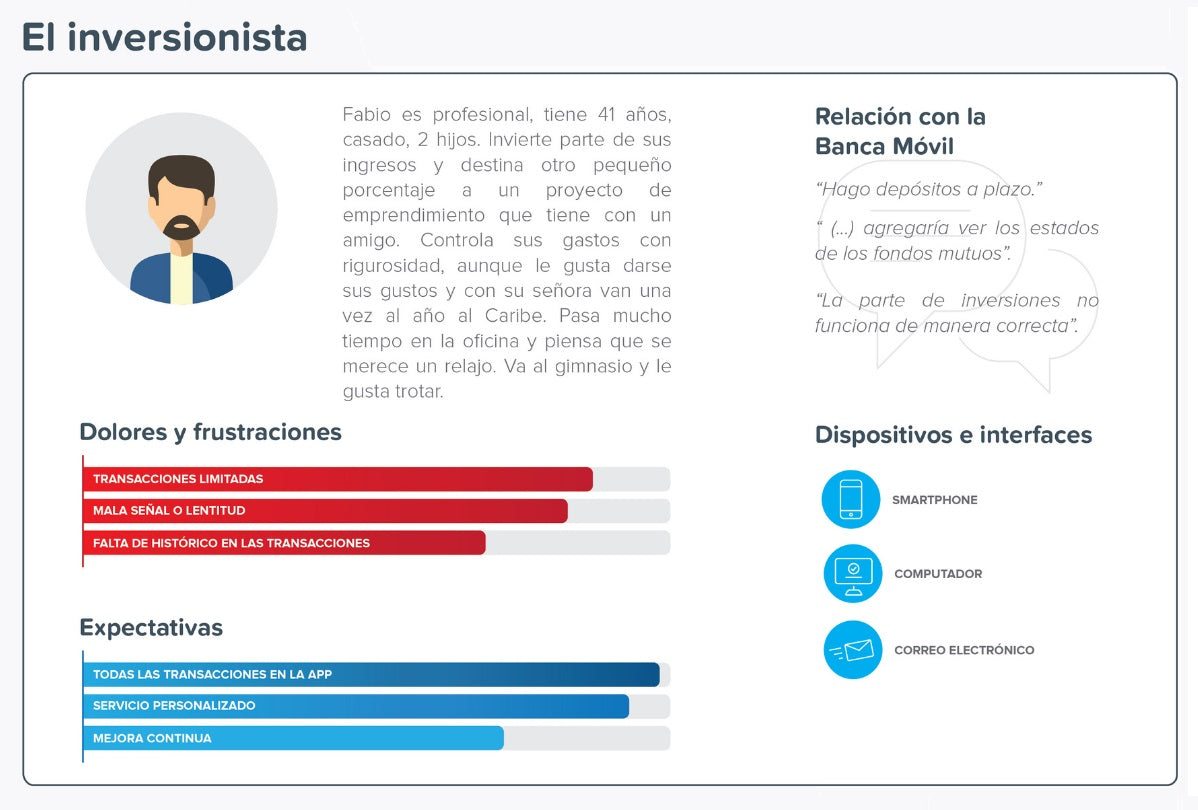
Generally, the cards are quite similar to this archetype we created for a study on mobile banking applications in Chile:
The card should collect characteristics that respond to the project's needs.
For example, if I am looking at people with a chronic illness and I am interested in differentiating between someone who recently acquired the illness and a person who has been living with it for 20 years, I can add this variable to the card so that, when designing, I can take this differentiating factor into account.
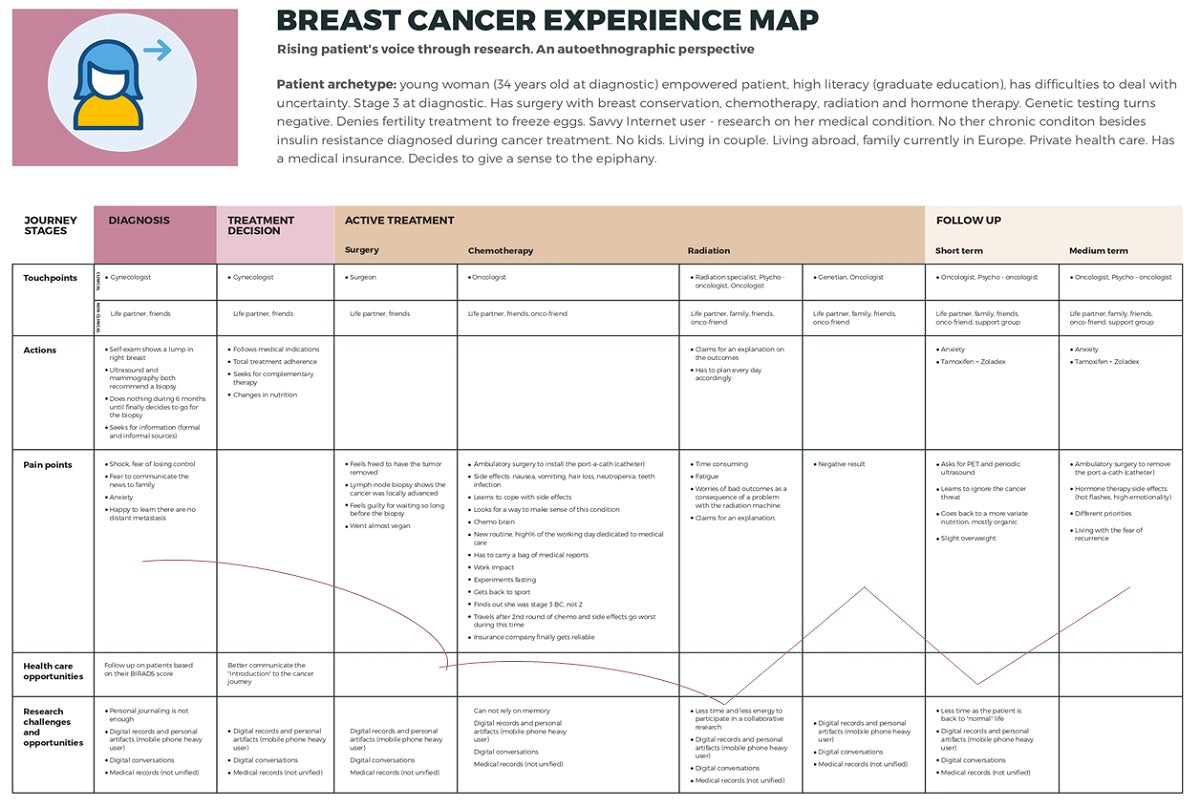
Once the user archetypes have been identified, we need to understand their journey with the service, and we do this through a user journey.
Source: self-made
In this case, we have the example of a patient's journey where we see:
- the different stages of their treatment,
- the touchpoints with the healthcare system,
- the actions they perform,
- the pain points,
- a graph showing the highs and lows in their experience, and
- finally, opportunities for the healthcare system, i.e., what improvements we can make to reduce that gap, especially when there are significant pain points.
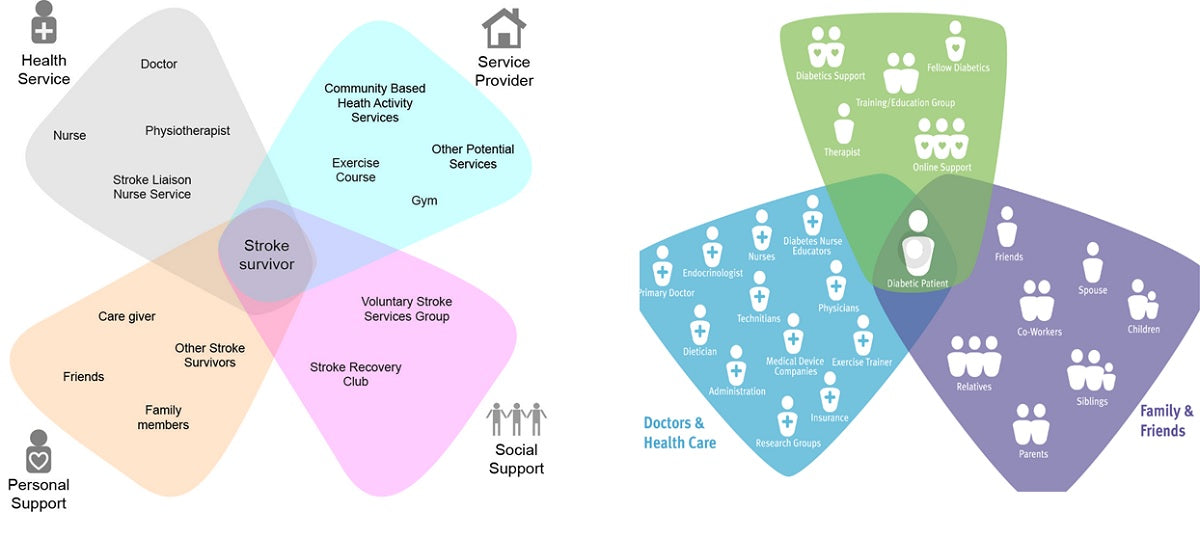
We can also visualize a stakeholder map to understand the relationships between each of the user archetypes we have identified with their close or less close circle, and the people they interact with in the healthcare area.
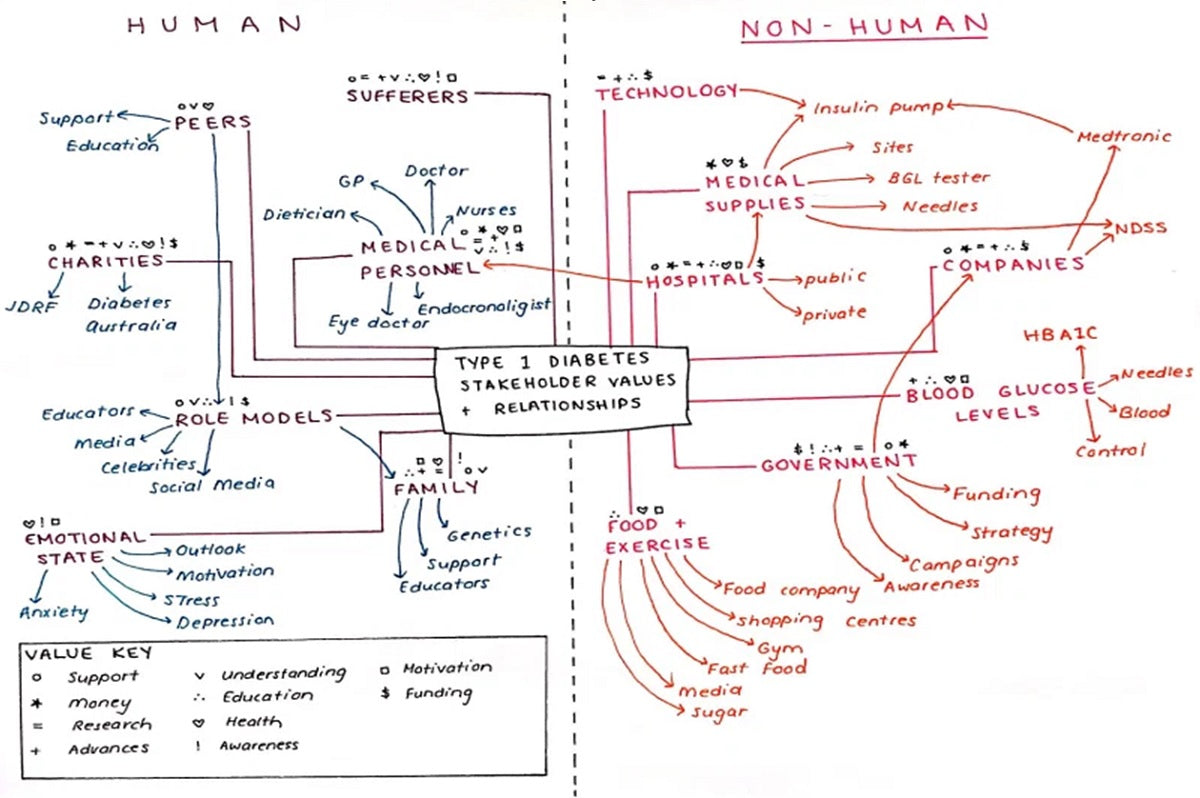
Here we have two different examples where we show more than anything a design choice of how we are going to display it, but the most important thing is what we want to communicate and, above all, how we are going to use this information to design in a next stage.
This other example is about a diabetic patient and their relationships with people, with their parents, with medical staff, with family, but also with the government, different technology tools, medicines, hospitals, food, exercise, etc.
Source: Emergent Practices.
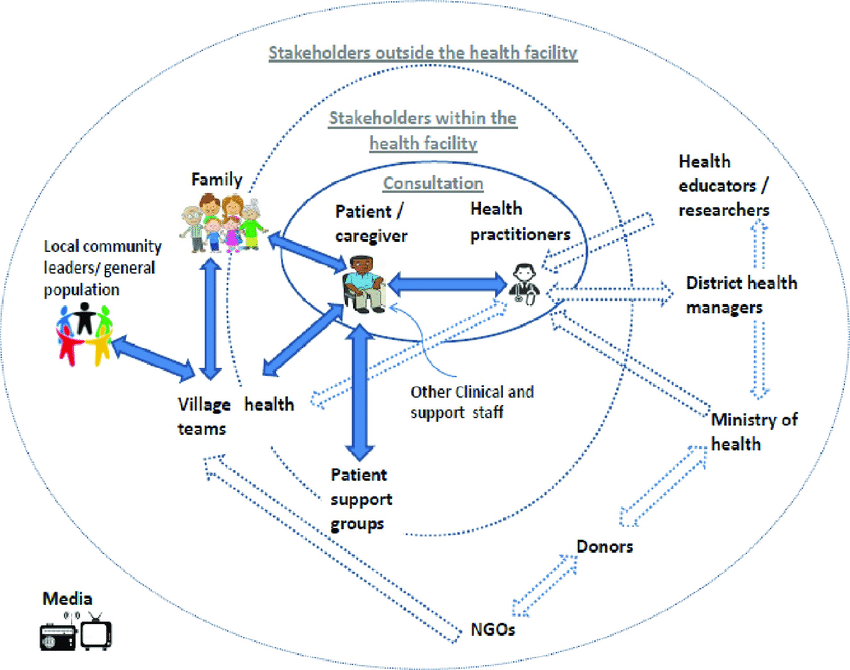
In this other stakeholder map, we can appreciate the relationships between the primary healthcare system and the patient.
We have the patient, their close circle, family, local food, and the village. It is an example of a primary care model in rural Uganda where we also see the NGO, donors, the Ministry of Health, and even the media.
Stakeholder perceptions of patient-centered care at the primary health care level in rural eastern Uganda: a qualitative investigation. Source: ResearchGate.
Have you had the opportunity to conduct UX Research in healthcare?
I will continue to develop the topic of UX Research in healthcare in other articles that I will publish soon, so stay tuned to the FREED UX Experience Blog.
Cover image by Sharon McCutcheon on Unsplash
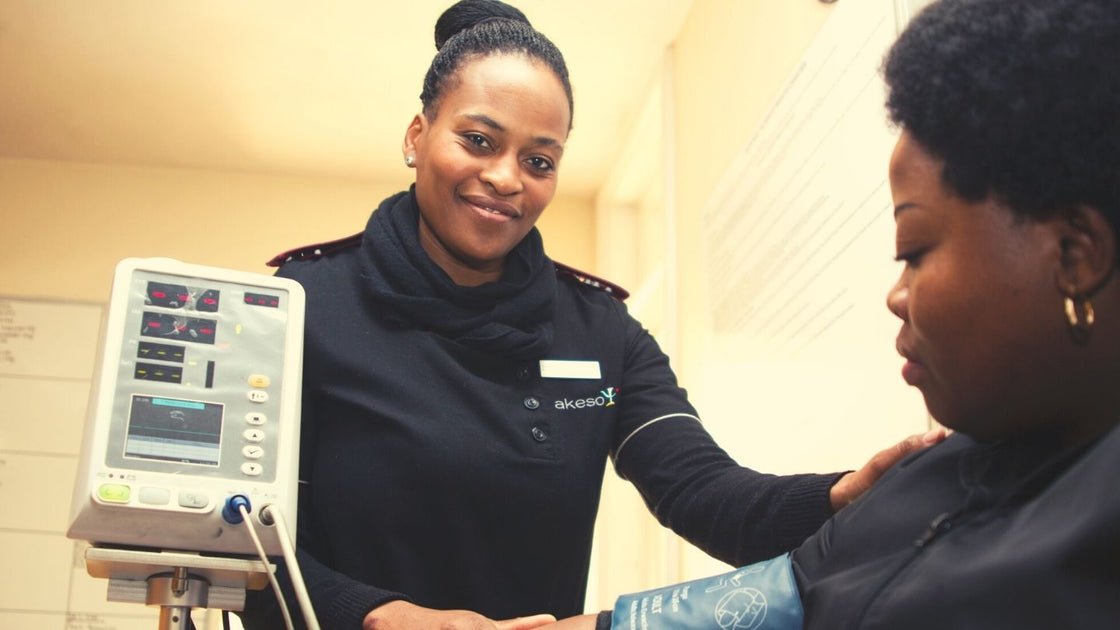
Image 2 by Luis Melendez on Unsplash

 By
By