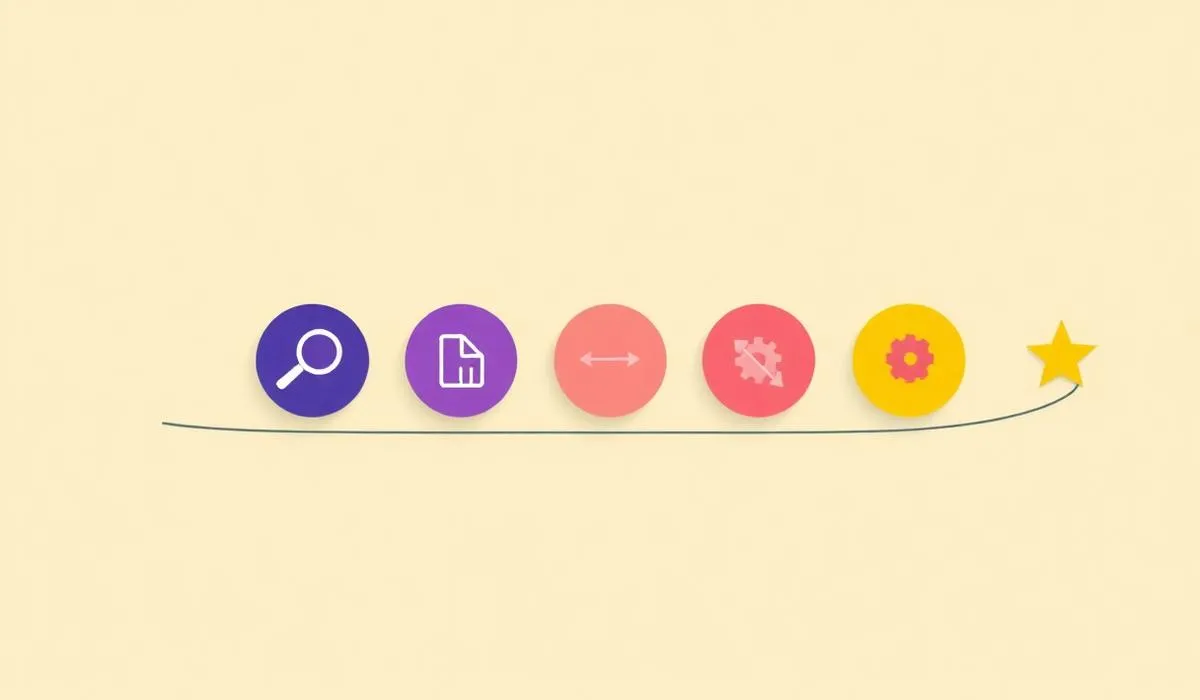
The innovation process is a six-step sequence that goes from identifying a real problem to implementing a user-tested solution: identifying the problem, generating ideas, selecting them, defining them, prototyping and testing them, and implementing them. In this guide, we cover each step with the methods we use in our workshops and link to the fact sheets for each tool, drawing on our broader guide to innovation methods and design thinking.
The innovation process is a six-step journey that organises a team's work when seeking to solve a real problem with a new solution: 1) identify a problem, 2) idea generation, 3) idea prioritization and selection, 4) idea definition or pre-prototyping, 5) prototyping and testing, and 6) implementation. Each of the 26 methods we use in our workshops — from a simple brainstorming session to a lean canvas — falls into one or more of these steps, and knowing this allows you to choose the right tool depending on your team's current stage.
Following the complete process, and not skipping steps, is what separates a loose brainstorming session from a real innovation process: without idea selection, the team gets scattered; without prototyping and testing, implementation is done blindly. In our two-day workshops, we see time and again that teams that respect the order of the six steps arrive at solutions that are better adjusted to the real problem, even if they generate fewer ideas along the way.
Every innovation process begins by thoroughly understanding the problem before thinking about solutions. This involves going out and talking to affected people, observing their real behaviour and not just what they say they do, and systematising these findings into visual tools that the entire team can review.
- Field observation: recording users' real behaviours in their context, without relying solely on what they state in an interview.
- Empathy map: organising what the user says, thinks, does, and feels regarding the problem.
- Stakeholder map: identifying who influences or is affected by the problem, beyond the end-user.
In our workshops, this step takes up the entire first day of a two-day workshop: the interview structure is defined, fieldwork is conducted, and data is systematised by identifying user archetypes and mapping the customer journey. If you want to delve deeper into how to structure this day, check out how to facilitate a 2-day innovation workshop.
Once the problem is well-defined, the team enters the idea generation stage. Here, the objective is to activate divergent creative thinking: seeking the largest possible number of ideas, not the best idea. Selection comes later, in step 3; mixing both moments is one of the most common mistakes when facilitating this stage.
There are multiple ways to generate ideas: finding service or experience gaps, improving an existing product, combining old ideas in new ways, or simply listening when people say "if only that existed...". The methods we use most to structure this divergence are:
- SCAMPER: a list of verbs (substitute, combine, adapt, modify, among others) to force new variations on an existing idea or product.
- Brainwriting: generating ideas in writing and in silence, useful for more introverted profiles to contribute on equal terms.
- Nominal group brainstorming: a structured variant of brainstorming that prevents one person from dominating the conversation.
- Divergent and convergent thinking: the conceptual framework that explains why idea generation and selection should be separated.
With a broad list of ideas on the table, the team needs explicit criteria to decide which ones move forward. Without a prioritisation method, this conversation tends to be resolved by hierarchy (the boss's idea wins) or by volume (whoever speaks loudest wins), rather than by impact and feasibility criteria.
- Idea prioritisation matrix: placing each idea in a quadrant according to effort and impact, to decide with criteria and not by intuition.
In a two-day workshop, this step opens the second day: the concrete design challenge is generated, and ideas are prioritised until the idea (or ideas) to be prototyped in the following hours is reached.
Before building a prototype, it's advisable to flesh out the selected idea: what problem it solves exactly, for whom, and what business assumptions lie behind it. This pre-prototyping step avoids building a beautiful prototype of an idea that, on paper, no longer makes sense.
This step is especially important in lean startup workshops, where after validating the client-problem pair, the team decides whether to move on to a second validation or if they can already advance to a concrete solution proposal.
Prototyping transforms the defined idea into something tangible: a paper flow, a mock-up, a service script. Testing, immediately afterwards, puts it in front of real users to see if it works before investing in building it seriously.
- Desktop walkthrough: simulating a service journey on a desktop mock-up, using figures and objects as substitutes for real people and spaces.
- Co-design: building the prototype together with the users themselves, instead of designing it for them and testing it later.
In our workshops, this is the block that is most often skipped when time is tight, and it is precisely the one that adds the most value to the exercise: without testing, the team ends up implementing an intuition, not a validated solution.
The final step converts the tested prototype into a real solution within the organisation. Here the focus shifts: it is no longer about generating or validating ideas, but about coordinating teams, deadlines, and resources so that the solution reaches production or operation. Task management and progress tracking tools, applied with the same visual post-it logic used in previous steps, help ensure that the transition from workshop to daily operation maintains continuity.
It is common for implementation to be planned in the workshop itself, defining responsibilities and next steps before the team disperses to their usual functions.
In practice, we compress the six steps into two workshop days. Day 1 covers steps 1 and part of 2: problem identification, user research, and initial idea generation. Day 2 covers steps 3 to 6: prioritisation, definition, prototyping, testing, and implementation planning. This agenda works best when the team executing it is multidisciplinary from the start; review how to compose multidisciplinary teams for innovation before inviting participants.
If your challenge is more focused, you can work on a single step of the process in a short two-to-three-hour session, instead of trying to go through all six steps. If it's more ambitious, you can extend the journey to several weeks, dedicating separate sessions to each step.
The most frequent mistake is skipping steps to "get to the solution faster": teams that go directly from idea generation to implementation, without going through selection, definition, or testing. The result is almost always a solution poorly adjusted to the original problem, built on assumptions that were never validated.
- Mixing idea generation and selection at the same time, which hinders divergence.
- Choosing the idea to prototype by hierarchy or sympathy, instead of using an explicit prioritisation method.
- Skipping testing due to lack of time, losing the validation that gives meaning to the entire process.
- Not planning the implementation at the close of the workshop, which causes the team's momentum to dissipate upon returning to routine.

 By
By