In this article, I'll discuss the fifth dimension of the Maturity Model for omnichannel customer experience management: Data and Analytics.
The Context of Omnichannel
If you've landed here after a Google search or by following a recommended link, it would be beneficial to first read a bit of context about our maturity model.
If you're already aware that our maturity model aims to operationalize the concept of omnichannel, then you might want to take a look at the other dimensions we've reviewed so far:
- Business Strategy
- Omnichannel Management
- Customer Experience (CX)
- People and Culture
And after getting the always-necessary context…
<p>
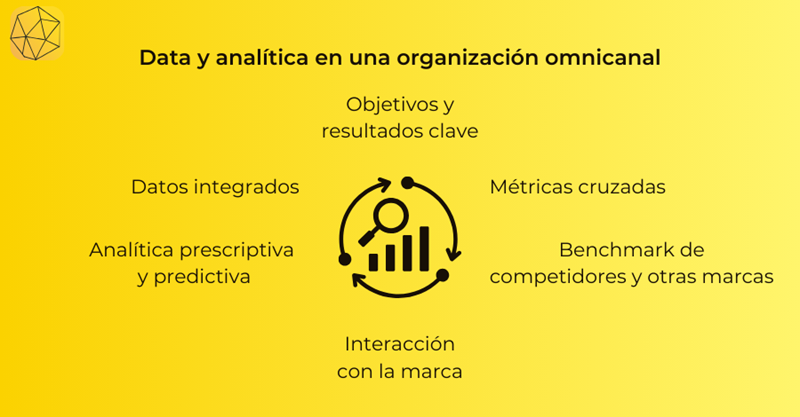
Data and analytics are one of the pillars of omnichannel CX management. In this context, key objectives and results must be aligned with the omnichannel strategy.
Customer data must be integrated to allow for a holistic view of the customer, from their touchpoints to their needs, problems, purchasing behavior, channel usage, and tracking of logistics order fulfillment.
The focus on omnichannel should be reflected in the use of cross-channel metrics and the pursuit of brand interaction results.
By cross-channel metrics, we mean metrics that go beyond a single contact channel, as we are looking for people to interact with our brand regardless of a specific channel. Simply put, it doesn't matter if the customer starts on the web and ends up resolving a need/requirement/task via WhatsApp.
Ultimately, what we seek is resolution and, with that, the smooth and proper closure of an interaction.
Finally, in an omnichannel company, analytics are prescriptive and predictive, while benchmarking allows for comparison with direct competitors and other brands in the market.
Why compare with other brands? Because people's (customers and employees) previous experiences impact or shape their expectations in their interactions with brands. Simply put, if we have a good experience with a financial brand, we tend to expect the same from a telecommunications company, for example.
If you apply our Omnichannel CX Management Maturity Model to evaluate your company, you will see that the Data and Analytics dimension covers the following evaluation criteria:
-
Objectives and key results: Our objectives and key results are aligned with our omnichannel CX strategy.
-
Integrated customer data: Our company has integrated data and aggregated information that provides a holistic view of the customer, their previous touchpoints, as well as their needs, problems, and purchasing behavior. We can thus track how our customers use each of our touchpoints and identify purchasing patterns.
-
Fulfillment tracking: We track the fulfillment of logistics orders such as: timeliness, availability, and condition of products (e.g., order completeness, initial pick accuracy, product condition, and wait time for out-of-stock items).
-
Benchmarking: In our company, we are aware of the omnichannel CX capabilities and actions of our direct competitors and other brands in the market. We compare ourselves with our direct competitors and brands from other industries.
-
Brand results: In our company, we measure the correct brand interaction results, such as brand trust, brand satisfaction, and brand engagement.
-
Cross-channel metrics: Our cross-channel metrics are prioritized beyond individual channel metrics (cross-channel metrics = metrics involving more than one channel).
-
Predictive and prescriptive analytics: We always seek predictive and even prescriptive analytics (predictive analytics allows for anticipation, while prescriptive analytics recommends actions to take).
-
Sociodemographic data: Our company captures and measures the individual characteristics of our customers (such as age, gender, income, etc.).
-
Dynamic segmentation: We have the ability to use dynamic segmentation, meaning we understand that customer segmentation can change over time. Our channel and CRM data are used to reveal hidden customer segments.
With this, you'll surely want to explore our online maturity model and be among the first to use it.
For now, I'll close this article by leaving you with the following questions to spark discussion:
How important is brand interaction in your organization?
If it's important, how is it measured?

 By
By