In the first article, I told you what the CX Omnichannel Management Maturity Model is, and there I named its 8 key dimensions. With this article, I will start going into more detail, so it's time to talk about the Business Strategy dimension and what criteria compose it. Let's see what it's all about.
When an omnichannel strategy exists, omnichannel is a top-down priority in the organization. This strategy must be based on customer centricity and the willingness to invest human and material resources.
Because without the willingness to invest and allocated resources, we are only talking about good intentions. So, if omnichannel is not a strategic priority, it is also not possible to transition from being a multichannel organization to an omnichannel one.
As an example, in a study with European supermarket chains, a team of researchers (Hübner et al., 2016) found that the willingness to invest in new channels and technologies, current market position, and the ability to integrate processes cost-efficiently have an impact on last-mile fulfillment and distribution decisions.
According to the authors, there is no single correct solution for designing a successful last-mile fulfillment strategy that is valid for every country, customer, retailer, and situation. After this example, let's return to business strategy.
The business strategy is also supported by suitable commercial partners, such as product and service providers.
Imagine you have a retail company that has a commercial partner for home delivery. Although this partner operates independently and you do not control their processes, the quality, efficiency, and attention in their services will have a direct impact on your customer's perception of your brand. Therefore, commercial partners must be chosen very carefully.
In this same context, every transaction counts, and the customer is encouraged to constantly interact with the company. This idea of "every transaction counts" is a reflection of what a top-down priority in an organization means.
This relates to practical experience management and the attention provided, but also to a deep understanding of how binding the product or service is and, therefore, from where or to what extent a customer relationship with the brand can be built.
This happens because not all products, services, or experiences require a deep bond; that is, not all brands have the same relevance in people's lives.
As a company leader or manager, you have to assume and have the humility to build from that point and not from the idea that all brands must deliver a "remarkable" experience.
Finally, the company's service and business model evolve with the adoption of an omnichannel strategy.
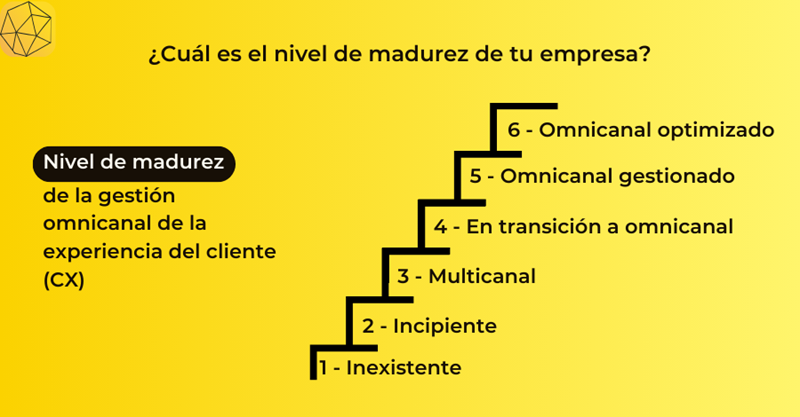
In simple words, if your company is currently at a non-existent or incipient level on the maturity scale, but it does have an omnichannel strategy, the service and business model must evolve so that climbing the "ladder" is possible.
Likewise, you cannot jump from level 1 to 6 without evolving along the way:
Image source: own production. Example taken from the real report of a company that was evaluated with the CX Omnichannel Management Maturity Model, which was placed at level "5-Managed Omnichannel" on a 6-level scale.
If you want to evaluate your company with our CX Omnichannel Management Maturity Model, the criteria you will have to assess in the Business Strategy dimension are:
-
Top-down priority: Omnichannel CX is a top-down priority for our company, meaning it is supported by our executives (C-level) and our board.
-
Customer-centricity: Customers and CX are at the heart of our company's strategy; therefore, we consider the omnichannel approach vital to improving customer experience.
-
Willingness to invest: Our management is willing to invest in new channels and technologies to support our omnichannel business strategy.
-
Service and business model: Our service or business model has evolved since we adopted the omnichannel strategy.
-
Every transaction counts: We focus on managing transactions and the value of each customer, encouraging our customers to interact with us constantly.
-
Commercial partners: We have the right commercial partners (e.g., product/service providers) to support our omnichannel CX strategy.
If you want to delve deeper into the topic of the transition from multichannel to omnichannel, I invite you to read this paper in English that we published in early 2022 (Gerea and Herskovic, 2022).
If you want to know more about omnichannel customer experience management, you know, you can also follow me on LinkedIn.
The original version of this article was published on LinkedIn for the Omnicanalidad en español Newsletter.
- Gerea, C. & Herskovic, V. (2022). Transitioning from Multichannel to Omnichannel Customer Experience in Service-Based Companies: Challenges and Coping Strategies. Journal of Theoretical and Applied Electronic Commerce Research, 17(2), 394-413.
- Hübner, A. H., Kuhn, H. & Wollenburg, J. (2016, 14 March). Last mile fulfilment and distribution in omni-channel grocery retailing: a strategic planning framework. International Journal of Retail & Distribution Management, 44(3).

 By
By