This time, we'll delve into the second dimension of the maturity model: Omnichannel Management.
This dimension evaluates the articulation of an organization's channels and touchpoints to support customer interactions with the company, from the perspective of:
- Transaction information.
- Channel switching.
- Service/product visibility.
- Shipping/delivery visibility.
- Stock and supply visibility.
- Return and replacement speed.
- Ease of return and replacement.
- Quality and performance consistency.
- A customer-centric logistics model.
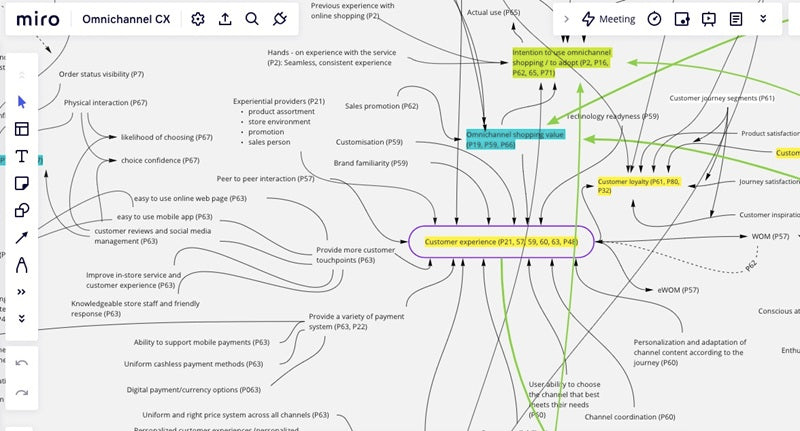
Before going into detail with each point, I want to emphasize that the criteria were selected after a systematic mapping in which we identified countless variables related to customer experience (CX) and omnichannel. And this is what it looks like:
<p>
Image source: original production. To show a bit of the process, this is what the criteria mapping in Miro looks like (only suitable for reading with coffee in hand and never when tired; the printed map fits on a very long wall).
If you evaluate your company using our Omnichannel CX Management Maturity Model, the criteria you will need to assess in the Omnichannel Management dimension are the following:
-
Integrated transaction information: Our customers can access their transaction history and past purchases through any channel.
-
Channel switching: Our customers can search for our products or services across all our channels and can move effortlessly, quickly, and smoothly from one touchpoint or channel to another.
-
Shipping/delivery visibility: We ensure transparency in delivery conditions, delivery status, location of shipped items, and proof of delivery.
-
Service/product visibility: We store and share product and service data, including technical, physical, component, ingredient, and product promotion data across all channels, so our customers can find advertisements or promotional information from one channel on another channel.
-
Stock and supply visibility: Inventory status and product location information are accessible and retrievable across all channels. Our customers know the origin and supply process of the products.
-
Return and replacement speed: Our company ensures adequate speed for a customer to receive a credit note or replacement for their returned purchase.
-
Return and replacement: Our company offers an adequate number of return points, making it easy for our customers to return products, and the return or replacement is visible to the customer across all channels.
-
Quality and performance consistency: The quality and performance of our products or services are consistent across different channels.
-
Price consistency: There is no price difference between channels.
-
Customer-centric logistics model: Our company has a logistics model designed to support our omnichannel CX strategy, allowing customers to choose based on their home delivery or in-store pickup preferences, willingness to pay for home delivery, and desired time slots. Therefore, our customers can complete the entire transactional process using one or more channels.
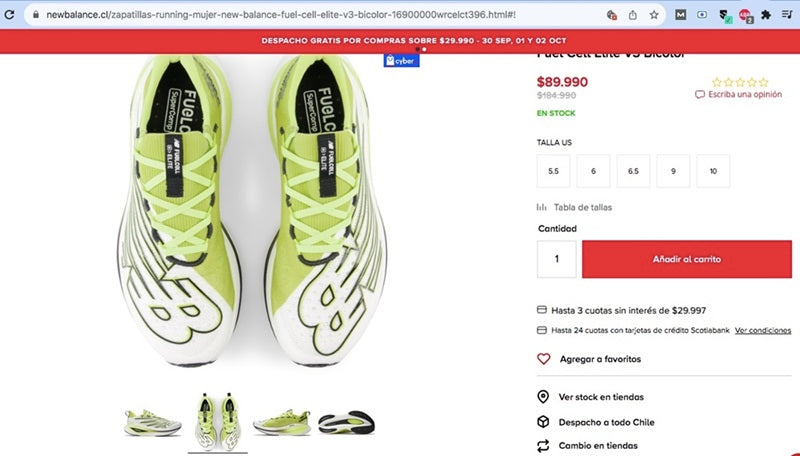
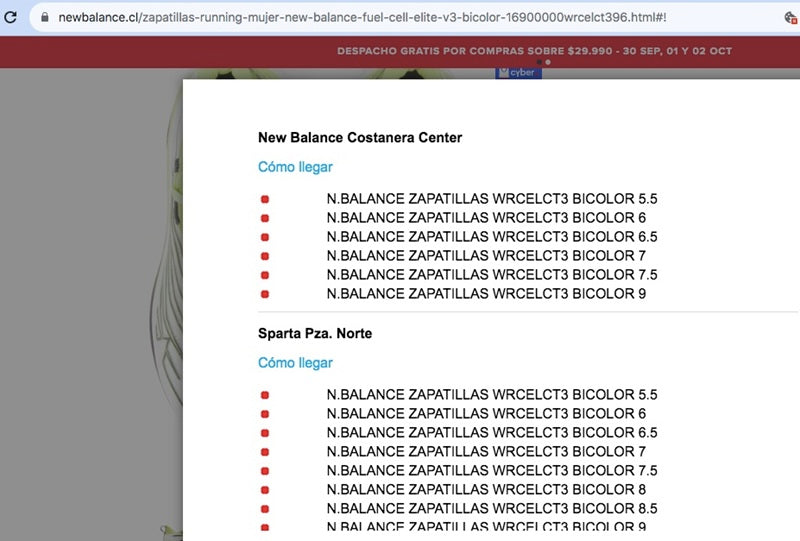
If we address Stock and Supply Visibility, a good example of this is the ability to see in real-time the stock of a product in a brand's different points of sale. In the following images, the New Balance brand allows us to check on its website if there is stock of the sneakers we are looking at for:
- online sales,
- its physical stores, and
- retailer stores (Sparta):
Thanks to this system integration, customers perceive a fluid and connected experience, regardless of the channel they choose. In addition, it gives them the ability to make decisions more quickly and securely, increasing the likelihood of conversion and loyalty.
It is important because customers...
- Can make informed decisions and avoid frustration due to lack of stock.
- Can choose the channel that best suits their needs, whether it's buying online, picking up in-store (BOPIS, Buy Online Pick-up In Store), or buying directly in a physical store.
- Perceive transparency and trust by being able to see inventory status and product origin.
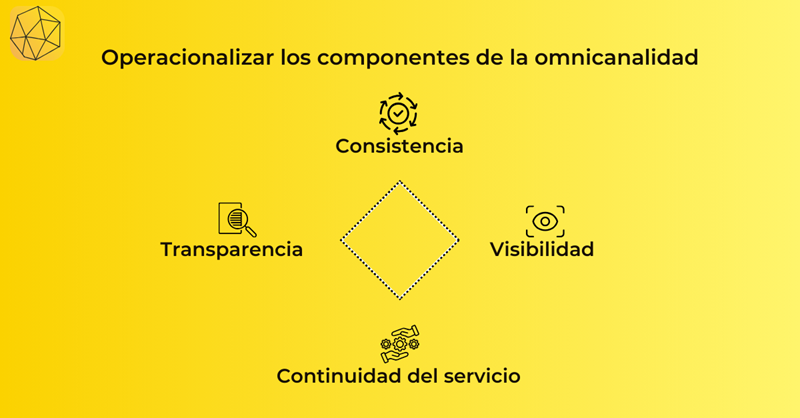
If you look at the criteria, there are several components of omnichannel that we seek to operationalize:
- Consistency,
- transparency,
- visibility, and
- service continuity.
In fact, a significant motivation that drove this work has been precisely this: to operationalize simple concepts that, in turn, are subject to interpretation and do not always have agreed-upon definitions at an academic and/or industry level, making them difficult to evaluate against a standard.
Another motivation has been to venture into the concept of omnichannel applied to services. We know that omnichannel originally emerged in retail, especially "traditional" retail where channels and points of sale developed in an inorganic way.
So, what about "pure" service companies? I mean those that have no product component. If you reread the criteria above, you will realize that it is very difficult for there not to be an equivalent in services, even if partial.
While a 100% service company cannot return a service after it has been "consumed," it can offer a transactional process using one or more channels or a refund in case of a service that has not been provided.
Finally, as in any maturity model and in all organizational realities, one criterion may be more feasible to implement than another and have a greater impact on the customer (thinking here about the micro-moments of the customer journey).
It may also be that in an industry, market, or country, one or more criteria are part of those previous experiences with which consumers are accustomed.
To the extent that a type of service becomes common, logic dictates that this service becomes part of our expectations.
If you are interested in learning more about omnichannel customer experience management, you can also follow me on LinkedIn.
The original version of this article was published on LinkedIn for the Omnicanalidad en español Newsletter.

 By
By