 By
By 
When we talk about omnichannel management, we refer to "the synergistic management of the numerous available channels and customer touchpoints, in such a way that the customer experience across all channels and channel performance are optimized" (Verhoef et al., 2015).
With this, I want to highlight the idea that omnichannel customer experience (omnichannel CX) is not only about customer experience aspects but also about organizational results. In this way, just as the customer experience is unique and personal, organizational aspects are also specific to each institution.
Although omnichannel has become a priority for companies, even more so during the global pandemic context, its operationalization is still complex. This means that there is limited explicit knowledge on how such integration can be achieved (Hansen and Sia, 2015) and the optimal level of this integration when moving from multichannel to omnichannel (Thaichon et al., 2020).
The objective is to provide practical guidance and tools to teams and leaders to facilitate their efforts to transition from multichannel to omnichannel.
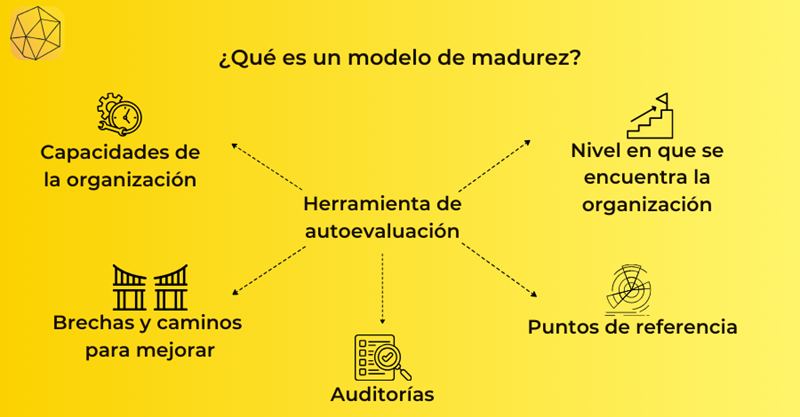
Likewise, all resources will be available to consultants who need to evaluate their business partners to identify gaps in their processes and thus determine what to do in their transition to omnichannel.
How the Maturity Model for Omnichannel CX Management was born
This all started with the question I posed for my doctoral thesis: What does omnichannel customer experience management mean?
Intuitively, one imagines that omnichannel goes far beyond channel and technology integration. Therefore, in my doctorate, I set out to "ground" this concept of omnichannel CX and break it down.
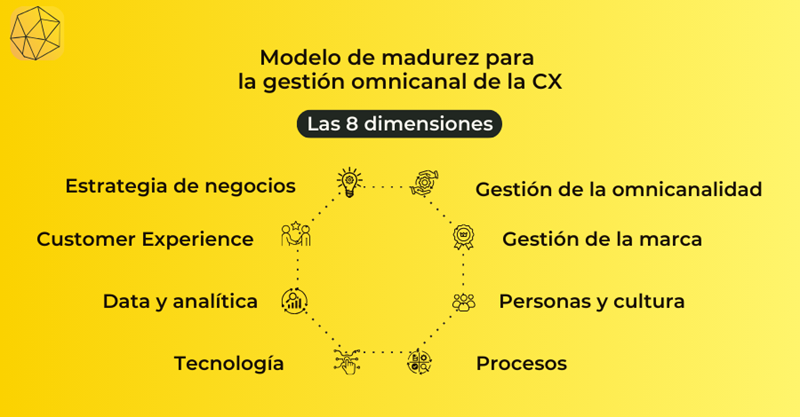
As a result of this question and from academic research, we identified the following 8 key dimensions for omnichannel customer experience management:
- Business Strategy.
- Omnichannel Management.
- Customer Experience.
- People and culture.
- Data and analytics.
- Processes
- Technology
- Brand Management.
The dimensions became part of the maturity model, and it is very likely that each one sounds like a world in itself, and you are intuiting correctly. That is why there are criteria that make up each dimension; I will talk about them in detail in other articles.