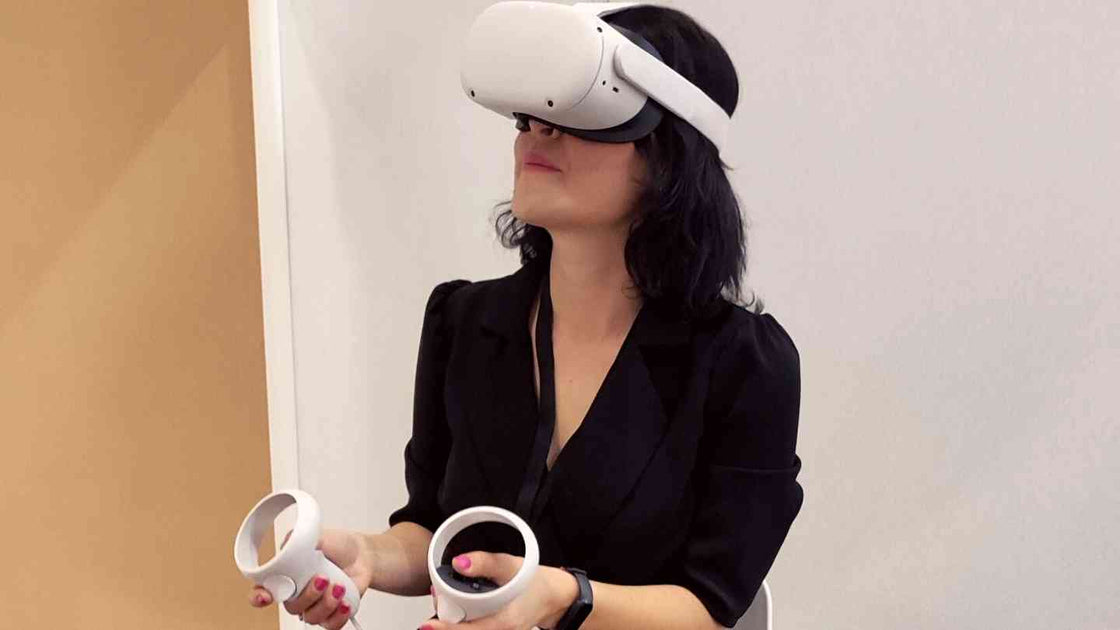
This week I tried the Oculus Quest 2, a virtual reality (VR) device, and also attended a talk on brand experiences with the metaverse. I'll tell you more about what all that generated for me later, but let's take it one step at a time.
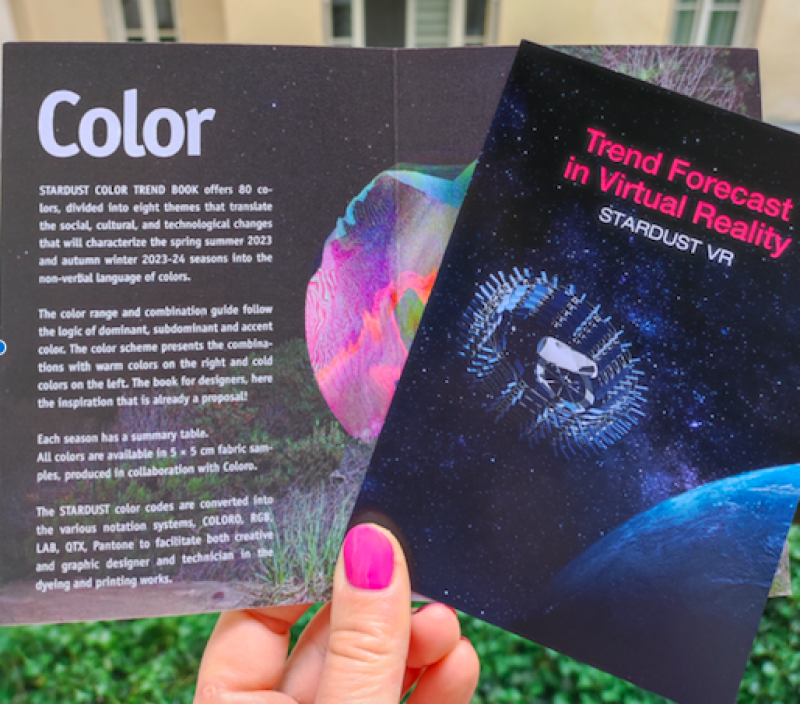
The experience itself was conceived and created by Nello Marelli with Stardust SRL as a proposal for an immersion in the trends of colors, shapes, and materials in the fashion industry for the 2023 - 2024 season. And I was able to experience it at a professional trade show in Paris.
Initially, I felt a bit uncomfortable with the touch controllers as I couldn't quite figure out how to move forward. I managed to move super fast horizontally and vertically, but not forward.
The hostess helped me a lot with other aspects, but it's complex to explain how to move since you don't see the same thing the person sees through the lenses. Here, from a UX Research perspective, this technology opens up a series of possibilities and complexities.
This immersive experience takes place in a kind of tunnel or spaceship (reference photo):
Image from NASA on Unsplash.com
You access different spaces via doors that open once you approach a point that seems to read your fingerprint / hologram. The thing is, you have to find that access point, and that's a bit difficult at first because you don't know how to move forward.
It's like being in a car, wanting to move forward in traffic, and not knowing how to drive. I illustrate it this way because I have a phobia of driving, and that's exactly my nightmare.
The difference is that here it was entertaining. In fact, it made me think about the possibilities these spaces offer to overcome real-world phobias.
As I progressed and overcame the movement barrier, I was able to enjoy the colors, textures, and the feeling of immersion became concrete. Also, since I'm fascinated by design, I quickly went from "how do I move forward?" to "wow, how fun!".
At some point, I left the ship, reached space, and it was equally incredible. I like movies about space, without being a megafan, and more than anything I'm fascinated by design in all its dimensions and colors. So, for me, it was amazing.
Image from NASA on Unsplash.com
Since I see Oculus Quest 2 as a very well-finished prototype, I imagine it took many hours of design and development, and considering the context, this sensory journey could surely:
-
Continue in the VR world with information capsules to understand the details of colors, shapes, textures, and their different applications.
-
Continue in the real world, which I imagine will happen in this case since physical catalogs of materials and colors are used in the industry.
A possible difficulty for the second scenario is how to ensure a consistent experience, especially at the level of color perception, given that it is known that colors on screen have more brightness. Here, something similar happens with Oculus Quest 2 lenses: they can create an expectation that reality must be able to sustain.
Talking with Nello, he told me that they tested with adults and children/teenagers, and they were fascinated by how each one experiences it differently. For children/teenagers, this accelerated learning process can come more naturally.
This is how we can all experience the immersive experience differently. For example, Nello told me, one person didn't worry so much about moving through the different spaces but returned to continue experimenting with each one.
Context and previous experience
I am not a gamer, a super important background to consider when anticipating who will or will not feel familiar, because a gamer may have already experienced this device or a similar one.
Before trying it, I remembered Google Glass a lot, which I had the chance to see in 2015, and I can't help but compare them.
In this sense, although they are different devices for a first VR experience with Oculus Quest 2, I found it much more powerful than Google Glass and it left me with the feeling that I would like to continue experimenting.
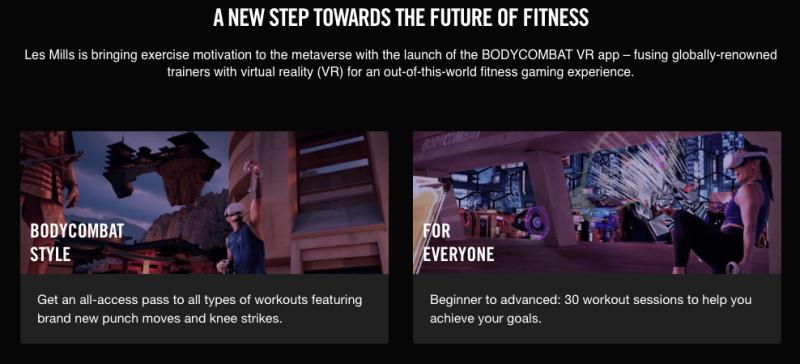
In fact, I had analyzed it some time ago because I'm interested in LesMills fitness classes from New Zealand, a method for which many gyms around the world are certified. LesMills offers its classes via VR, in the metaverse.
Image from the LesMills website.
Usually, when I'm in Romania, I go to Les Mills classes, and I absolutely wanted to continue that in Chile. Initially, I didn't have anywhere, but recently I found a gym next to my house and signed up. For this type of activity, I prefer real contact with instructors, classmates, and exercising outdoors.
About the cost of the Oculus: At the moment, I see that the cost of the device is around 400,000 CLP, about 430 euros. At first glance, it seems to me that, although in Europe I can get it at a better price (perhaps 350 euros), for now I wouldn't buy it since I wouldn't use it regularly.
Professionally, I wouldn't invest in it either, since at FREED we decided to move away from UX Research testing as a service and continue doing research as a tool for different projects. I would reconsider if we had a project that required it.
In fact, a few years ago we worked with a client who had a VR solutions development for different industries, but for our intervention in that project, it was not necessary to test or do any other form of research. As an alternative and out of a sense of responsibility, I could borrow one.
Why do I talk about responsibility when acquiring technology? Because I have a couple of design and testing devices that I bought, with which I was fascinated at first sight and then never used again. With today's responsibility and maturity, I wouldn't do it because they become obsolete quite quickly.
For our e-commerce projects, although there are many possible VR applications, it seems to me that most clients and clients' clients (end consumers or audience) still don't need it.
Continuing with professional aspects, beyond general culture and the obligation to be aware of what is happening around us and in the world, it is clear that virtual reality is real and it is now.
And augmented reality (AR) too. In fact, Facebook and Instagram filters are concrete examples of AR applications that you have surely already used.
If you work in marketing, UX Research, or experience design, you cannot ignore the VR world.
Remember that we don't know what we don't know. If we don't experience it, we can't imagine those experiences. In this sense, for me, it is an obligation to explore and experience.
Whether you like it or not, your customers or your future customers are already there. Watching a video on YouTube and reading about the topic is not the same as experiencing it. And experiencing it is not the same as being an expert. Besides earning the right to have an opinion, it opens your mind to multiple possibilities. For everything else, you have to network and find people with complementary experience.
If your children or nephews are gamers and have a device, borrow it and play.
If you work in marketing or UX Research: should you rush to develop something for VR? Obviously not.
The global VR market is projected to reach US$6.71 trillion by the end of 2022 (source: Statista; considering hardware and software).
- By 2022, eMarketer estimates that a quarter of the US population will use AR and almost a fifth will use VR. Adoption will increase as device manufacturers improve AR and VR headsets and new use cases emerge.
-
Gamers and young social media users are the main customers at the moment.
- According to Techjury, with data from AngelList: in January 2020, the number of VR startups worldwide listed on AngelList was 2,270, a significant jump from just over 1,800 in May 2018. The analysis also identifies 978 investors, meaning many of these startups have also secured funding for their projects.
There are already multiple applications for the use of virtual reality in education, health, and architecture, and in the real estate, automotive, beauty, fashion, e-commerce sectors, among others. In this context, it is essential to understand what mental references and previous experiences your audience has and what expectations other brands in the market have shaped, not just in your industry.
How do you see it? Have you already experienced virtual reality?
Note: finishing writing this post, I remembered having experienced cultural experiences in 3D. Although it remotely approaches the VR experience, it is not the same. The feeling of immersion is infinitely greater in VR, especially if it is well designed.
Edited by: Camila Oliva

 By
By