In this article, we will teach you how to perform a task that is part of SEO auditing and SEO strategy design. This involves conducting an SEO Benchmarking, which is a study of the competition for a brand that wants to improve its organic search engine ranking on the internet, such as Google or Bing.
You can also watch and listen to this article in podcast format
Get our analysis in your inbox
Subscribe to the FREED newsletter: applied research, trends and tools.
No spam. Unsubscribe anytime.
Objectives of an SEO Benchmarking
Let's go step by step and first review the objectives of an SEO Benchmarking:
Understand the contexts of the different markets where the brand wants to position itself, identifying:
SEO competition and industry benchmarks (brands that are present in people's searches).
Opportunities for new sales channels.
Possibilities for developing linkbuilding.
Detect the search terms that best classify our brand in organic searches.
Compare the positioning and visibility of our brand versus the competition.
Analyze the weaknesses and strengths of the competition and our brand, as well as opportunities to compete for organic positioning.
Define the actions to be taken, according to available resources.
This information is vital to know where we are starting from, both when conducting an SEO audit and when designing an SEO strategy, and thus make the necessary improvements. Therefore, we must constantly monitor the competition, especially when Google updates its algorithms.
You can also include in your research some technical elements such as page loading speed and the technology used on the website (e-commerce platform, payment services, content manager, etc.).
I- Identifying the competition in SEO
SEO competition refers to the pages and websites that have positioned themselves with industry-related content, using the keywords that our brand has defined for its SEO strategy.
In other words, you will find pages and websites that do not necessarily belong to other companies competing for the business. So, after identifying the SEO competition, you should organize it by categories:
Websites of brands that manufacture similar products and/or services.
Retail brands that sell similar products or services.
Marketplaces that sell similar products or services.
Blogs that publish articles about the industry.
Websites of industry associations and guilds.
Wikipedia articles and other relevant sites.
First, let's look at direct competitor brands because they offer something similar. Here, the analysis will help us understand:
Which brands in the sector are better positioned.
Domain authority compared to our brand's. Here it is important to compare with the closest and most achievable competition, and set realistic goals.
Backlinks (links from other websites that refer to that site).
In which search terms they have positioned themselves.
Whether it is convenient to compete in those search terms.
In which niches our brand can position itself better.
What topics we could develop in our content.
In what formats it has been published (articles with text and photographs, infographics, videos, podcasts, etc.). And, evaluating how high the SEO competition is, decide whether we try to position ourselves with the same formats or with one where there is no content.
II- Linkbuilding possibilities
A competition that we can turn into an ally for an SEO strategy are those blogs, websites, and online media that publish articles with links to the website of the brand they are talking about.
Let's look at some examples:
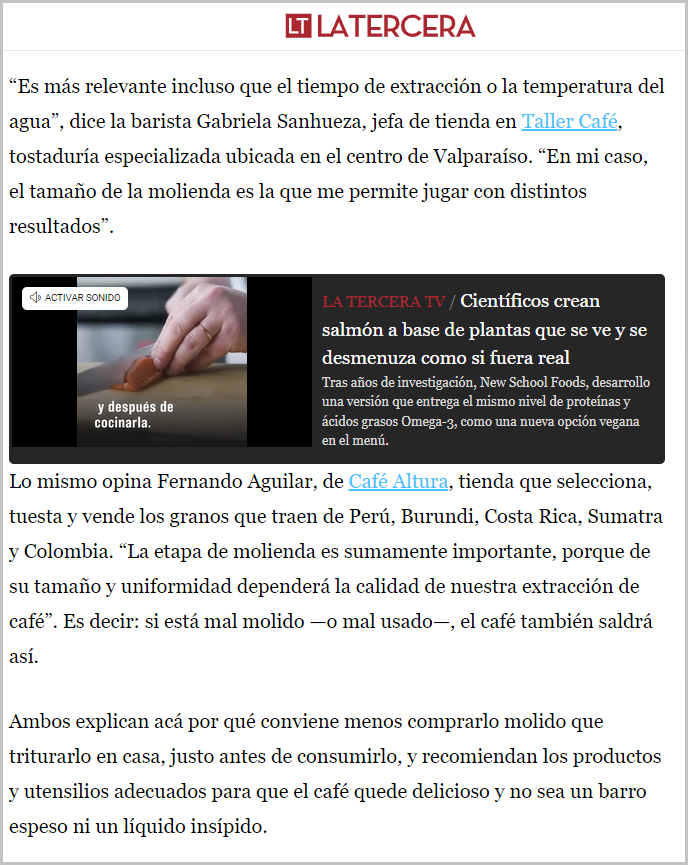
Online media that, in addition to publishing current news, develop reports where they cite reference brands, including links to their websites. In this example, we see an excerpt from a report on specialty coffee by La Tercera. They interviewed baristas and entrepreneurs in the sector, and included links to their online businesses:
Specialized blogs and websites in a sector that publish articles with reviews and comparisons of products or services, and present the different brands that compete in that market. This women's portal shares links to the websites and social networks of the brands that collaborate with their articles:
Generalist blogs that accept publishing third-party articles.
Blogs and websites of trade associations that highlight companies in the sector.
How to do an SEO Benchmarking?
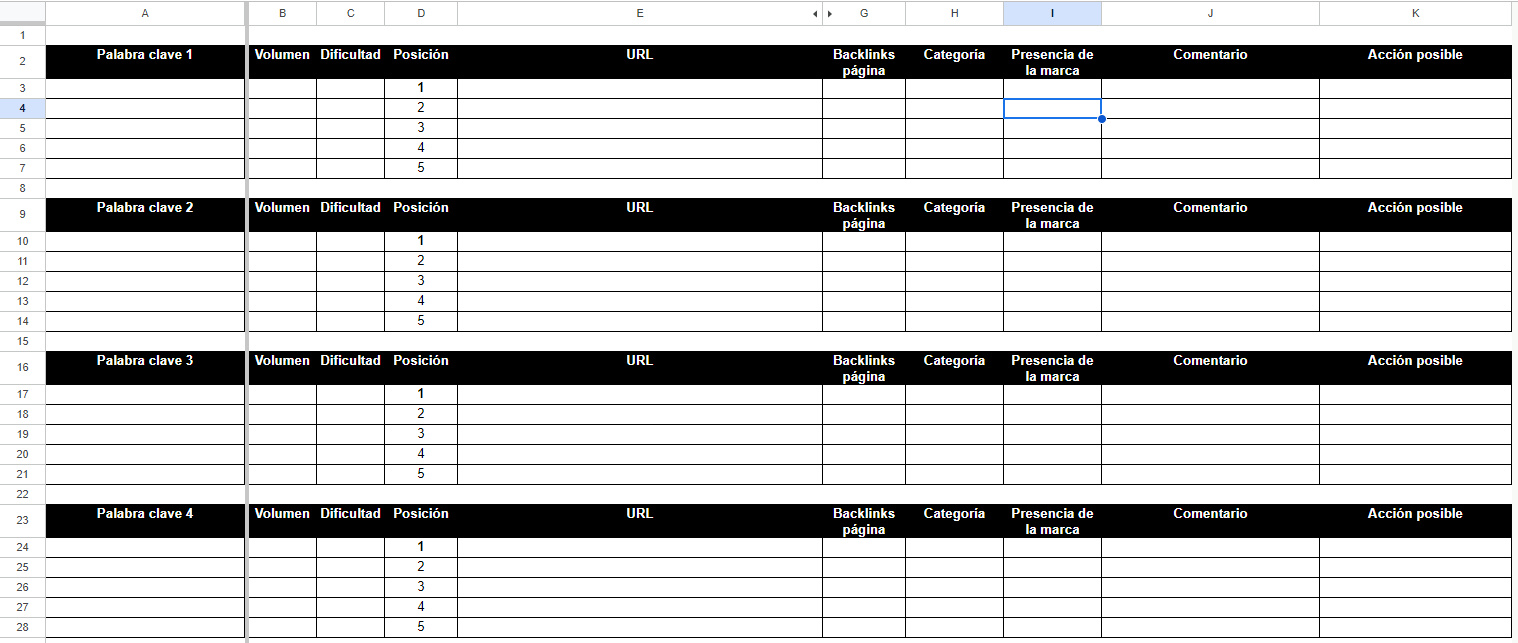
After conducting keyword research, analyzing the findings, and selecting the main keywords, you could start by setting up a table like this in a spreadsheet:
Click on the image to enlarge it.
In the first three columns, note the data you already have: your keywords, monthly search volume, and SEO difficulty.
For the data you will obtain later:
Further to the right, you will copy the URLs of competitor pages.
Then, the number of backlinks.
In the "Category" column, you will identify the page according to what we saw earlier.
In "Brand Presence," comment on whether it is convenient for the company to be there (in that marketplace, with an article in that blog, etc.).
In "Comments," note the brand's opportunities ("Content opportunity," "New sales channel," include a keyword used by the competition, "Not applicable" for the brand, etc.).
"Possible Action" is what you will do ("Optimize product listings," "Public relations" for linkbuilding, analyze the feasibility of a new channel, etc.).
How to get all that data?
Let's start by looking at examples with Ubersuggest, an easy-to-use SEO tool ideal for learning how to do this research.
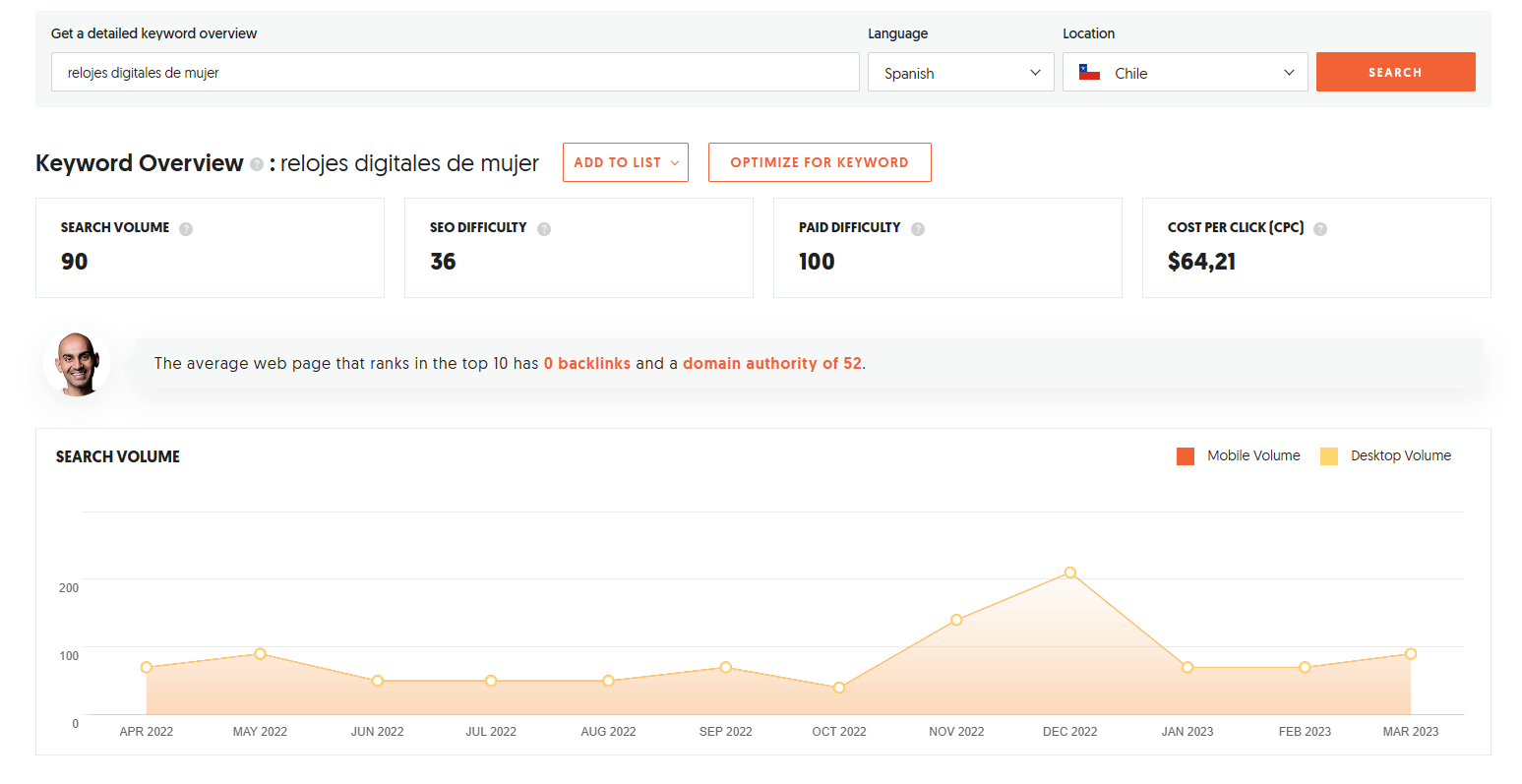
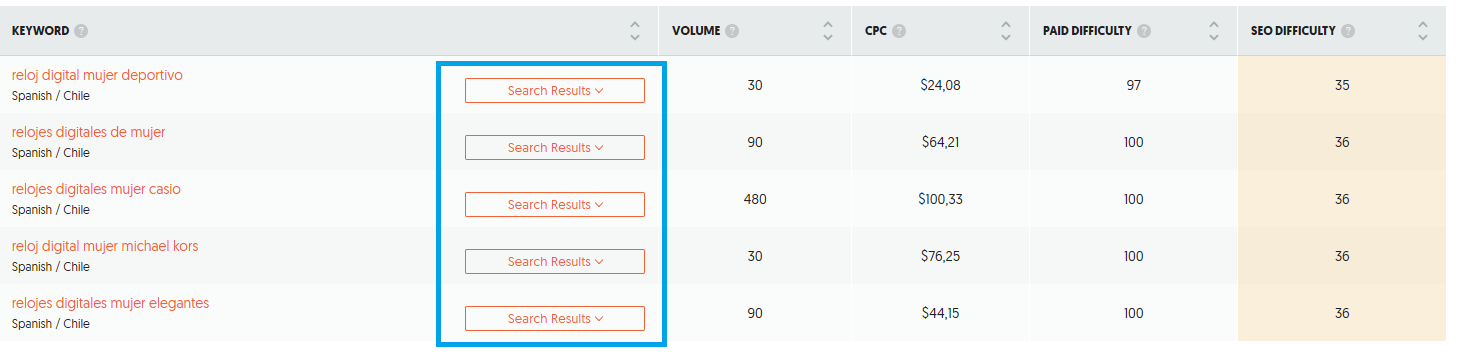
1. We enter the keyword "relojes digitales de mujer" (women's digital watches) for the Chilean market, in Spanish, and the first result shows the Search volume and SEO Difficulty:
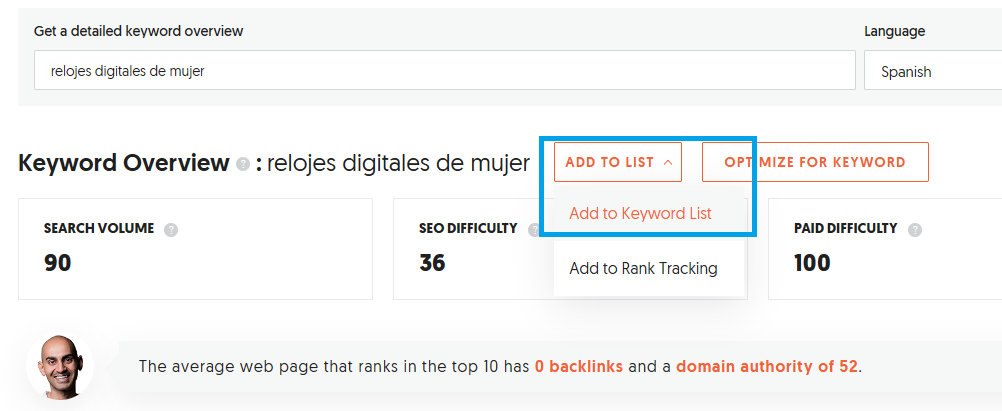
2. We create a List that we call "relojes digitales" (digital watches):
3. In the list, we verify the competition for each keyword by clicking on "Search Results":
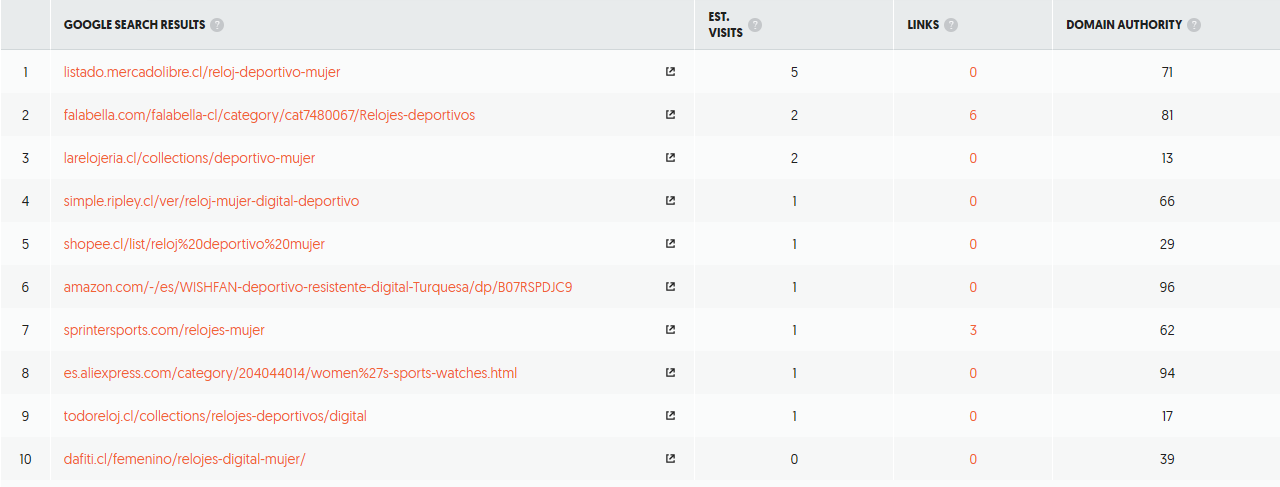
4. A ranking appears of the 10 most important pages with their URLs and very useful data for our analysis: estimated visits, backlinks (Links), and domain authority:
Now let's look at another example with Ahrefs, a tool widely used by SEO professionals.
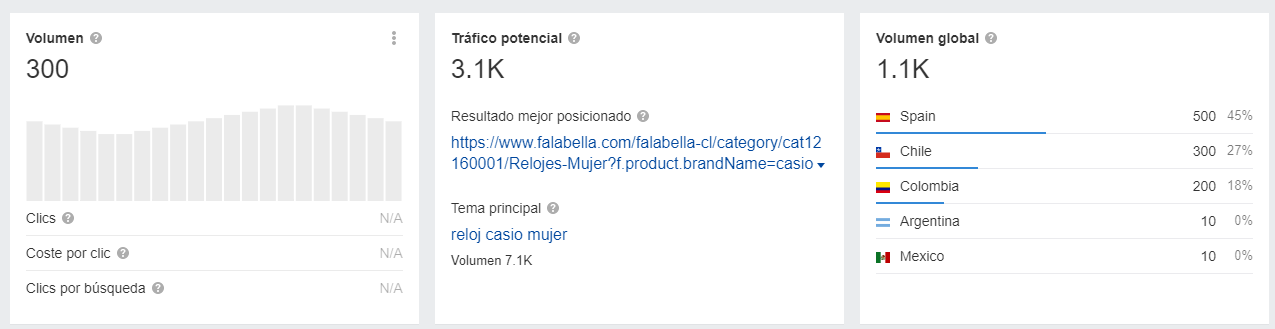
1. We enter the keyword "reloj digital casio mujer" (Casio digital watch women) for the Chilean market and obtain the Volume and Difficulty. In addition, at first glance, the potential traffic, the URL of the most important competitor, the global volume, and the monthly search volume in other countries are visible:
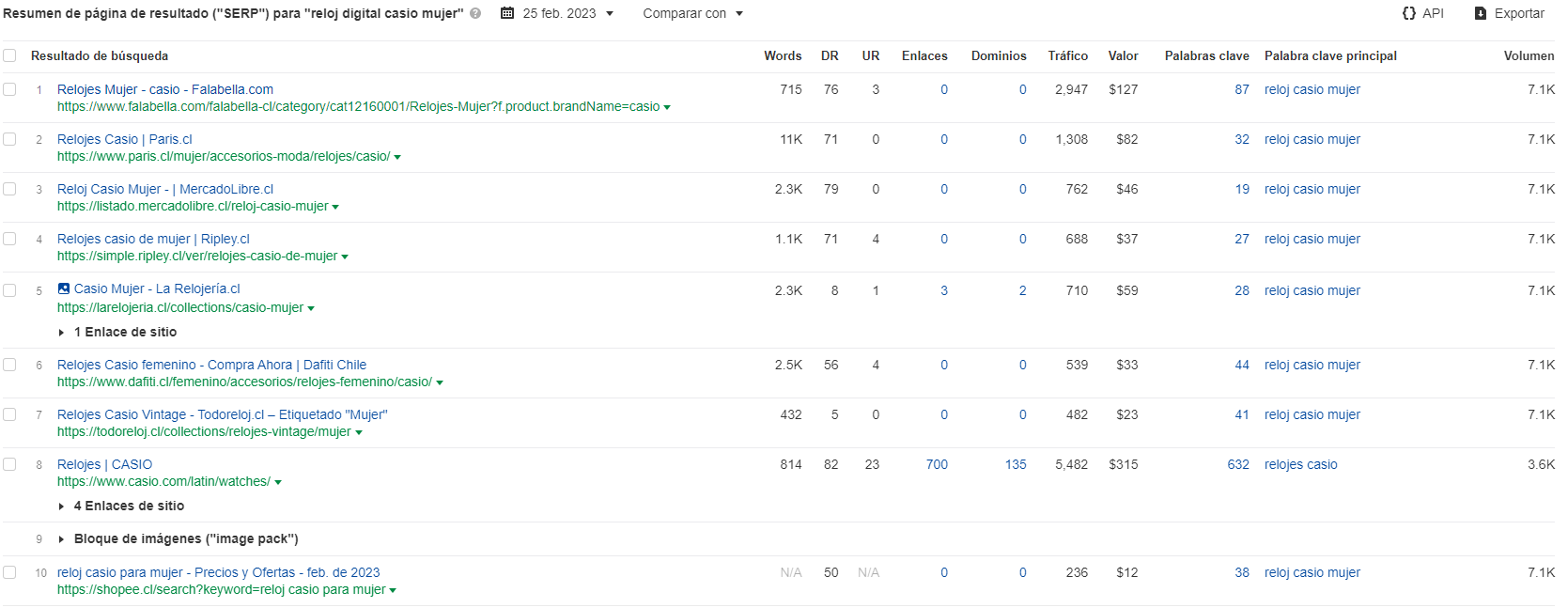
2. Scrolling to the bottom of the page, the 10 most important SEO competitors appear, along with their URLs and very useful data for analysis:
This way, you can now complete your spreadsheet to perform an analysis of the SEO competition and brand opportunities.
Found more than 5,000 keywords for the Home and Decoration product category.
Identified search trends on Google Chile in desktop and mobile versions.
Analyzed the market share of 17 e-commerce stores and marketplaces in Google Chile search results.
Identified the Long tail keywords of the category and a niche market example.
What methodology did we apply?
I- In the first stage, where we defined the search universe:
We selected a sample of local e-commerce stores and marketplaces from the Home and Decoration product categories.
We registered an initial sample of 35,983 keywords according to website categories and subcategories, using the Ubersuggest tool.
We conducted a Keyword Research for the Google CL search engine, in desktop and mobile versions, using the Ubersuggest tool.
We reduced our keyword database to a final sample of only 5,830, based on various criteria such as search volume and keyword relevance.
II- In the second stage, analysis and results:
We explored the positioning and visibility on the internet of 17 online store brands.
We analyzed the positioning campaigns of these 17 brands in relation to the 5,830 keywords in our sample, in the Google CL search engine for desktop and mobile versions, using the Semrush tool.
We systematized, analyzed the keywords, and developed a benchmark with the base of 5,830 keywords, obtaining a volume of 5,046,840 searches.
What were our findings?
Let's look at some examples of what you can discover with an SEO Benchmarking. For more details, download the study for free.
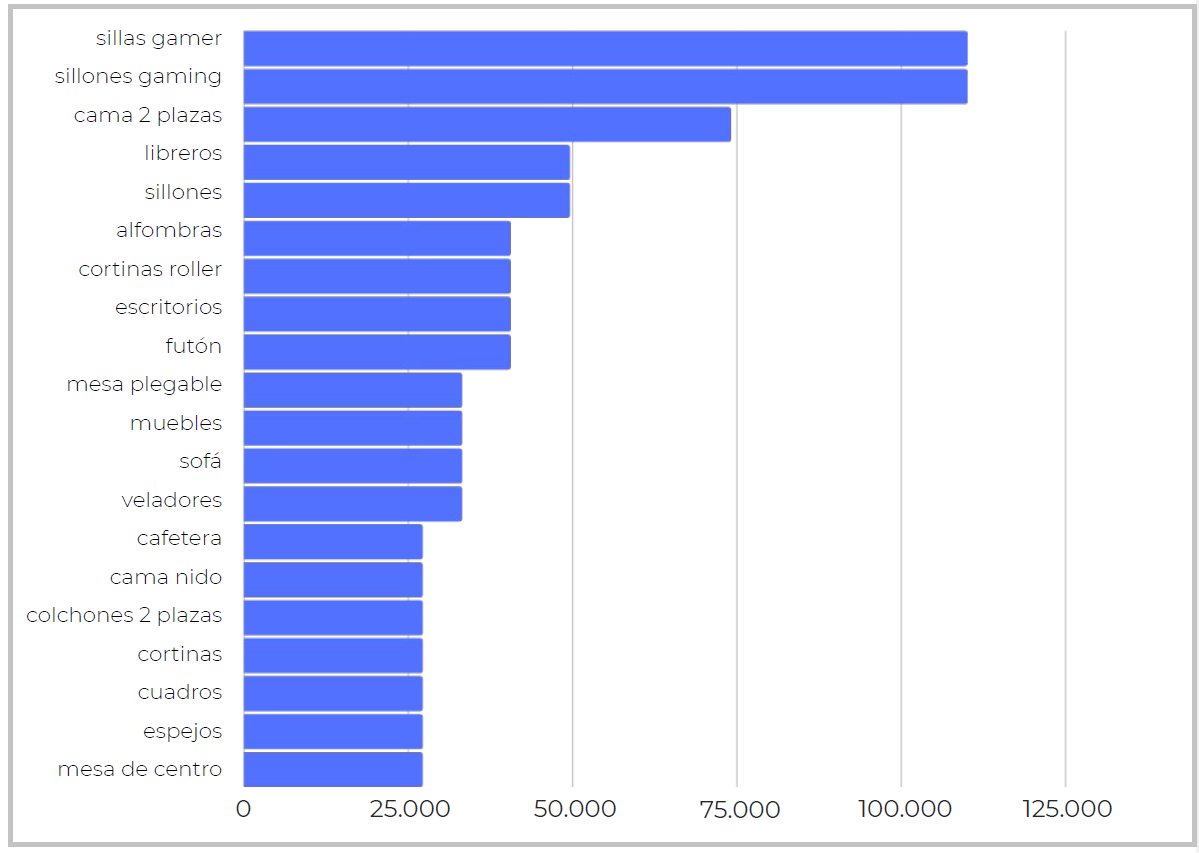
1. The 20 most searched keywords within the total searches. To a large extent, these are very general search terms, but relevant for e-commerce businesses looking to appear first on Google CL:
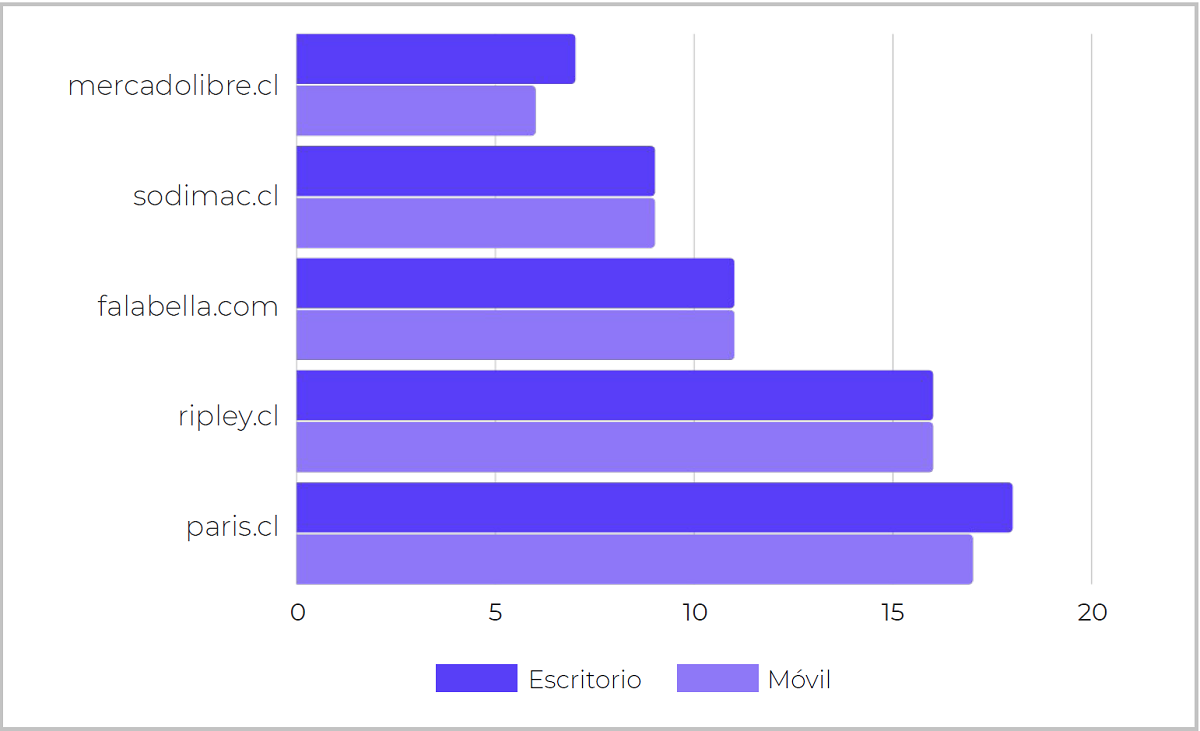
2- The average position of e-commerce sites in the search results for all keywords on Google Chile, in desktop and mobile versions, in the Home and Decoration category. We see that mercadolibre.cl has the best average position, being top 7 in the search results list on desktop computers and top 6 on mobile web:
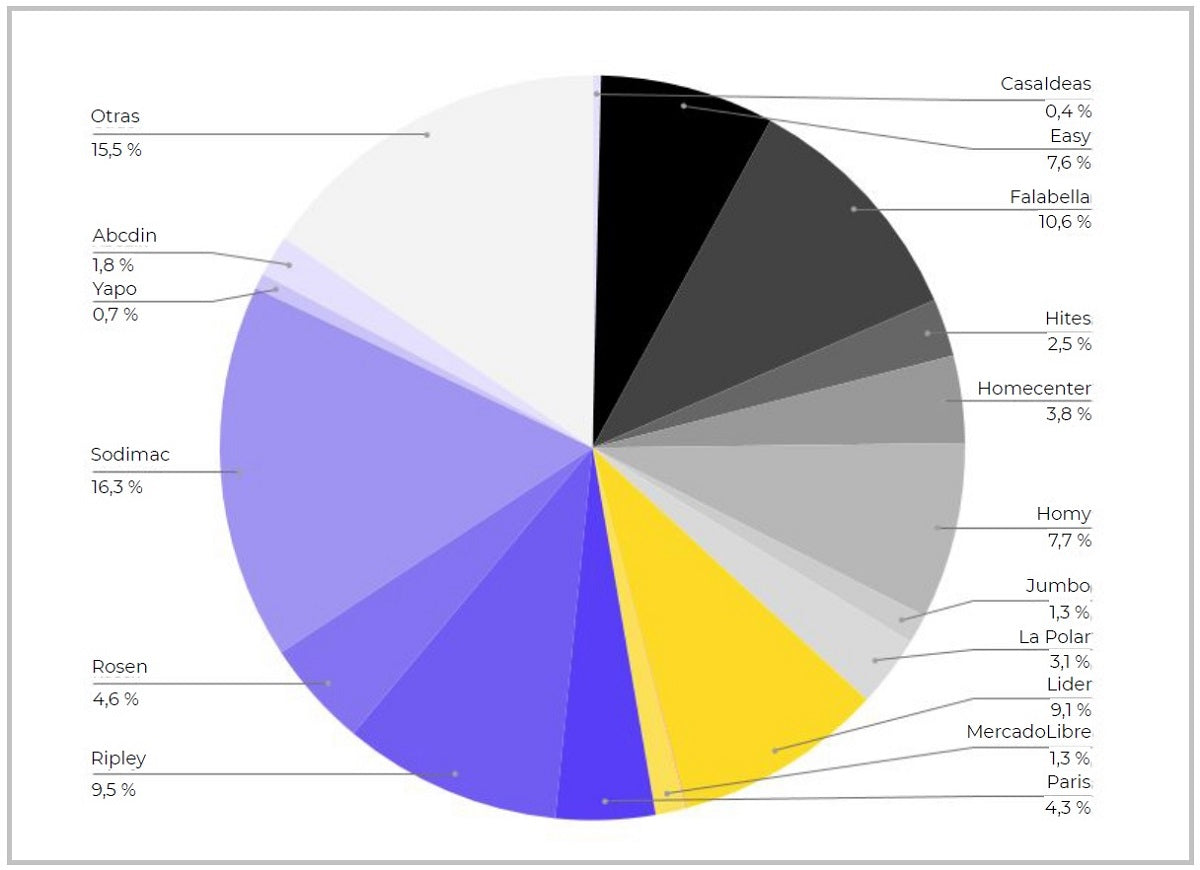
3- The Share of search or a brand's search share, based on the percentage of searches on Google. Like Share of Voice, it helps us guide and measure marketing and branding actions, and is a way to measure a brand's health.
So, we calculated the participation level based on over 1 million mentions that include a brand name and found that Sodimac takes the largest market share in the category with 16.3%.
And it is particular that their other brand, Homecenter, also appears in the ranking, so by adding it with Sodimac, we reach 20.1%, which makes it the biggest mental reference for Chilean buyers.
Do you see that conducting your first SEO Benchmarking research is not complex?
Tell us when you do your first benchmarking how your experience was and what SEO tools you used.
Share this article
Follow us on YouTube
Nuevas Economías, Research Thinking and FREED AI Studio: conversations and analysis on business, technology and human behavior (in Spanish).
Why are customer reviews important for brands? Find out why they should be part of your SEO strategy, how to get them, and how to transform them into social proof.

 By
By