Ethnography as a discipline provides us with a series of methods and tools that enrich the process of designing and developing solutions that meet the needs of a work team, helping teams build accurate customer archetypes.
Likewise, a new collaborative system ceases to be an IT development and becomes a multidisciplinary project that starts with the study of people in their work environment, to identify opportunities or gaps. Then, it continues with design and testing, to conclude with the iterative development of the solution.
Undoubtedly, ethnographic methods provide a qualitative approach to research in collaborative systems, delivering insights through the study of people, their culture, and the relationships and interactions that occur spontaneously.
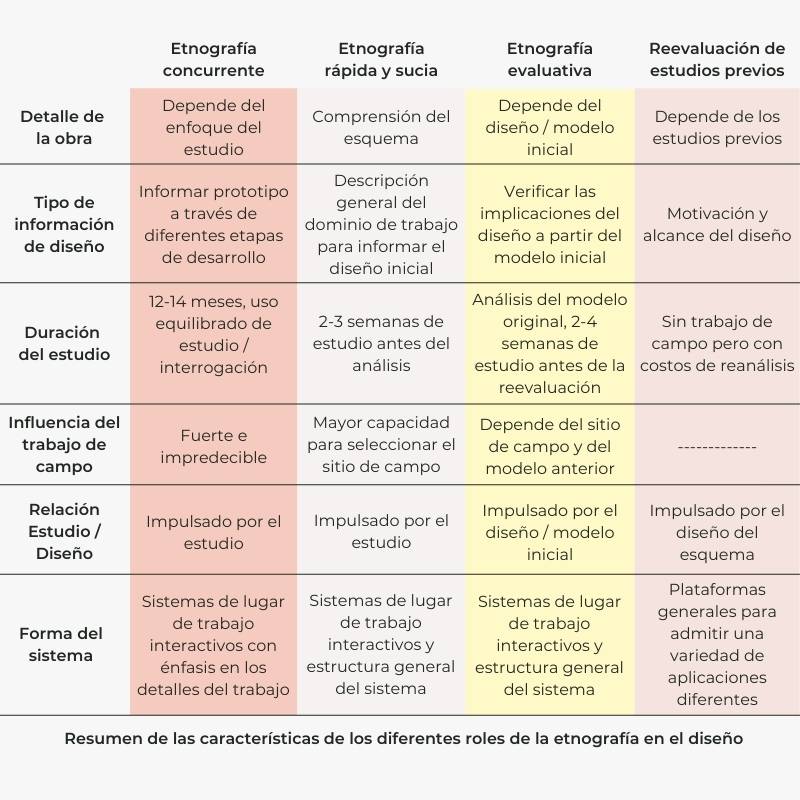
The following table summarizes the role of ethnography in system design (Hughes):
On the other hand, finding a fundamental link between ethnography and design, a kind of analytical rather than empirical connection, has not been trivial (Dourish, 2006).
According to Dourish's arguments, ethnography should "deliver facts – how people work, how they talk to each other, what they do when they sit in front of the computer – that can be translated into technological requirements and opportunities."
So, ethnography is valuable when it delivers more than descriptions of actions and interactions (Crabtree, 2009).
The authors speak of "exotic tales methodology," something that in practice and in our local reality is seen quite often: Who hasn't seen a significant amount of resources dedicated to impressing senior management with how much we approach people through studies?
It's almost an exotic activity to see your clients or collaborators through the researcher's lens.
But what happens next? How much time is invested in analyzing and critically reflecting before moving forward and designing solutions?
This gap between "what we saw" and "what we designed" has been observed on multiple occasions.
In the same work by Hughes cited earlier, the difficulties of transforming insights from fieldwork into a clear formulation of design objectives are mentioned.
A possible explanation for this gap may be the difficulty of moving from reporting observations during fieldwork to interpreting the nature of the actions occurring in the given place (Gajera and O'Neill, 2014).
When an ethnographer or sociologist participates in the research process, the same restrictions and rigid production release times become challenges for carrying out a rigorous analysis process (Gajera, Hughes).
Therefore, in the case of system redesign projects, it is preferable to approach them as "small redesigns in stages," rather than one large project.
That is, it is more valuable to consider shorter and more frequent periods of fieldwork than a single investigative process at the beginning, followed by a significant evaluation stage at the end.
As a framework, it is a similar vision to the lean methodology.
Now, ethnography is not the panacea for all system development problems (Hughes, 1994). Likewise, making the designer an ethnographer is not the magic potion to provide us with relevant insights.
It is fundamental and extremely valuable for both the designer and the developer to have the sensitivity and capabilities to get involved in the user research process.
To conclude, here are some questions or topics for reflection:
- How can we ensure that the senior designer, who already masters research methodologies and tools, doesn't become too "enamored" with fieldwork and loses interest in carrying out tasks related to "deliverables," such as designing prototypes or more refined interfaces?
- What happens to the objectivity of interpretation when we move from what we observe to what we think we should design?
- Is it preferable to incorporate an articulator – a person or instance – into the team between the role of the researcher (ethnographer, sociologist, or user experience designer) and the design and development role?
As supporting material, I leave you with a mini-class I taught some time ago: Introduction to ethnography (definitions, methods, tools) for design and development in collaborative systems.
- Crabtree, A., Rodden, T., Tolmie, P. (2009). Ethnography considered harmful. In CHI ’09 Proceedings of the SIGCHI Conference on Human Factors in Computing Systems, 879-888.
- Gajera, R., O´Neill, J. Ethnography in Parallel, In: Proceedings of the 11th International Conference on the Design of Cooperative Systems, 27-30 May 2014, Nice (France), 259-275.
- Hughes, J., King, V., Rodden, T., Andersen H. (1994). Moving Out from the Control Room: Ethnography in System Design. CSCW ’94: Proceedings of the 1994 ACM conference on Computer supported cooperative work.

 By
By ![Ethnography in the Design and Development of Collaborative Systems [Reflections]](/content-images/f170a584-etnografia-portada.jpg)