In today's competitive and ever-changing digital world, User Experience (UX) and Customer Experience (CX) are crucial for all brands looking to delight their users and build loyalty. However, both terms are often used interchangeably, when in reality they are two distinct but complementary disciplines. In this article, we will highlight the particularities of both so that you understand the difference between UX and CX, and ultimately, how to know your customer better.
Starting with a bit of history, UX (short for User Experience) was coined in the early 90s by Don Norman during his time at Apple. Simply put, User Experience encompasses all aspects of a user's interaction with a company, its services, and products.
So, UX focuses on designing technologies or making improvements that meet user needs without complications and also provide a pleasant and efficient experience. This discipline focuses on how the user feels with each interaction, including ease of use, efficiency, and overall satisfaction in using a system, product, or service.
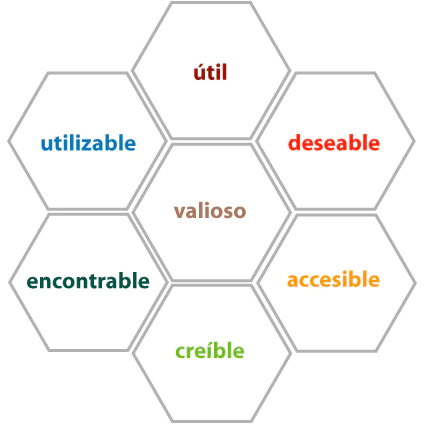
A good example to understand what UX is is Peter Morville's User Experience Honeycomb. This model groups the components that help design a good user experience and define priorities:
Here's a brief explanation of the UX components:
- It must be Useful, not a whim of a boss or the user themselves. We must ask ourselves if it is innovative and if it will truly help someone to satisfy a need.
- It must be Usable or Utilizable, easy to use.
-
Desirable refers to emotional design. No matter what you design, it must create a desire to use it.
-
Findable means that people can easily and practically find what they need.
- Designing something Accessible means thinking about all the people who are looking for that product or service with their possible limitations. More than 10% of people live with some type of disability. How do we make it easier for them to use our product or service?
-
Credible: Do users believe in what you are offering them? We must understand how to design the elements that influence user trust.
-
Valuable: It should not be limited to satisfying a user's need; it should also offer added value.
To establish its scope of action from the outset, let's look at what characterizes User Experience:
- It is user-centered, which means that it must be designed with the user in mind at every stage of the product or service lifecycle.
- It focuses on the specific interaction between the user and the product or service.
- It is measurable and quantifiable through usability tests designed to collect concrete data on design effectiveness.
Thus, User Experience helps us ensure that products or services meet user needs and also provide a positive user experience that fosters user loyalty and satisfaction. Therefore, investing in UX is highly profitable for brands.
On the other hand, CX (short for Customer Experience) offers a holistic view of the customer's interaction with the brand throughout the entire customer journey and lifecycle, including every touchpoint and their experience with the brand, both in digital and physical environments.
This discipline seeks to bridge the empathy gaps that UX cannot cover, offering a cohesive and satisfying brand experience.
Let's now look at the scope of action of Customer Experience, reviewing its main characteristics:
- Its vision is holistic, it is integral. This means it covers all interactions in different customer journeys with the brand, throughout its entire lifecycle.
- It includes UX as one of its components and an essential part, but it is not the whole of CX.
- It focuses on the long term and seeks to improve customer loyalty, satisfaction, and brand advocacy.
- It is measurable through customer satisfaction and loyalty indicators.
With what we've seen here, we can see that Customer Experience focuses on understanding and improving how the customer feels about the brand in general. That is, it is a discipline that helps us achieve greater customer satisfaction, build their loyalty to the brand, and encourage them to recommend it within their network of contacts.
To better understand how User Experience and Customer Experience contrast, let's look at the following table:
| Aspect | UX | CX |
| Focus | Specific interaction between user and product. | Holistic experience throughout the customer journey. |
| Objective | Satisfaction and efficiency in product use. | Satisfaction and loyalty towards the brand. |
| Measurement | Usability tests, conversion rate. | NPS, customer satisfaction, loyalty, repurchase, recommendation. |
| Components | Interface design, usability. | Customer service, marketing, UX, product quality. |
Although User Experience is a critical component of Customer Experience, it is important to note that the latter encompasses much more.
How is this? Well, it's explained like this:
While UX focuses on how the user interacts with a specific product or service, CX takes into account the customer's complete experience with the brand, from awareness to post-purchase and beyond.
Seen this way, UX can contribute significantly to a positive CX, but without an integral vision and a focus on all touchpoints, the overall customer experience can still fail to reach its full potential.
If you still have doubts, let's delve deeper into the difference between UX and CX, based on what we've seen so far:
-
Scope: UX focuses on specific products and services, while CX covers all aspects of the customer's interaction with the brand.
-
Perspective: UX is concerned with functionality and ease of use, CX with overall perception and emotion towards the brand.
-
Impact: Poor UX can affect a specific touchpoint, but poor CX can completely alienate the customer from the brand.
Knowing how to distinguish between User Experience and Customer Experience is fundamental for organizations facing markets with high competition and ever-increasing customer expectations.
Because it's not enough to offer excellent products; it's essential to provide memorable experiences. And brands that understand and effectively execute both UX and CX stand out in this highly competitive context, building customer loyalty.
Ultimately, UX and CX are allies in the mission to provide exceptional experiences, and recognizing that their roles are distinct but complementary is the first step to designing experiences that exceed customer expectations.