The nominal group brainstorming technique combines individual, silent work with an organized sharing session and a final vote, avoiding the typical chaos of an unstructured verbal brainstorm. It ensures that everyone on the team participates equally and that the session ends with a clear ranking of ideas, not just a scattered list on a whiteboard.
The nominal group technique was created to solve a classic problem with verbal brainstorming: a few people end up dominating the conversation while the rest participate little. It involves asking each participant to generate their ideas individually and in writing before sharing them, and then structuring the sharing session turn by turn, instead of letting whoever speaks first take the floor.
It is, in a sense, a close cousin of brainwriting: both start with a moment of silent writing. The difference is that the nominal group adds an explicit phase of oral sharing round by round and always ends with a formal vote.
| Aspect | Classic Brainstorming | Nominal Group |
|---|
| Generation | Out loud, no fixed turns | Individual and in writing |
| Participation | Unequal, dominated by those who speak most | Even for everyone, with turns |
| Closure | Open list, no prioritization | Formal voting with ranking |
| Main Risk | Ideas from few people, dispersion | Session is slightly longer due to order |
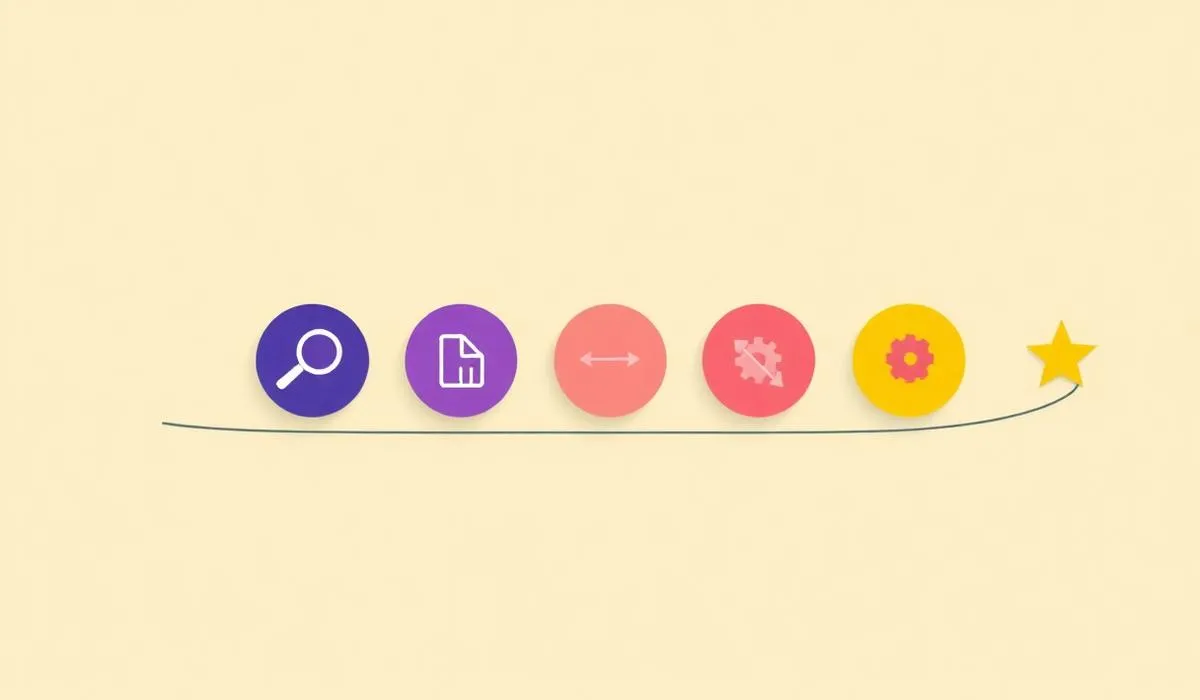
- 1. Problem Presentation: The facilitator poses a specific question and writes it visibly for the entire team.
- 2. Individual and Silent Generation: Each participant writes down their ideas on a sheet of paper or post-its, without talking to anyone.
- 3. Turn-by-Turn Sharing: The group goes around in a circle; each person shares only one idea per turn (not their entire list at once), and rounds are repeated until no new ideas emerge.
- 4. Clarification: Questions about the meaning of each idea are clarified, without discussing whether it is good or bad yet.
- 5. Voting: Each person chooses their preferred ideas within a limited number of votes.
- 6. Closing with Ranking: Ideas are ordered according to the votes received, and it is decided which ones will be worked on first.
In an in-person workshop with teams of 5 to 6 people, these are the times we usually use so that the dynamic doesn't extend beyond an hour:
| Block | Approximate Duration |
|---|
| Problem Presentation | 5 min |
| Individual Generation | 10 min |
| Turn-by-Turn Sharing | 15-20 min |
| Clarification | 5-10 min |
| Voting | 10 min |
| Total | 50-55 min |
The simplest and most frequently used method is dot voting: each participant receives 3 to 5 adhesive dots (or marker marks if virtual) and distributes them among the ideas on the wall, being able to place several dots on a single idea if they are very convinced. Finally, the dots per idea are counted, and the ranking is created for everyone to see, without the need for additional discussion.
A more formal variation is to ask each person to rank their 5 favorite ideas from highest to lowest preference, assigning scores (5 for the first, 4 for the second, and so on), and then sum the scores from the entire group. This variation takes more time but is useful when there are many similar ideas and simple dot voting is not enough to differentiate them.
Post-its or cards, markers, a large wall or whiteboard, adhesive dots for voting (or their digital equivalent on a collaborative board), and a visible timer. Before the session, it's advisable to have the problem formulated concisely and visibly, just like in brainwriting.
- Letting someone share their entire list of ideas in one go during their turn, instead of one idea per round: this again favors those who have more ideas written down, breaking the balance that the technique aims to provide.
- Allowing judgmental comments ("that idea is useless") during the clarification phase, instead of reserving them for after the vote.
- Skipping the formal vote and informally deciding which ideas seemed best, losing track of why each one was chosen.
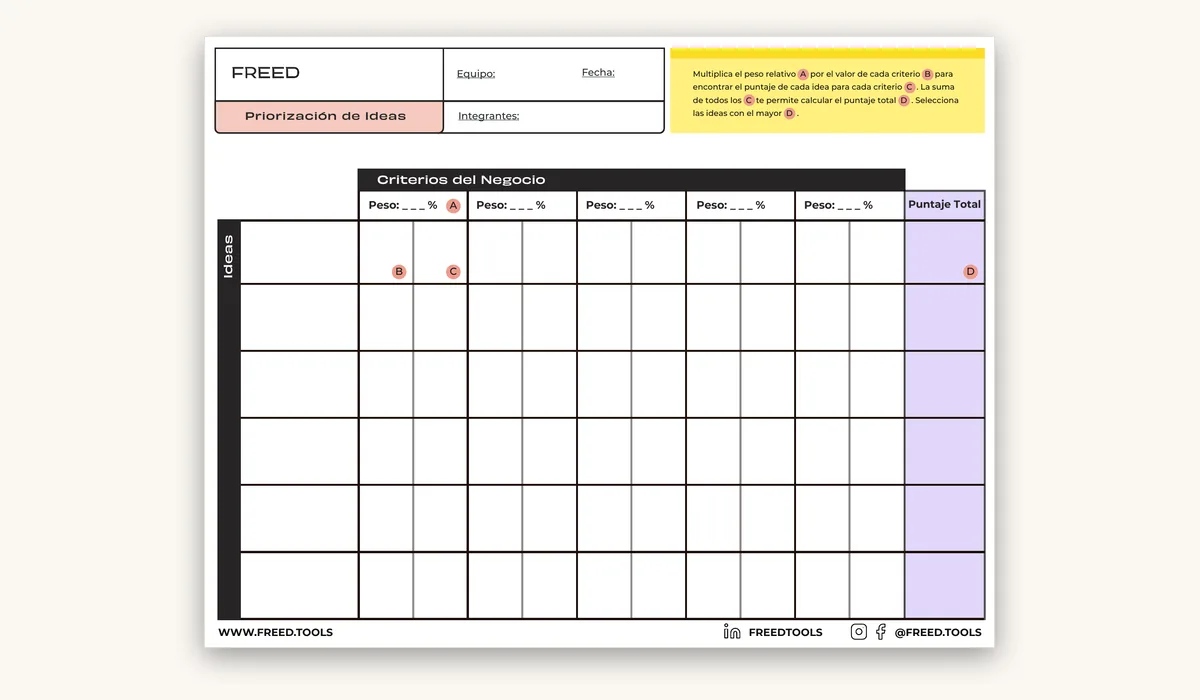
With the ranked list of prioritized ideas, the next step is to take the 2 or 3 most voted ones to a deeper convergent thinking stage, evaluating them against impact and effort criteria, and then building a prototype of the one with the best relationship between the two.

 By
By