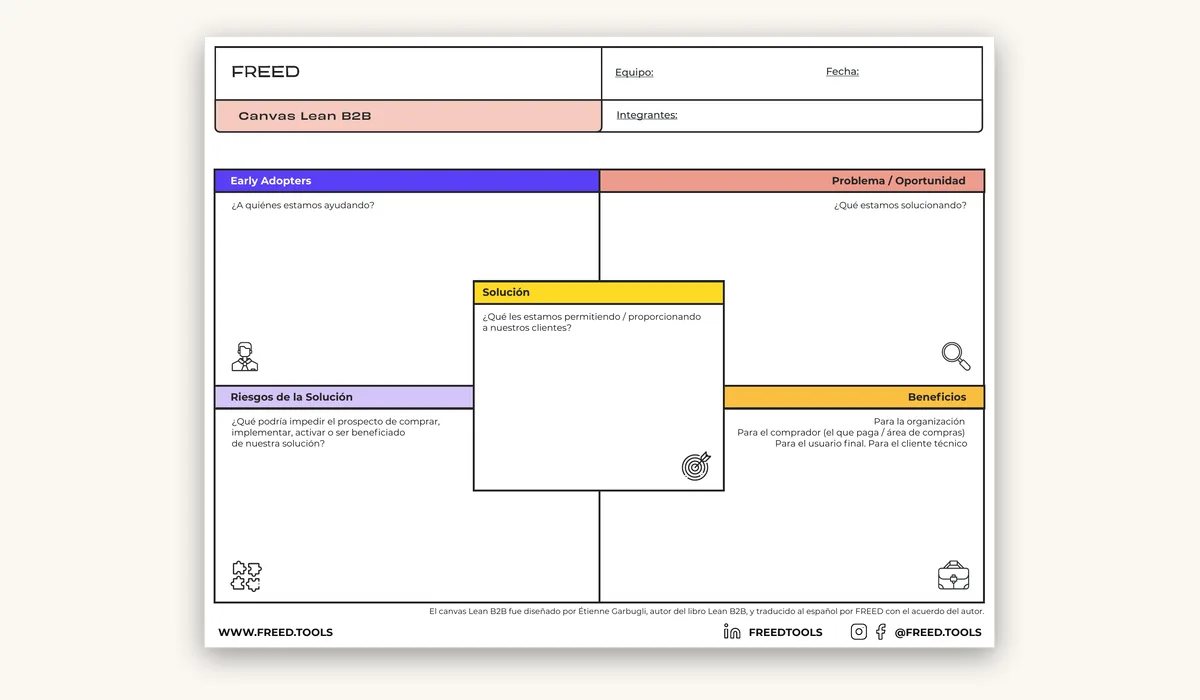
The Lean Canvas and the Lean Canvas B2B are single-page templates that help describe and test a business model before investing in its development. However, they differ in the blocks they prioritize, depending on whether the customer is an end-user or an organization with its own purchasing process.
The Lean Canvas is an adaptation of the Business Model Canvas, geared towards startups and projects with high uncertainty. On a single page, it summarizes the problem, solution, value proposition, channels, customer segments, cost structure, revenue streams, key metrics, and unfair advantage (what competitors cannot easily copy). Its strength lies in forcing concrete hypotheses, not vague aspirations, into a deliberately small space.
In our workshops, we use it right after prioritizing ideas with an idea prioritization matrix, because each selected idea needs to become a testable business model before moving to prototyping.
The Lean Canvas B2B emerged from a real limitation of the classic canvas: when the client is a company, the payer, the decision-maker, and the product user are often three different people, and the original canvas doesn't have space to represent this complexity. The B2B version adds or splits blocks to explicitly distinguish between the end-user, the buyer (who controls the budget), and, in some cases, the technical influencer who approves the purchase.
It also adjusts the channels block to reflect longer sales processes (with meetings, pilots, and contracts) instead of mass acquisition channels typical of a consumer product.
| Block | Classic Lean Canvas | Lean Canvas B2B |
|---|
| Customer | An end-user segment | User, buyer, and influencer distinguished |
| Problem | End-user problem | User problem and buyer's business pain |
| Value Proposition | Direct benefit for the product user | Benefit for the user and ROI for the buyer |
| Channels | Digital marketing, social media, referrals | Consultative selling, partnerships, commercial references |
| Revenue | Subscription or individual one-time payment | Contracts, per-seat licenses, annual agreements |
| Key Metrics | User adoption and retention | Sales cycle, contract renewal rate |
It is suitable when the product is sold directly to the person who uses and decides, without corporate intermediaries: a personal finance app, a niche e-commerce, or a subscription service for consumers. For example, in a workshop with a team developing a savings habit app, the classic Lean Canvas was sufficient because the same person downloaded the app, used it, and decided to pay for the premium version.
This is the correct option when the project involves a corporate sales cycle: management software for SMEs, an internal tool for an HR department, or a service that requires purchasing approval. In a workshop with a team designing a training platform for companies, distinguishing between the end-user (the employee taking the course), the buyer (the HR manager), and the influencer (the technology team reviewing data security) completely changed the value proposition they ended up writing.
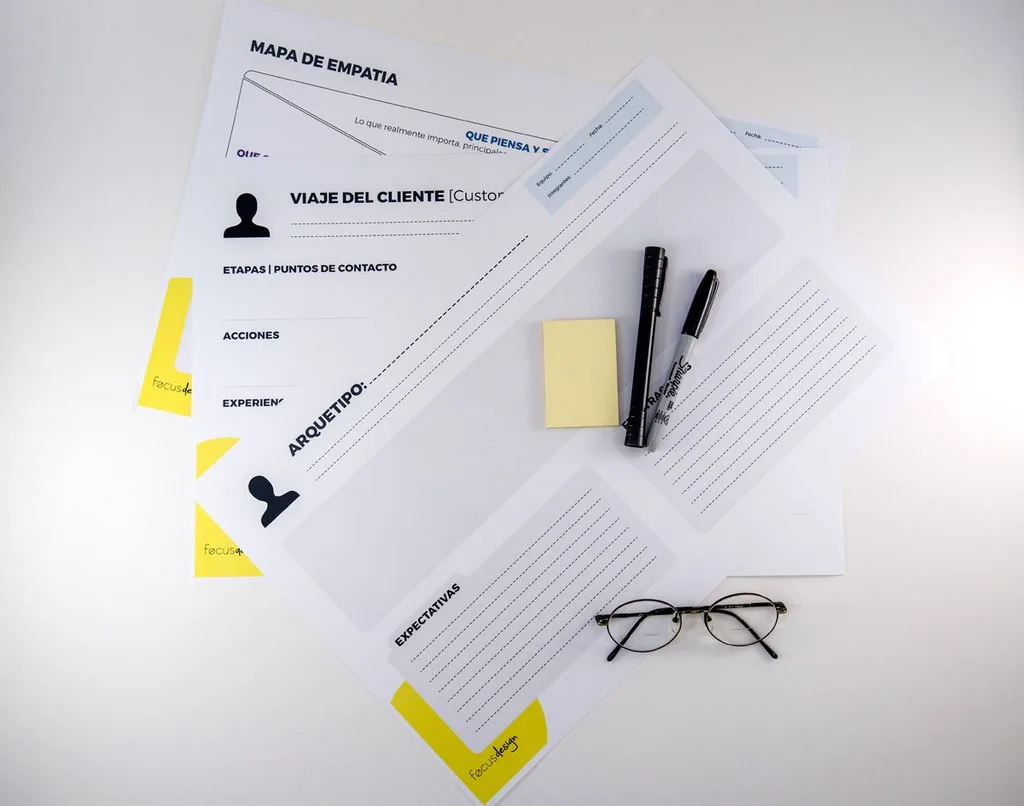
The sequence we use with teams of 3 to 6 people, with the template printed poster-size and different colored post-its for each block:
- Start with the problem and customer segment, never the solution.
- Complete each block with short phrases, one idea per post-it, avoiding long paragraphs.
- In the B2B version, dedicate an explicit moment to name who uses, who buys, and who influences, before continuing with the rest of the canvas.
- Leave the cost structure and key metrics for the end, as they depend on decisions made in previous blocks.
- Conclude by identifying the three riskiest hypotheses, which will be validated first with in-depth interviews or a simple prototype.
- Filling the canvas with certainties instead of hypotheses. Each block should read as something yet to be proven.
- Confusing user and buyer in a B2B project. This is the most costly mistake, as it leads to building a value proposition that doesn't convince the person who actually signs the contract.
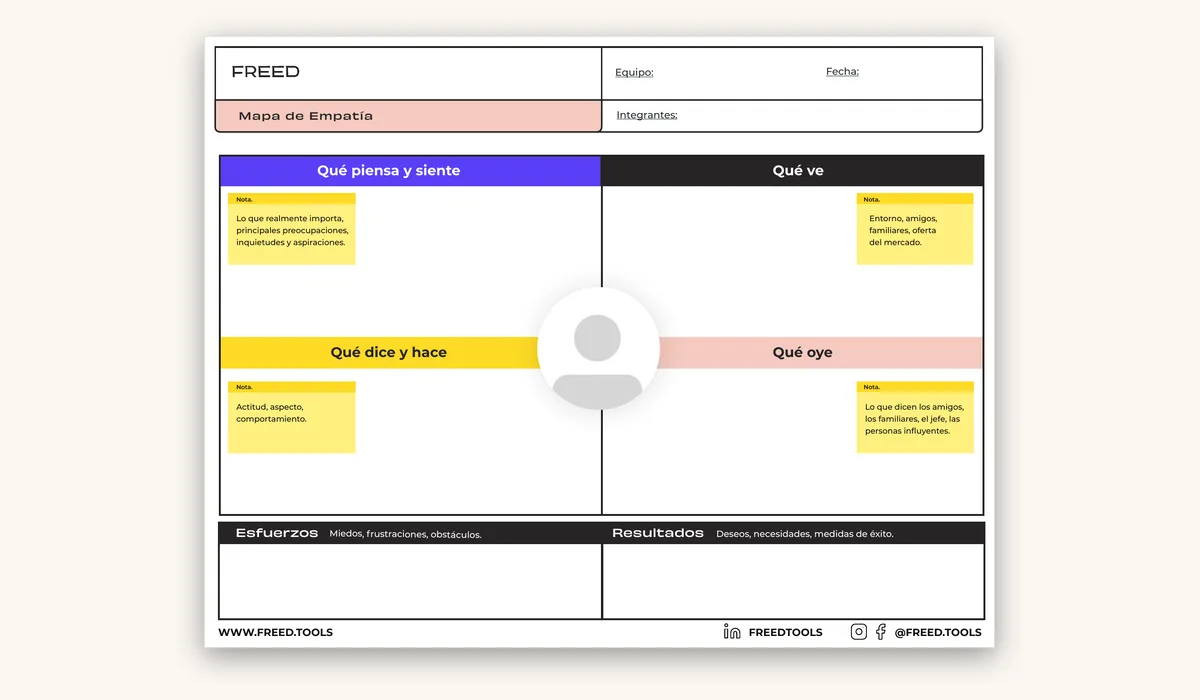
- Skipping the empathy map before writing the canvas. Without first understanding the motivations of each stakeholder, the canvas is filled with generic assumptions.
- Not reviewing the canvas after each validation round. The Lean Canvas is a living document, not a deliverable completed only once.
A simple question resolves most cases: Is the person who will pay the same person who will use the product every day? If the answer is yes, the classic Lean Canvas is sufficient. If the answer is no, or if more than one person is involved in the purchase decision, it's worth investing the additional ten minutes it takes to complete the B2B version, as it avoids building a value proposition aimed at the wrong person.
In teams working simultaneously on a consumer product and a corporate business line, we have seen good results by filling out both canvases in parallel during the same workshop session, comparing side-by-side how the problem, channels, and key metrics change depending on the customer type. It's also worth documenting the assumptions that turned out to be false in the first round, as they often repeat in similar projects within the same organization.
If you're interested in seeing how we facilitate these exercises in real workshops, you can subscribe to the FREED YouTube channel.

 By
By