The idea prioritization matrix is a visual tool that organizes initiatives generated in a brainstorming session according to two or more criteria, typically impact and effort, to decide with the team which ones to prototype first. It helps to move from "we have twenty sticky notes" to "we know which three to start with," using explicit and shared criteria.
After a good brainstorming or SCAMPER session, a team usually ends up with fifteen, twenty, or thirty ideas written on sticky notes. The problem is no longer generating ideas, but deciding which ones to move forward with, without the choice depending on who spoke the loudest in the room. The prioritization matrix solves this by making decision criteria explicit before discussing each idea individually.
In our two-day workshops, we dedicate 45 to 60 minutes to this activity right after grouping and refining duplicated ideas. It's a turning point: the team moves from the divergent (generating) to the convergent (selecting) stage, and needs an explicit change of energy and rules to achieve this.
The most commonly used version is a quadrant with two axes: impact (how relevant the idea is to the user or business) on the vertical axis, and effort (time, money, technical dependencies) on the horizontal axis. This creates four zones:
- High impact, low effort: "quick wins," prioritized first.
- High impact, high effort: strategic projects, planned for the medium term.
- Low impact, low effort: done if there's spare time, without much analysis.
- Low impact, high effort: discarded or archived.
To set it up in an in-person workshop, we draw the quadrant on a large flip chart and ask each participant to physically place their sticky notes according to their own perception, without discussing yet. This silent first pass prevents the first person to speak from "anchoring" the criteria for the rest.
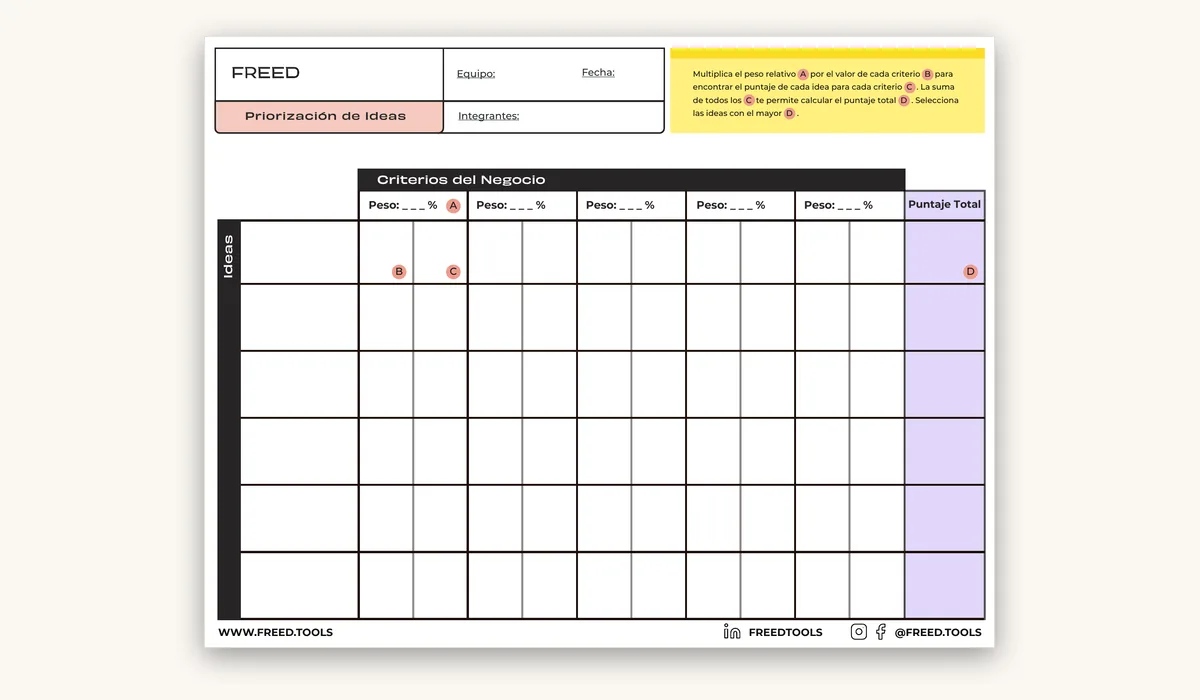
When impact and effort are not enough (for example, in projects where regulatory risk, strategic alignment, or data availability also weigh in), we use a weighted matrix. It's set up as a table: each row is an idea, each column is a criterion with a percentage weight assigned by the team before scoring, and the result is a total score per idea.
| Idea | Customer Impact (40% weight) | Technical Effort (30% weight) | Strategic Alignment (30% weight) | Final Score |
|---|
| Onboarding Redesign | 5 | 3 | 4 | 4.1 |
| New Support Channel | 3 | 4 | 2 | 3.0 |
| Automate Quotes | 4 | 2 | 5 | 3.7 |
Each criterion is scored on a scale of 1 to 5 and then multiplied by its relative weight. This version takes more time (between 60 and 90 minutes with a team of 4 to 6 people) but provides a more defensible result to a committee or sponsor who asks to justify why one idea was chosen over another.
The biggest risk of any matrix is that it ends up reflecting the opinion of the person with the most seniority or charisma in the room. To avoid this, in our workshops we follow three simple rules:
- Silent, individual scoring first. Each person assigns their scores privately, with numbered sticky notes or dot votes, before any open discussion.
- Average, don't negotiate aloud. The final score is the average of all individual scores, not the result of a discussion where the most insistent person wins.
- Discuss only outliers. If an idea has very dispersed scores (for example, someone scored it a 5 and another person a 1), then we open a two or three-minute conversation to understand the difference in criteria, not to convince the other person.
This method significantly reduces the effect of hierarchical bias, something we have seen repeatedly in teams where both junior analysts and managers participate in the same session.
A sequence that has worked well for us in two-day innovation workshops, with groups of 3 to 6 people per table:
- Group and eliminate duplicate ideas from the previous generation exercise.
- Explain the criteria and their weights, and validate them with the team before scoring (not after).
- Score individually and silently, with a time limit of 10 to 15 minutes.
- Consolidate the scores in the matrix, either manually on a flip chart or in a digital template.
- Discuss only ideas with dispersed scores or those close to the cut-off threshold.
- Conclude with a maximum of three to five selected ideas to move to the next stage of the process.
- Prioritizing without having clearly defined the problem. If the design challenge is ambiguous, any matrix will produce unhelpful results.
- Using too many criteria. More than four or five criteria makes the session slow and confuses participants; fewer, well-chosen criteria are better.
- Estimating effort without a technical person in the room. The effort axis loses meaning if no one can provide real knowledge about implementation complexity.
- Not setting in advance how many ideas will move forward. Without a target number, discussions drag on and the group avoids making difficult decisions.
Ideas that fall into the "high impact, low effort" quadrant or have the highest score should not go directly into production: it's advisable to first take them to a Lean Canvas or a Lean Canvas B2B if the project is for a corporate client, to test assumptions before investing in development. It's also good practice to document why other ideas were discarded, because that information prevents the same discussions from repeating in the next workshop.
If you want to see these facilitation dynamics applied in video, you can subscribe to the FREED YouTube channel.

 By
By