What does omnichannel mean in practice? First and foremost, adopting an omnichannel approach to customer experience (CX) management goes beyond technology.
And in this regard, I want to present a business case analyzed from the perspective of the maturity model I developed in my PhD, which is based on 8 dimensions, each with its criteria:
-
Business strategy.
-
Omnichannel management.
-
Customer Experience.
-
People and culture.
-
Data and analytics.
- Processes
- Technology
-
Brand management.
ASICS is a brand specializing in the manufacture and sale of sports products, mainly footwear and apparel, founded in Japan in 1949. ASICS stands for "Anima Sana In Corpore Sano" (Latin), meaning "a sound mind in a sound body."
I chose ASICS for this case study analysis because it is a company that was not born omnichannel, but omnichannel is part of its business strategy, as shown in several of its annual reports.
Furthermore, it caught my attention, somewhat due to professional bias. My researcher hat leads me to analyze different brands with which I interact as a user or consumer. I have known ASICS for many years, ever since I started running. I wear ASICS shoes, among other brands, so I had the opportunity to observe it over time and in different contexts (sports events, the Internet, third-party stores, among others).
For this analysis, I primarily used secondary data sources, such as the company's annual reports, press releases, cases presented by technology providers working with ASICS, as well as my experience with the brand (mystery shopping or participant observation sessions).
Below, I present the definitions of omnichannel experience and its application through the aforementioned maturity model. In this article, I will emphasize the Business Strategy dimension.
2- Context
With the aim of leveraging its business strategy and providing an exceptional customer experience, ASICS has decided to implement omnichannel in its operations. This strategy seeks to integrate all sales and communication channels to offer a consistent and fluid experience, regardless of the customer's touchpoint with the brand.
Now, ASICS' omnichannel strategy is centered on e-commerce (ASICS, 2020), but that doesn't mean forcing the customer to buy exclusively through e-commerce; quite the opposite, as we will see later.
ASICS' omnichannel strategy aims to provide a unified and recognizable brand experience, regardless of the channel customers choose to interact with the company. Currently, ASICS products are sold through wholesale (distributors), retail, and e-commerce channels.
All of this occurs within a market context in which the pandemic accelerated the adoption of e-commerce by people, but also sparked an awakening: greater awareness of the importance of health and a digital-based lifestyle.
ASICS Integrated Report 2020.
3- The business context
-
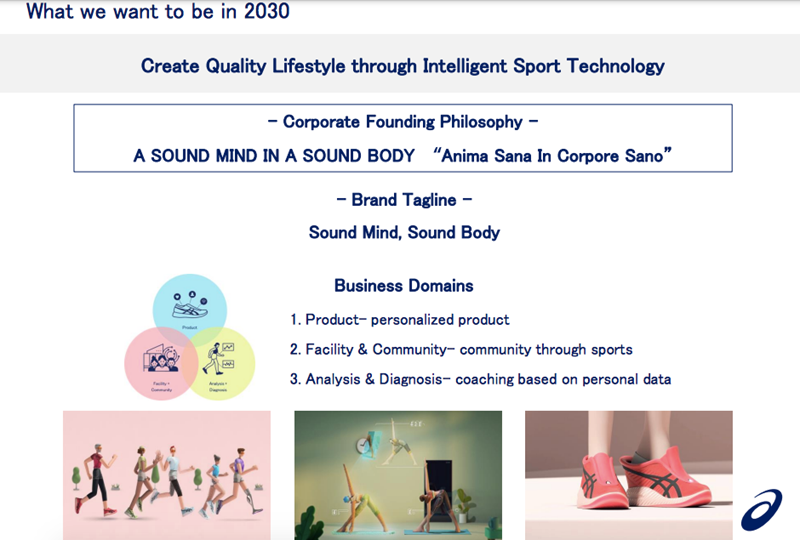
Vision 2030: Create a quality lifestyle through smart sports technology.
-
Corporate founding philosophy: Sound Mind, Sound Body.
-
Brand tagline: Sound Mind, Sound Body.
ASICS thus defines itself as being in 3 businesses:
- Product: personalized product.
- Facilities and community: community through sport.
- Analysis and diagnosis: training based on personal data.
Image source: ASICS Mid-Term Plan 2023
Beyond the declarations of good intentions that anyone can read in the reports cited at the end of this article, there are concrete decisions and actions that support the strategy.
And we can also perform an analysis using our Omnichannel CX Management Maturity Model with the criteria that make up the "Business Strategy" dimension:
-
Top-down priority: ASICS has established omnichannel customer experience as a strategic priority, supported by its executive leadership and the commitment of the company's senior management (ref.: annual reports).
-
Customer-centricity: ASICS' strategy is based on a deep understanding of customer needs and desires, which is reflected in the development of innovative and personalized products (ASICS, 2020).
-
Willingness to invest: ASICS has demonstrated its willingness to invest in digital technologies and channels to support its omnichannel strategy. For example, they have made significant investments in technological infrastructure and in optimizing their website and mobile applications (ASICS, 2023).
-
Service and business model: On the one hand, ASICS has evolved its business model to offer services beyond product sales, such as personalized training programs and expert advice. On the other hand, ASICS seeks to transform into a highly profitable company in markets such as Korea, and to grow again through business reconstruction in the Latin American market (ref.: ASICS, 2020).
-
Every transaction counts: ASICS considers the value of each customer and seeks to build long-term relationships. For example, they offer exclusive discounts and special promotions for members of the OneASICS loyalty program.
-
Business partners: ASICS partners with reliable and quality product and service providers to ensure excellence in its products and provide a satisfactory customer experience.
Like most companies that were not born digital, ASICS is transitioning from multichannel to omnichannel. This process means a series of changes and the evolution of its business model and its approach, from a product-based one to a customer and experience-based one:
“Customers can enjoy the advantages of each sales channel, whether trying on items to find a comfortable fit while consulting with sales staff in a retail store or enjoying the convenience of shopping online; we are considering using both methods and plan to accelerate digital investments to create an omnichannel approach. (...) if we can integrate a variety of customer data through omnichannel developments between e-commerce and retail stores, we can expect not only effective marketing activities but also an improvement in customer satisfaction.”
(Mitsuyuki Tominaga, Managing Executive Officer; General Manager, IT & Digital (CDO) and CEO, ASICS Digital Inc. - cited in ASICS Integrated Report 2020).
“That’s what we’re specifically going for with an omnichannel vision and a customer-centric vision, and we’re evolving ASICS from a product-centric approach to a customer-centric approach as a global business strategy.”
(Alice Mitchell, Global Head of Omnichannel, ASICS - cited in CMO, 2019).
Thinking about your favorite brands or the ones you know best, have you seen other cases of omnichannel put into practice? Tell me in the comments.
If you've made it this far, it's because you're interested in omnichannel customer experience management. Then, you could evaluate your company with our online maturity model.
The original version of this article was published on LinkedIn for the Omnicanalidad en español Newsletter. You know, you can also follow me on that platform.

 By
By