In previous articles, I've told you what the Maturity Model for Omnichannel Customer Experience (CX) Management is and the dimensions that evaluate a company's performance. Well, the time has come to talk about the factors that drive organizations to begin their journey from multichannel to omnichannel and how this transition is facilitated.
To give you some context, I got into omnichannel CX management while pursuing my doctorate. Originally, when I chose omnichannel experience management as my thesis research topic, I thought I'd first explore what it means to be omnichannel from the perspective of professionals in charge of customer experience. I soon realized that most professionals didn't envision their company as omnichannel, so I had to first look at the process of becoming omnichannel.
It was then that I set out to understand how organizations approach CX management and evaluation in an omnichannel context. To do this, I conducted interviews with professionals in charge of customer experience-related areas.
Already in my first interviews, prior to the COVID-19 pandemic, it became clear that most teams did not perceive their organization as omnichannel. Therefore, the research question became:
"What are the characteristics of the transition process from multichannel to omnichannel CX?"
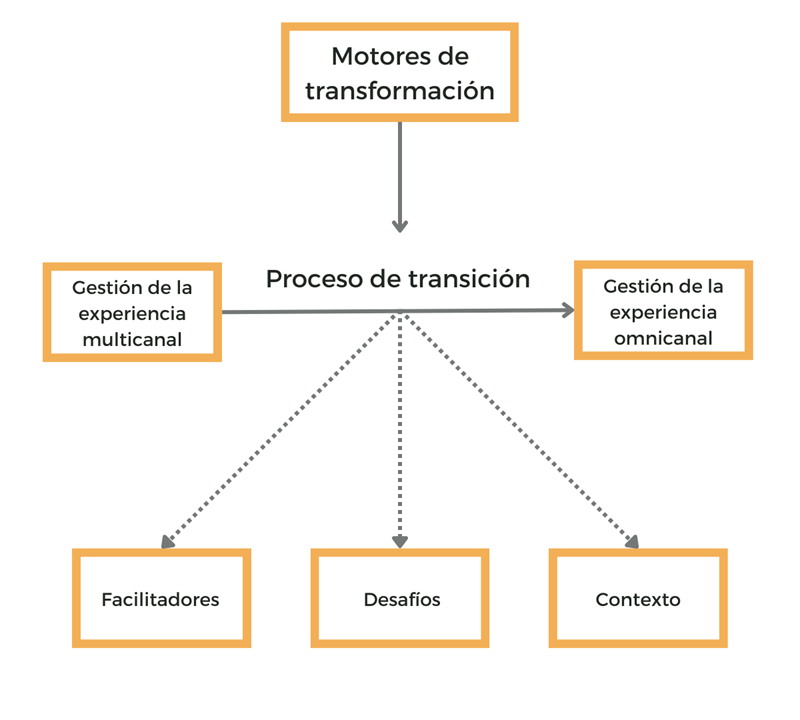
I reformulated the objectives to understand this process, which resulted in an initial framework representing the facilitators, challenges, and contextual factors that organizations must face during this transition process (Gerea and Herskovic, 2022).
This framework was validated with professionals through group interviews (more methodological details in the reference paper at the end of the article). And here I pause because the context led to a new fundamental component for the framework: these group interviews were conducted remotely because they took place during the strictest lockdown measures of the COVID-19 pandemic, a situation that allowed me to identify the existence of Transformation Drivers for the transition from multichannel to omnichannel.
I also confirmed that this transformation process accelerated during this period.
After validation with professional teams, this is the definitive framework:
Figure: Conceptual Framework - translated from English (Gerea and Herskovic, 2022).
In summary, in this framework, we can identify the following components, considering the professionals involved in the transition process towards omnichannel:
Facilitators are those elements that make the transition process from multichannel to omnichannel possible:
- Strategic customer-centric mindset at scale.
- Customer-centric brand outcomes.
- Unified CX metrics.
- Integrated systems.
- Willingness to invest.
The main challenges companies face during their journey from multichannel customer experience to omnichannel customer experience are:
- Human talent.
- Organizational behavior.
- Organizational culture.
Transformation drivers are elements that force transformation, those that determine change:
-
COVID-19: The almost complete closure of offices in many industries led to accelerated digitalization for numerous companies. For those that already had multiple channels and touchpoints, the pandemic forced them to take the omnichannel path to ensure greater synergy between these channels, both from a consumer perspective and from an organizational efficiency standpoint.
-
Customer acquisition: Having to secure sales or sustain growth forces companies to look for ways to optimize processes, and offering an omnichannel experience is a way to differentiate themselves.
-
Post-sales customer relationships: Companies must rethink their customer journeys and find better approaches to acquire, attract, convert, and retain customers through positive brand experiences.
4- Contextual factors
In this component, we identify macro trends that shape the competitive landscape for service-based companies. These are:
-
Industry changes: If your direct competitors evolve, that forces you to do so as well.
-
Mental references: There are industries or companies that serve as mental references for both customers and professionals within companies.
-
Commodification of services: A bank offering a checking account or a telecommunications company offering a phone line is the baseline. No one will differentiate themselves by something that is the norm anymore.
-
Evolution of customer needs: Not only have we changed the way we interact, but our needs have also been mutating and continue to evolve according to a series of social and personal factors.
As in any transformational process, transitioning from multichannel to omnichannel arises because there is something within the organization and, in our case, in its industrial, social, and general market context, that forces it to move from one state to another.
Likewise, the transition from multichannel to omnichannel is facilitated when it becomes a top-down strategic priority within the organization, when there is a willingness to invest in systems, people, and processes, with an integrated brand vision and integrated customer-centric metrics.
Finally, let's remember that the customer does not interact with contact channels but with a brand, so all this behind-the-scenes work is ours, it belongs to the organization. Out there, no one cares how it's done; what matters is that for people, the experience of both purchasing and subsequent interaction with the brand is fluid, coherent, and consistent.
To conclude, I leave you with a question: what factors are influencing whether your company transitions to omnichannel or not?
If you've made it this far, it's because you're interested in omnichannel customer experience management. So, you could evaluate your company with our online maturity model.
The original version of this article was published on LinkedIn for the Omnicanalidad newsletter in Spanish. You know, you can also follow me on that platform.
Gerea, C. & Herskovic, V. (2022). Transitioning from Multichannel to Omnichannel Customer Experience in Service-Based Companies: Challenges and Coping Strategies. Journal of Theoretical and Applied Electronic Commerce Research, 17(2), 394-413.

 By
By