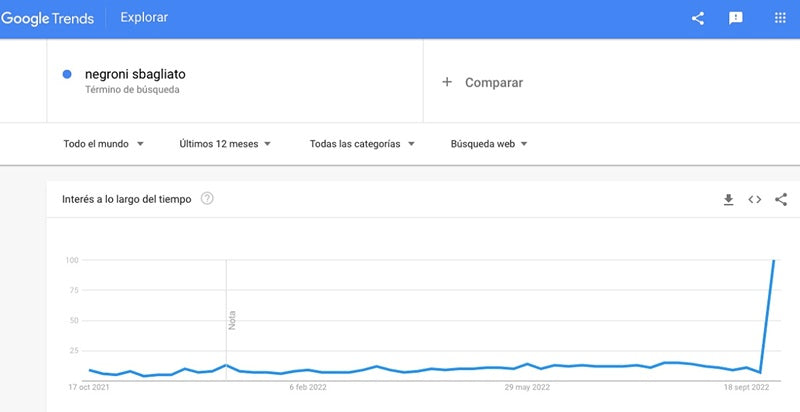
Have you had your Negroni Sbagliato with Prosecco this week? Not yet? Or maybe you have no idea what it is. Well… It's a drink that went viral on TikTok a while ago and, if you didn't hear about it there, maybe you saw it on Instagram.
As a result, it's very likely that Google searches for it skyrocketed at the time:
This example of a drink going viral is an extreme case, but let's be clear: every day we
evaluate, recommend, and spread the word about brands and products on a small or large scale. The internet and the use of mobile devices have facilitated a type of communication that already existed: word-of-mouth.
<p>
Picking up on the Omnichannel Customer Experience Management Maturity Model, let's remember that the Customer Experience (CX) dimension evaluates a company's capabilities to design a desired experience (a benchmark) and deliver it seamlessly throughout the customer lifecycle, via the appropriate channels that customers can choose.
The Customer Experience dimension includes several criteria, among which I will highlight the following:
Word-of-mouth: Our company understands how word-of-mouth affects our consumers' decisions in both traditional and digital environments.
<p>
After the central theme (word-of-mouth), the key word in the previous sentence is "understands."
<p>
And it says "understands" because what we are looking for is for companies to understand, become aware, and see how they can influence word-of-mouth, not control it. Why? Because fundamentally, word-of-mouth depends on what other people say about your brand and, therefore, is beyond your control. Although you can influence it.
Now, let's see how and why that is important, recalling some fundamentals of marketing, communications, and consumer behavior science.
Traditionally, in marketing and consumer behavior, word-of-mouth is verbal communication that occurs in person (face-to-face) and involves two parties:
- A consumer who expresses an opinion, a perception about a product or service, and
- another who receives that opinion.
Likewise, word-of-mouth is informal communication that can be used to evaluate products and services, and it is not part of the formal communications between consumers and a company (Anderson, 1998).
Word-of-mouth influences decision-making, shapes our attitudes as information recipients, and predisposes us positively or negatively to interact with a brand (Siqueira et al., 2019).
In general, both in industry and academia, there is a consensus that consumers trust other consumers more than traditional media (Goldsmith and Horowitz, 2006).
If we add to that the rise of user-generated content and the fact that brand communication with people has long ceased to be one-way, the possibilities we have as consumers to recommend brands, content, and express opinions are endless.
Some of these possibilities are:
- Leaving a product review on Amazon or another marketplace.
- Reviewing a local business on Google (Google Business Profile).
- Reviewing a brand on Facebook.
- Recommending a product to a friend who is actively looking for a solution.
- Recommending a supplier on LinkedIn.
- Making an unboxing video on Instagram.
- Taking photos and tagging a brand in an Instagram story.
- Sharing a blog article with friends, family, or colleagues.
- Recommending a business solution to a partner or colleague because we have tried it before.
These are just a few examples we find in all spheres of life, personal (B2C) or professional (B2B), that can apply to products or services, and as marketers, we must be aware of word-of-mouth and how it influences the building of relationships between brands and consumers.
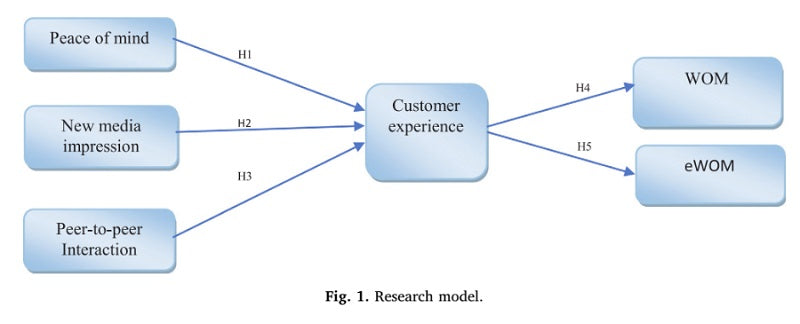
There are several validated instruments for measuring word-of-mouth. Here is one built by a team of researchers and used with Falabella Colombia to validate the relationship between CX and traditional and digital word-of-mouth.
Basically, they had several hypotheses, of which they validated 3 (h3, h4, and h5, in the following image):
Image source: Siqueira et al., 2019.
To do this, they constructed an instrument (survey) that had the following statements (Siquiera et al., 2019):
Word-of-mouth
- You mention to others that you do business with Falabella.
- You make sure others know you do business with Falabella.
- You speak positively about Falabella employees to others.
- You recommend Falabella to family members.
- You speak positively about Falabella to others.
- You recommend Falabella to acquaintances.
- You recommend Falabella to close friends.
Digital word-of-mouth
- You say positive things about the company on social sites like Facebook.
- You use social media to encourage friends and family to buy the company's products.
- You recommend the company on social sites like Facebook.
- You become a fan of the company's brand pages on social sites like Facebook.
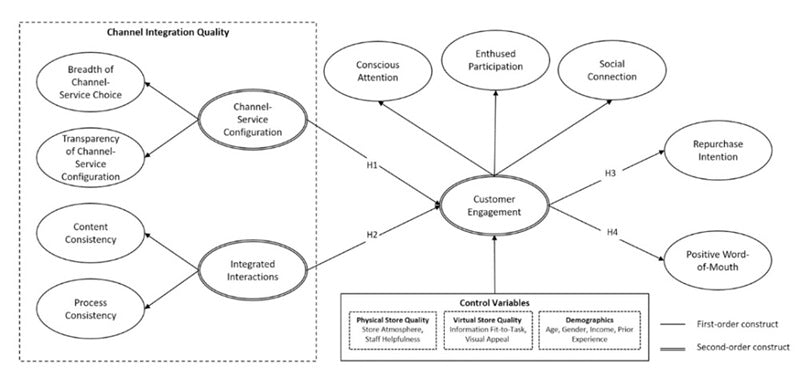
Another team of researchers validated the relationship between consumer engagement, repurchase intention, and positive word-of-mouth (Lee et al., 2019) in a similar model:
Image source: Lee et al., 2019.
What about influencers? While influencers are not our main topic today, I would like to make two points:
- The concept of an influencer has evolved, and every day we see the emergence of micro-influencers, who are people who don't have millions of followers but do have a community with whom they interact, and there is a greater closeness and mutual understanding than with a distant influencer.
-
We all influence the purchasing decisions of our close circle. We constantly genuinely recommend brands, products, and content spontaneously or at the request of others.
In this context, if I think back a bit, I can tell you the following:
- I constantly recommend books to my close circle and clients. I also take screenshots of book recommendations I see on LinkedIn and then buy them.
- My students recommend UX research tools they have tried to each other.
- My nutritionist reviews and tests products, and recommends them or not. You'd be surprised how many supposedly "healthy" products are not being recommended by nutritionists. Hence the need to reach the influencer/recommender and not just the end customer, as well as to avoid marketing messages and communications not based on scientific arguments, when the case warrants it.
- Today I recommended to a runner friend that he read about shoe replacement rates or the maximum number of kilometers to run with a pair of shoes. That is, we recommend not only products but also content.
Is your brand a digital product or a startup?
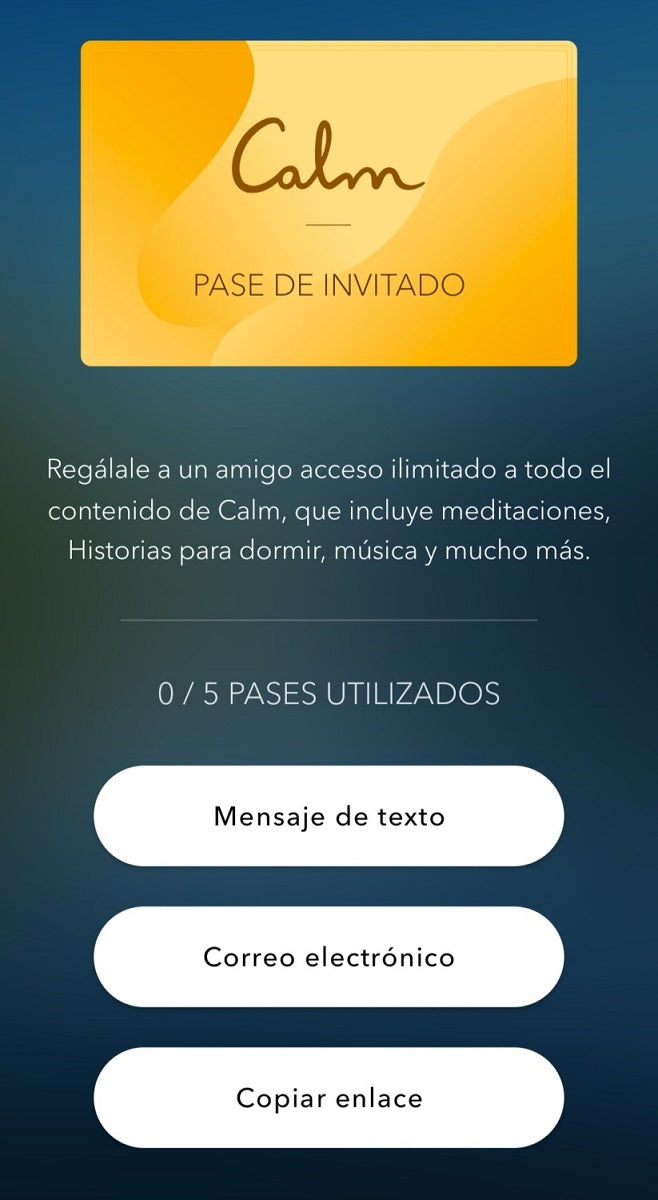
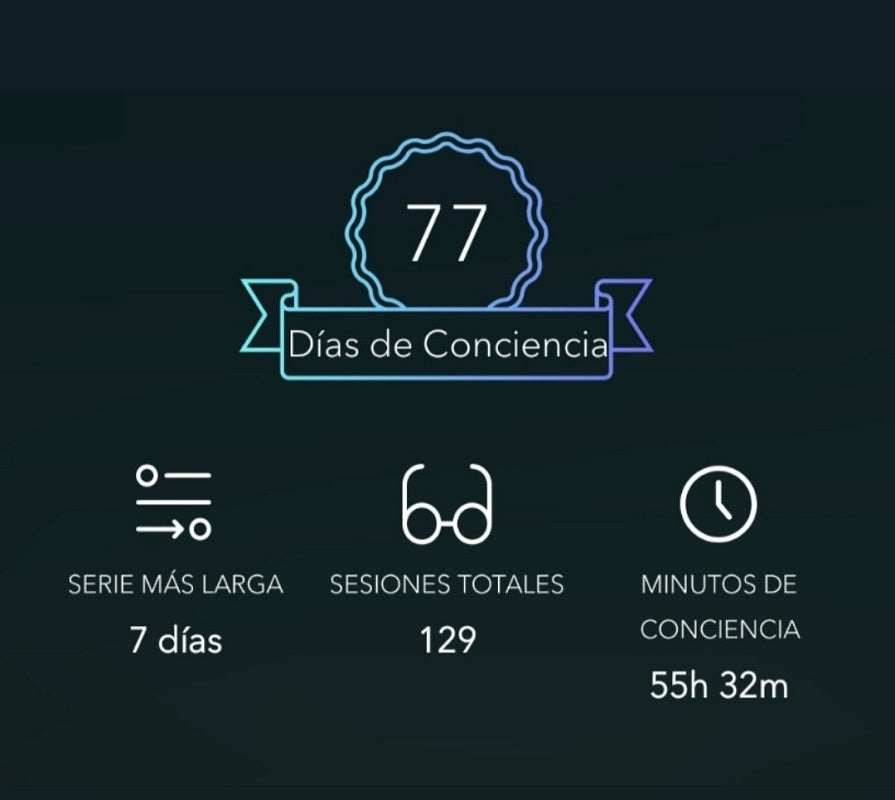
The Calm app is a great example of how it encourages its users to:
- Invite other users to register through a demo.
- Share content.
- Share their "achievements" or progress with their network and close circle.
Look at these messages:
What is the basis of all this? Having a product or service that people know, use, and want.
Note, we don't necessarily have to be unconditional fans of a product or want to tattoo a brand name to recommend it. But, definitely, having a good customer experience is the first step towards positive word-of-mouth.
In this regard, I recommend you read more about the Product-Led Growth framework and follow Elena Verna.
Now tell me: what are you doing to make people recommend your brand?
With what you've read here, you'll want to know about our online maturity model and be among the first to use it to evaluate how your company is doing in omnichannel CX management.
The original version of this article was published on LinkedIn for the Omnicanalidad en español Newsletter. You know, you can also follow me on that platform.
- Anderson, E. W. (1998). Customer Satisfaction and Word of Mouth. Journal of Service Research, 1(1), 5-17.
- Goldsmith, R. E. & Horowitz, D. (2006). Measuring Motivations for Online Opinion Seeking. Journal of Interactive Advertising, 6(2), 2-14.
- Lee, Z. W., Chan, T. K., Chong, A. Y. L. & Thadani, D. R. (2019). Customer engagement through omnichannel retailing: The effects of channel integration quality. Industrial Marketing Management, 77, 90-101.
- Siqueira, J. R., Peña, N. G., ter Horst, E. & Molina, G. (2019). Spreading the Word: How Customer Experience in a Traditional Retail Setting Influences Consumer Traditional and Electronic Word-of-mouth Intention. Electronic Commerce Research and Applications, 37, 100870.

 By
By