If you have a website and want it to rank well when someone searches on Google for content related to yours, then you must assume that you own a machine that requires continuous maintenance. For a car or a washing machine, we call it a technical inspection; for a website, we talk about an SEO Audit.
An SEO audit involves subjecting a website to an evaluation to verify its ability to rank well in search engine results (SERP), such as Google.
That is, if you want your website and its pages to appear at the top of search results and be more likely to be seen by users, you need to comply with numerous factors.
Complying with this series of factors will help your website and its pages to be considered and well-ranked by search engine algorithms.
For example, a criterion that has weighed heavily for Google for some years now is that the website has a responsive design; that is, that its pages adapt appropriately to the screens of various devices: computers, tablets, smartphones, etc.
So, an SEO audit is performed by checking each factor on a list or guideline that allows you to find any problems related to proper search engine optimization, which must be corrected or improved.
The goal behind this SEO audit is to address an improvement process that optimizes the performance of the website and its pages for the search engine.
As you can see, it's something like a report card check, like when you take your car for a technical inspection to get its circulation permit.
If your website is well designed and you apply the appropriate organic positioning techniques, it will have a higher probability of ranking in Google searches.
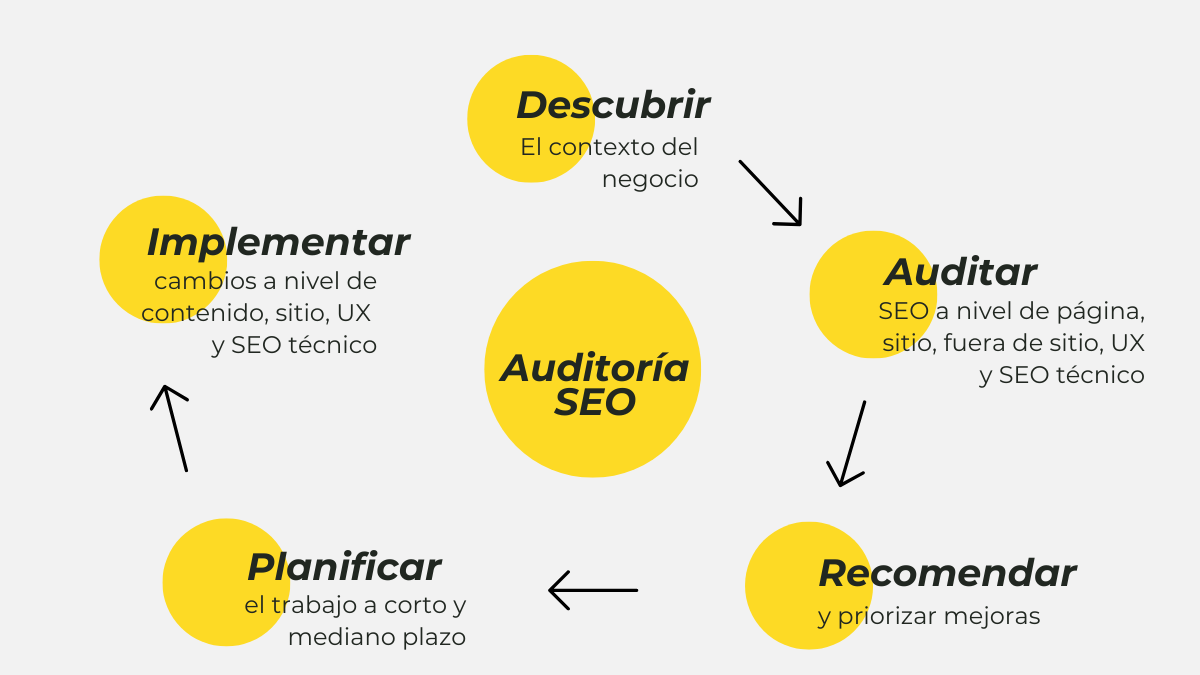
The SEO audit is a 5-step process:
1- Discover the business context
Start with two key questions:
Does the site have enough content and at least 6 months of traffic?
Does the business have the necessary resources to make improvements and sustained improvement work over time?
If these two conditions are met, then it is advisable to perform an SEO audit.
Evaluate the website to verify if it ranks well in search engine results (SERP), such as Google, and if it complies with SEO factors (more details later).
After the evaluation, it is necessary to propose in detail the corrections and optimizations that should be made at different levels (content, technical SEO, UX, etc.) to identify the human, technical, and financial resources that will be involved. And it will be important to know how to prioritize tasks.
Having defined the priorities for the short term and what will be addressed in the medium and long term, a timeline for the development of improvements must be established.
Here, the SEO professional's role will be to verify that the improvements have been developed correctly. Possibly, there will be iterations to continue optimizing the website.
As we mentioned, an SEO audit consists of a list or evaluation guideline. Here we will show you the one we use at FREED, which corresponds to an industry standard with very FREED nuances, such as the focus on user experience (UX) and content.
Also, you should consider some nuances, such as that in a complex site, the audit will be exhaustive and will contain findings and recommendations according to the type of pages on the site.
For example, in an e-commerce site, it is very important to evaluate the situation of product and product category pages, in addition to the homepage.
On the other hand, if a website is very small, for example, it has 1 or 2 pages, an audit may not be relevant.
Similarly, if you don't plan to invest in SEO, an audit is not useful either. What good would it do you to know where you could improve if you're not going to do it?
Now let's see what elements we are analyzing in an SEO audit.
Page-level SEO
- Search intent
- TITLE
- Meta description
- h1, h2… tags
- URL
- Internal links
- External links
- Image optimization
- Content
- Information architecture
- Navigation (main menu)
- Footer
- Breadcrumbs
- Security certificate
- Mobile optimization
- Loading time
- URL structure
- Errors and redirects
- Duplicate content
- Domain name authority
- Backlinks - domains
- Backlinks - quantity
- Link relevance
- Anchor text
- Spam score / Toxicity
- User journey on the site
- Navigation
- Custom 404 page
- Elements that interrupt navigation
- Google Analytics
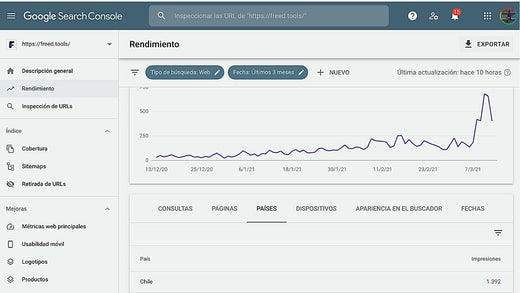
- Google Search Console
- Google My Business
- Social media
As advice to apply in your SEO audits, consider that:
1- If it is a large site, opt for a representative sample of site pages; you don't need to review each of its pages. For example, on an e-commerce website, you should consider that there are pages for:
- Products
- Product categories
- Corporate (About Us, team, social commitment, etc.)
- Terms and conditions, Privacy policies, shipping, returns, etc.
So, you can audit 3 to 5 pages of each type.
2- If it is a small site, this is an opportunity to do a complete tour that allows you to have a total overview.
In our case, during the SEO Training we taught in 2021, we performed audits on three websites and started with a large one. So, we applied the first criterion.
Also, if you don't have experience yet performing SEO audits, you can do what we ask our students: to review page-level factors, take two important and representative pages.
As we said, in an e-commerce, product category and product pages are standard. And precisely, our first task was to audit a large e-commerce site.
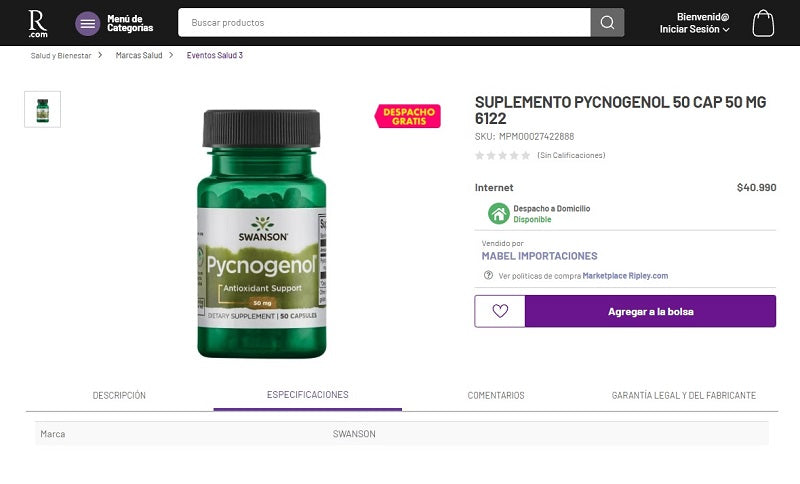
Let's see what our students found on Ripley.cl:
Page-level SEO findings
First, we see page-level SEO findings: content, HTML elements that display information about the page itself, and internal links.
This is an example of the data shown on Google's results pages:
It is important to consider that Google may change the TITLE for other relevant information such as the page's H1 title. This does not mean that we should not work on the page's TITLE; it is just a variation that Google applies in some cases.
TITLE (title seen in the browser's title bar and on search engine results pages)
"Could describe the item (product) a bit more."
"Has spelling mistakes. Gives more importance to the Ripley brand."
META DESCRIPTION (description seen on search engine results pages)
"It is not very specific regarding the category."
URL
"The URL can be improved since it is complex to locate due to being a code."
"It has a code that does not contribute anything to SEO."
Example:
https://simple.ripley.cl/suplemento-pycnogenol-50-cap-50-mg-6122-mpm00027422888?s=o
CONTENT (texts)
"More product details are missing."
"It is present, but it seems to have been translated with Google. Duplicate content."
MOBILE OPTIMIZATION
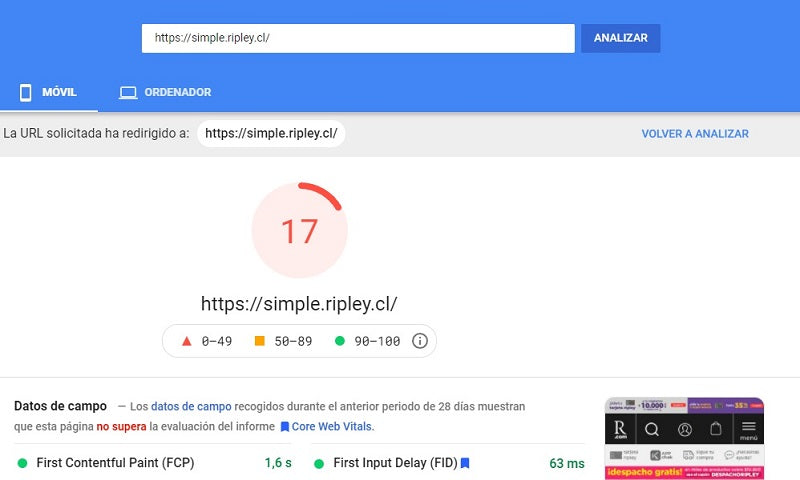
"Slow site, Pop-ups that bother navigation. Menu out of finger reach."
"The mobile version could be simpler."
LOADING TIME
"It's a bit slow."
"Slow on mobile."
As we mentioned, these examples correspond to the audits carried out by our students in the 2021 version of the SEO Training: organic positioning techniques and tools.
Are you interested in learning how to do an SEO audit yourself?
Or perhaps you own or manage a website and need FREED to perform an SEO audit to evaluate what you need to improve.

 By
By