On our SEO blog, we've discussed actions that help a website's organic ranking in Google searches, such as conducting keyword research, for example. Today, we want to delve into a somewhat complex topic: E-E-A-T, an acronym that not everyone understands or knows what to do about. Let's see what it's all about.
Since we'll be discussing a somewhat complicated aspect of an SEO strategy, we'll approach this article in the most didactic way possible, so that after reading it, you'll have a clear picture and know what you need to do for your brand and website to gain relevance with Google's algorithms.
Let's start with the basics: E-E-A-T is a concept Google uses to evaluate the quality of a website's content. Today, it holds great importance in an SEO strategy; if you review Google's Search Quality Rater Guidelines, you'll see E-E-A-T mentioned over a hundred times.
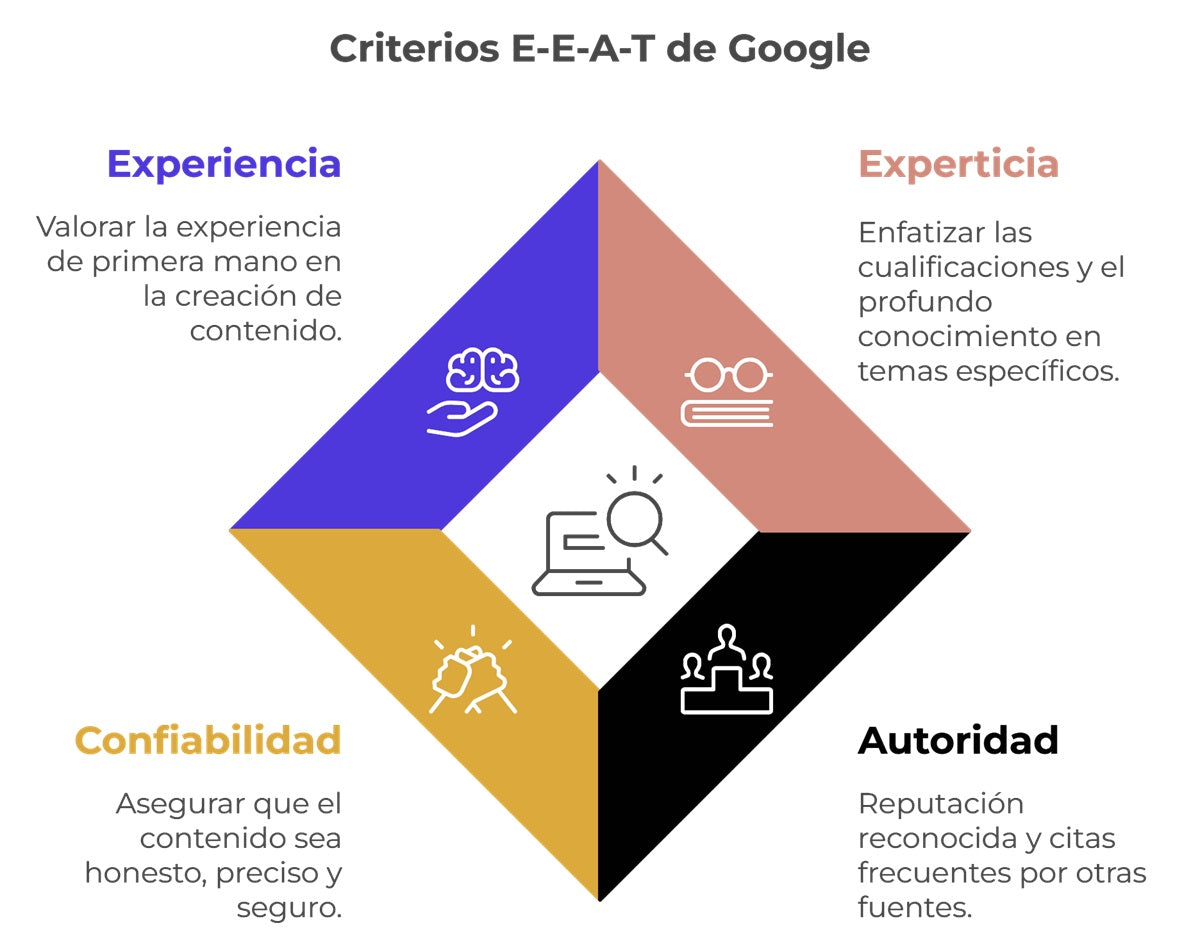
And what does it mean? The acronym E-E-A-T stands for four words:
- Experience,
- Expertise,
- Authoritativeness, and
- Trustworthiness.
So, these words represent four criteria that Google uses to determine which content is most useful, relevant, and trustworthy for users of its search engine.
Just for context, we'll tell you that originally it was E-A-T, which included the last three criteria (Expertise, Authoritativeness, and Trustworthiness). However, in December 2022, Google added a new component: Experience.
Now, let's break down each of the E-E-A-T criteria to clarify how they contribute to the evaluation of web content quality, according to Google's guidelines.
For Google, it's important that content is created by people with first-hand experience in the topic they are writing about. This criterion assesses whether the creator has used a product or service, visited a place, or participated in a specific event, for example.
This applies to topics where personal experience can add unique value to the content: a typical case is a product or service review, which must have been used by the person publishing it. If so, it will have a higher value for Google because these types of experiences help users better understand the benefits and potential problems of what is being evaluated.
Google values whether the content author has the necessary qualifications (training, preparation, accreditation...) to write about a specific topic, which is especially important in areas that can significantly affect users' lives, such as health, finance, and safety (these are YMYL topics: "Your Money or Your Life").
For content to be considered trustworthy in terms of expertise, it must be supported by people who have in-depth training or knowledge of the subject. For example, an article on electrical installations would be more reliable if written by a certified electrician than by a mere amateur.
Undoubtedly, sectors such as pharmaceuticals, medicine, biotechnology, health, and general well-being are among the most sensitive. Often, their websites are not technically prepared or lack quality content, and both points require investment in time and effort to generate the necessary internal changes.
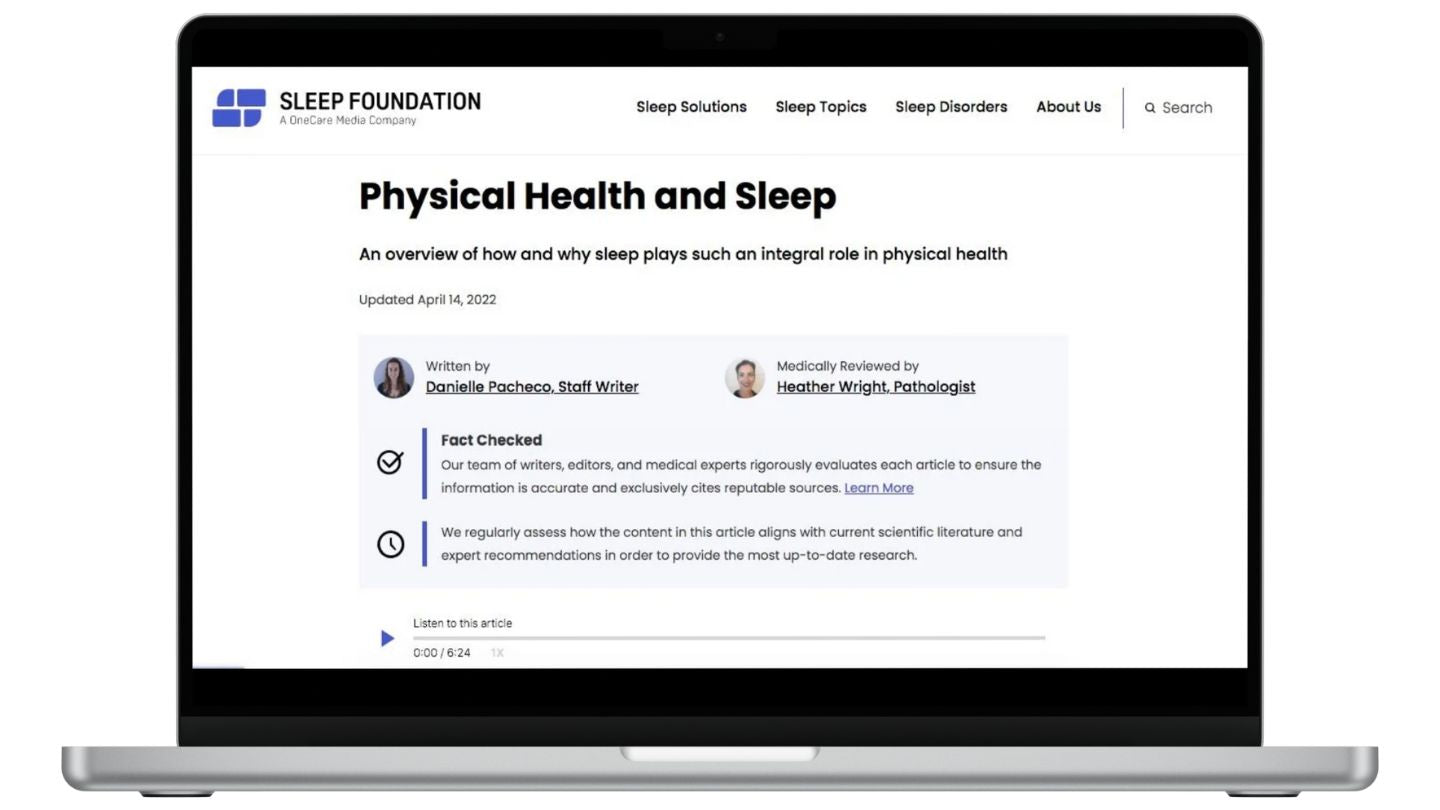
An example of this work can be seen at Sleep Foundation, whose website reflects that behind it there is:
- An editorial content team.
- Review by a medical team.
- Academic and scientific references.
- Solid sources.
- Names, faces, real people.
They are gaining authority because the content is co-created by writers and real-life health professionals. And we must emphasize this in an age where artificial intelligence is being used to create massive content that adds no value and can be imprecise, confusing, or even false.
To avoid confusion: the key difference from the previous criterion (Experience) lies in the author's formal or technical knowledge.
This refers to the reputation of the content creator or website within the niche of the topic being addressed. Google values whether other websites and industry experts recognize the creator as a reliable and reference source. A high level of authority implies that it is frequently cited, linked to, or mentioned by other reliable sources.
Signals of authority include:
- citations in relevant publications,
- brand mentions on social media, and
- a high volume of searches for the company or author's name.
Having backlinks (links to your website) from high-authority sites is another strong signal to Google that a web page can be considered a reliable reference in its niche.
This is the most important E-E-A-T criterion because it evaluates whether the website and its content are honest, accurate, and secure. For Google, trustworthy content must be clear in its intentions and free from conflicts of interest that could compromise objectivity.
Trustworthiness is fundamental for all types of pages, especially for websites dealing with YMYL topics. Let's look at two examples:
- Online stores (e-commerce) must have secure payment systems and good customer service to be considered trustworthy. They must also publish their terms and conditions, privacy policy, return and exchange policy, shipping policy, and available payment systems.
- Pages that provide medical or legal information must be especially careful to ensure the accuracy and security of the information provided.
The consequence is that, by complying with these guidelines, the chances of improving a website's visibility in search results (organic ranking) increase, which is especially important for sensitive topics that affect people's lives and well-being.
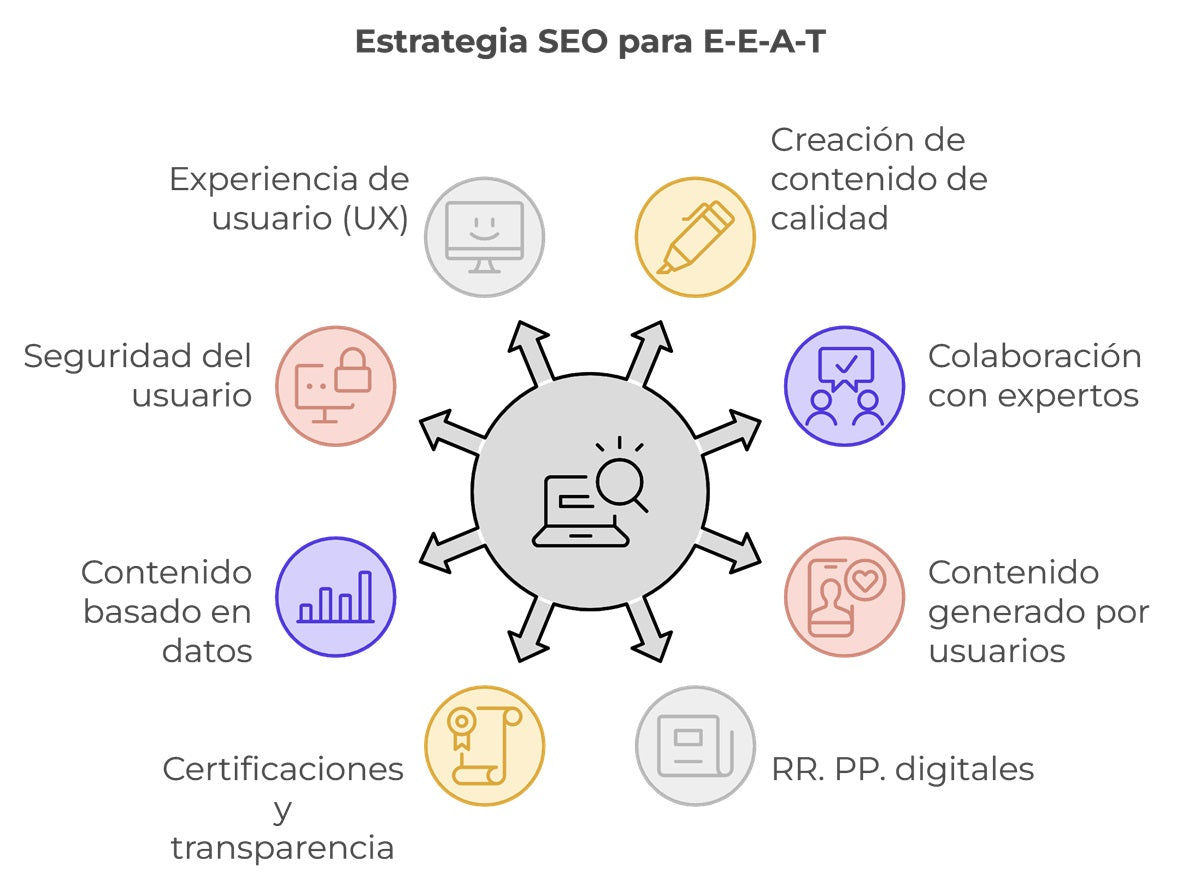
At FREED, we carried out an SEO project with an aesthetic surgery clinic, so we can tell you how a brand can develop an SEO strategy focused on working on E-E-A-T to improve its organic ranking in Google search results.
1. Create quality content and thought leadership
The cornerstone of an E-E-A-T strategy is the creation of quality content. This means it should be informative and clearly demonstrate experience and expertise. This includes the production of:
- in-depth articles,
- case studies,
- comprehensive guides, and
- expert opinions.
All of this must align with the needs of the target audience.
Something you cannot overlook is that the brand must identify its internal experts and position them as thought leaders in the sector. For example, by encouraging them to write blog articles, give interviews in media, and deliver conferences. These efforts will help reinforce authority and expertise, as they allow the brand to be perceived as a reliable source of information based on real knowledge.
Likewise, it is necessary to create pages with the profiles of experts on the brand's website or even encourage them to create their own websites, to have a showcase where they can talk about their training, work experience, participation in important events, and received recognitions. As an example, we leave you Carmen Gerea's page, founder of FREED and author of most of the articles on our website. This page appears in search results; therefore, Google already knows who she is and that she has authority in topics such as SEO and UX Research.
This involves inviting experts to collaborate in content creation, as authors or co-authors of articles, to participate in interviews, or to provide quotes on important topics. This generates a perception of authority among the public and search engines.
3. Leveraging User-Generated Content (UGC)
Content generated by a brand's customers is an excellent way to strengthen experience and trust. Therefore, it's good to encourage them to create reviews, testimonials, and posts using the products on their social media. All of this helps demonstrate that the brand has customers who genuinely use and appreciate its products or services, and that there is a real connection and positive impact on their lives, which is highly valued by Google in terms of experience.
The digital public relations strategy should focus on achieving mentions in relevant and high-authority media. Appearing in these media increases brand authority and enhances the perception of trust by being presented in a context that users already recognize as reliable.
Consequently, using current news and industry events to create relevant and timely content helps position the brand as an informed reference.
Through digital public relations, the brand should seek to be mentioned and linked (backlinks) by these respected sites, to help build the perception that it holds authority in the field.
Displaying quality certifications, awards received, and trust seals on the brand's website adds an important layer of trust. This clearly communicates its values and ethical practices through pages like About Us, where the responsible parties are shown and how the quality of its products or services is ensured.
Transparency is also key to improving trust, which is why it's ideal to display customer reviews and opinions on the website, but without using filters that remove criticism, instead reflecting how the brand responds to negative comments and uses that feedback to improve.
6. Content based on proprietary data
Using proprietary data to develop valuable and reliable content, such as original studies or surveys, and sharing their results through press releases and proprietary articles and in the media, helps position the brand as a relevant player.
This allows for obtaining mentions and building quality backlinks, which help demonstrate methodological soundness and relevance through the information the brand provides.
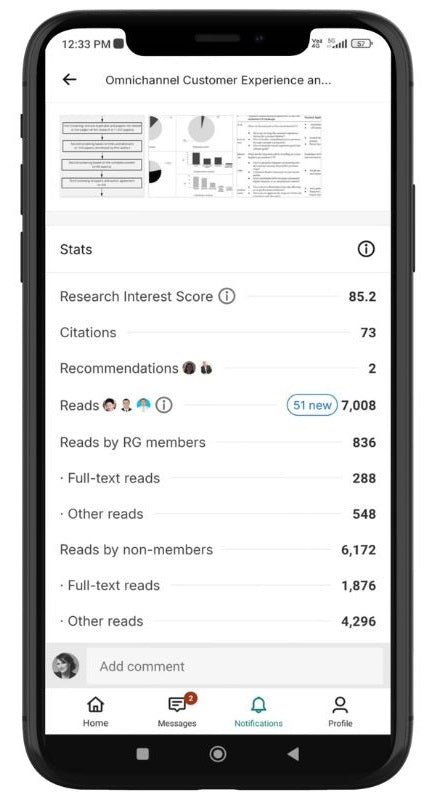
An example of this type of content is papers written by brand experts, which can be published in specialized media such as scientific and research journals. These media often have international prestige and very high authority, helping to position the expert's name and the brand. This is the case of the research on omnichannel conducted by Carmen Gerea which, upon being published on ResearchGate, became one of the most cited works on that topic. The effects of this are that both the author's name and her new website Omnicanalidad.es gain authority with Google's algorithms and reviewers.
Website security is an important component of trust. This translates into:
- implementing SSL security certificates (https),
- keeping privacy policies updated, and
- providing secure payment methods.
These three actions contribute to users and Google perceiving the site as secure and trustworthy.
On the other hand, improving the user experience (UX) on the website also contributes to E-E-A-T. A site with good navigability, where content is accessible, clear, and easy to consume, will make people trust the content more and Google value it positively.
Confirming that this is a somewhat complex aspect of SEO, expert Olaf Kopp suggests that there are more than 80 indicators for E-E-A-T. Since 2022, he has been investigating what Google bases its evaluation on, for which he has reviewed many Google patents that provide some clues in this regard.
In summary, he states in his article How Google evaluates E-E-A-T? 80+ signals for E-E-A-T that in the search for significant positive attributes, Google's algorithms would act in what he calls three ranking dimensions:
-
Document level: Evaluates the quality of documents in matters such as keyword usage and content quality. So, this dimension represents useful content and can be transferred to the entire site or to areas of the website. Therefore, the sum of high-quality useful content affects the domain level.
-
Domain level: This is a quality evaluation focused on the entire site or the website area. It takes into account site-wide quality factors, such as the link profile and E-E-A-T.
-
Source entity level: This is the quality of the authoring entity and is evaluated according to E-E-A-T criteria.
And these indicators are grouped into three categories that cross the different dimensions:
-
Knowledge and experience: Content depth, updates, and citations.
-
Trustworthiness: Domain reputation, verified information, and clean links.
-
Authority: PageRank, historical data, and brand recognition.
Another important aspect that Kopp raises is that Google's classifiers do not assign points in the E-E-A-T evaluation, but rather there are classes that classify source entities, domains, and documents into:
- spam,
- bad,
- medium, or
- good.
To conclude, we can state that working on E-E-A-T is essential to increase visibility and trust in a brand and its website, especially in sectors that impact people's lives and well-being. The four criteria we reviewed are not only key concepts for improving organic positioning in search engines, but also for building genuine and lasting relationships with the audience and customers.
Integrating these elements into an SEO strategy will help Google recognize the quality of the website, which translates into organic positioning in search results and, above all, a greater connection with the target audience.
Have you implemented any of the actions we've reviewed in this article? Tell us if you've achieved good results.

 By
By