Sometimes it's debated whether SEO and SEM are such distant and even rival strategies. To the point that we find article titles that talk about SEO vs. SEM. But the truth is that they can complement each other in various aspects. That's what I'm talking about in this article to understand the differences, the current reality on Google, and how we can create synergies between organic and paid traffic.
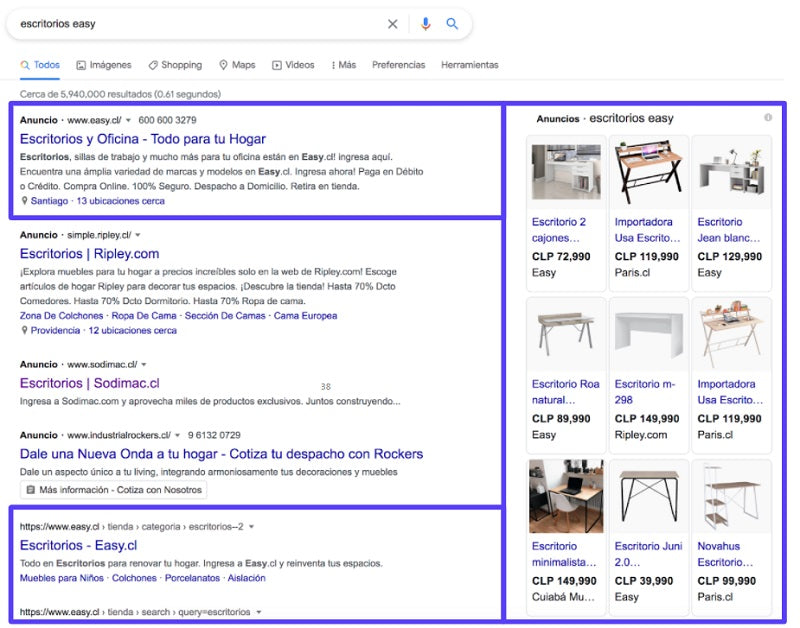
For some search terms, the visual space for organic positioning can be very small.
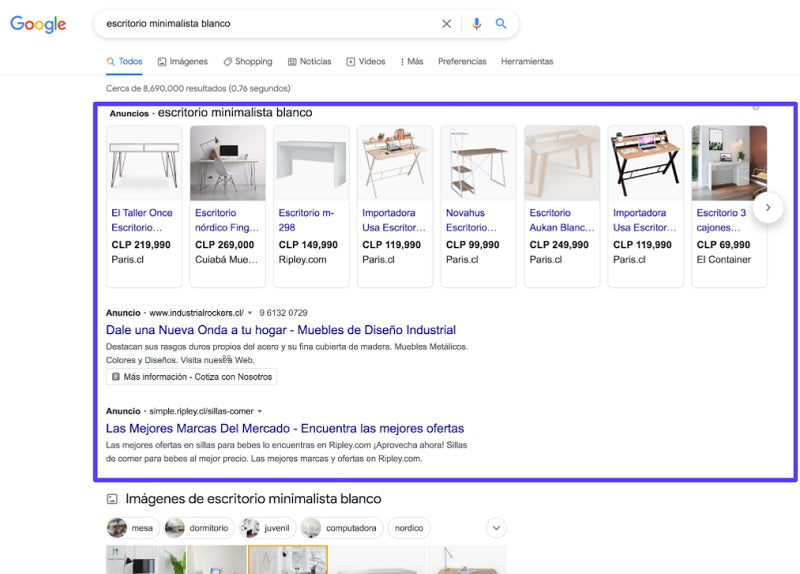
That is, if there is a lot of competition, for example, if we search on Google for "minimalist white desk," you will notice that most of the search results screen is occupied by ads.
Therefore, after scrolling, organic results will be visible.
If we do another search, for example "Easy Desks" (Easy is a local brand in Chile), the same thing happens: the first search results are ads and the rest are organic results.
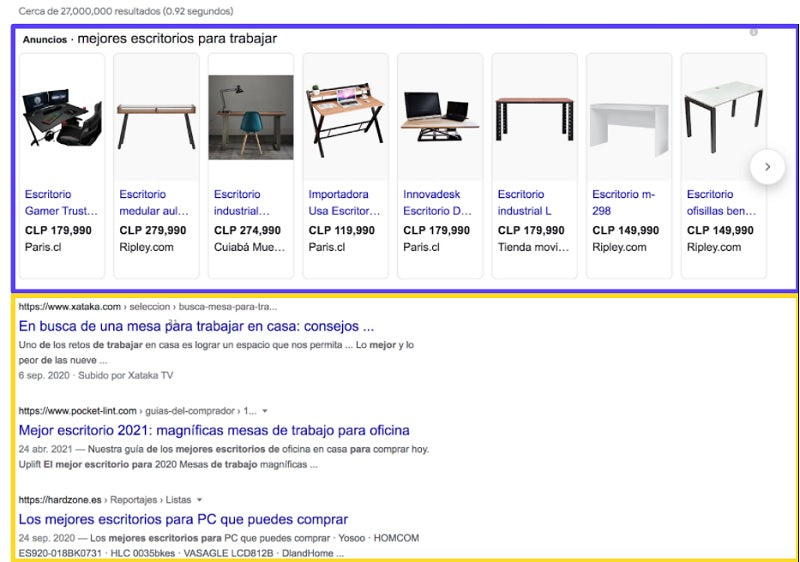
But in a particular case, for example, if we search for "Best desks for working," we can see that the screen is occupied by a small part of ads and the rest are organic results.
Since this is difficult to control, a brand must maintain good conditions on both sides, both in paid traffic and organic traffic.
It can happen that many organic terms with very little competition are paid for, meaning that there are not many paid campaigns for those terms. However, there are factors that we are not able to measure and, therefore, it is better to be solvent in both areas.
Changes are constant, and not only in terms of algorithm evolution, but also in terms of the actions taken by the brand.
That is, whether or not there are campaigns for a certain number of terms is something we cannot control, as it depends on market conditions.
Therefore, we must remain alert and aware of what is happening, checking if any parameter has gone up or down, why it happened, and what influenced it.
Today, it is true that there is less and less visual difference on Google between paid ads and organic results.
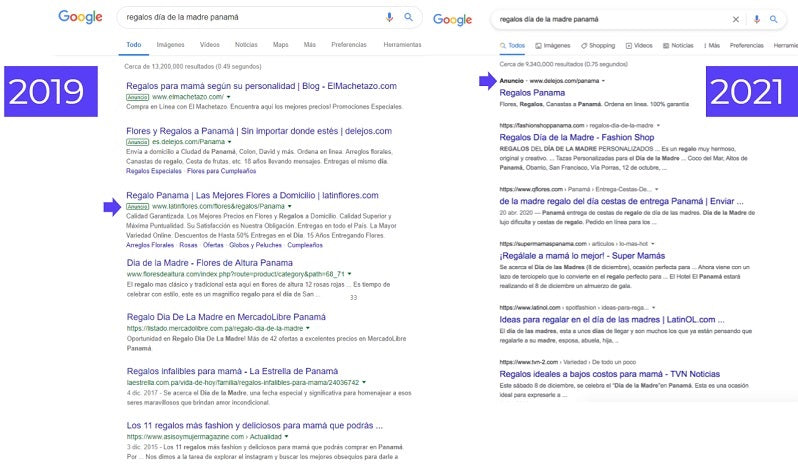
For example, if we compare Google search results from 2019 with today, in the former year we could see a label in the results with the word "Ad" and the site's URL in green.
However, today we see that everything is in black, which makes it difficult to notice the label that identifies a result as an ad if you take a quick glance at the results.
Google is constantly experimenting, so these labels may not be seen in the same way in the future and may change to a less or more highlighted appearance, so we must be attentive.
These changes are not only seen on Google, but also apply to marketplaces. Today there are marketplaces where it is very difficult to notice the difference between an advertiser and a person who did not pay for advertising.
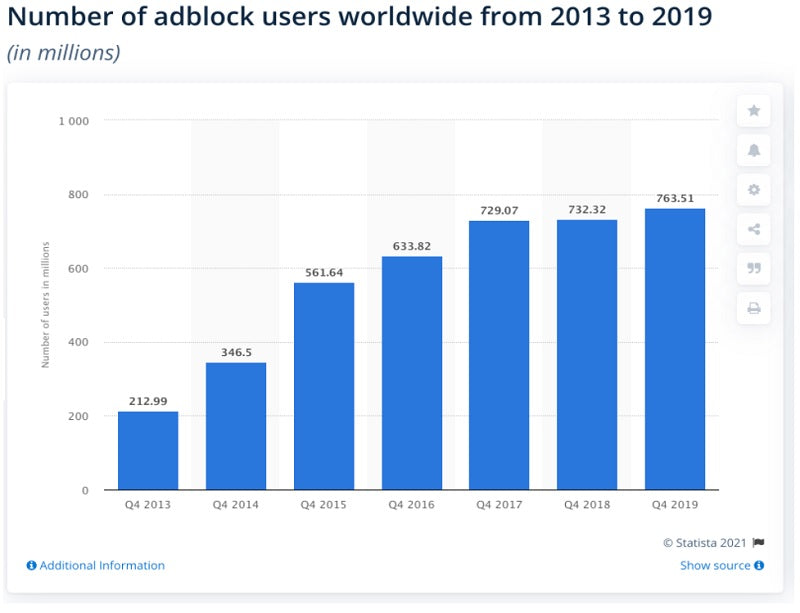
Approximately, one-third of internet users worldwide use ad blockers.
It is an undeniable reality that all those users will not see campaigns because they have them blocked.
Increase in users using ad blockers between 2013 and 2019.
We also have "Ad blindness." That is, a percentage of people tend to ignore ad spaces.
Furthermore, it is estimated that only between 15% and 30% of people click on ads.
Generally, the portion of paid traffic is usually very small, around 1%.
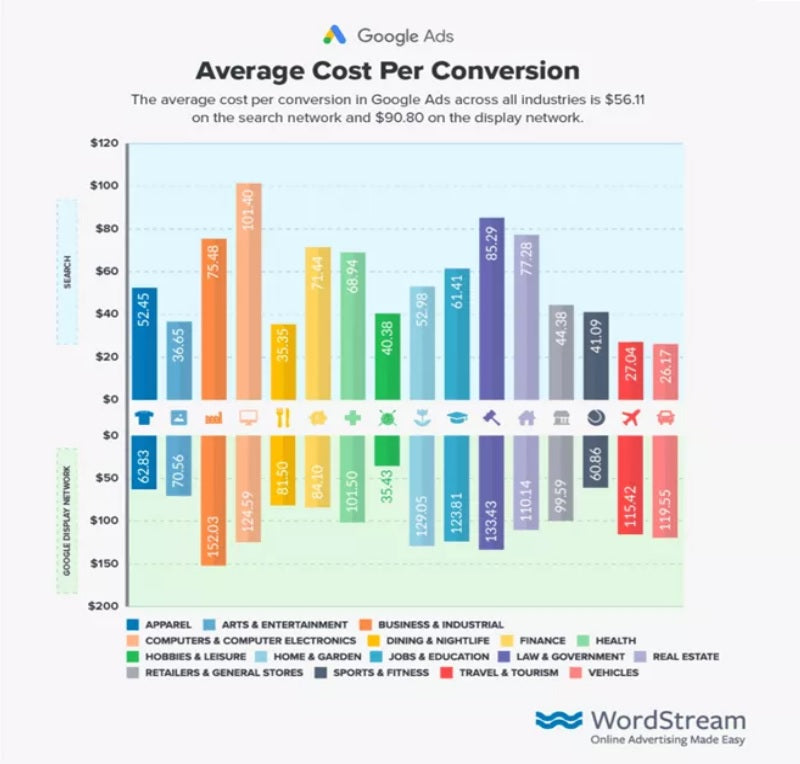
The cost per conversion in SEM can be very high in some industries.
Depending on the sector and comparing with other sectors, we could see notable differences in terms of conversion.
For example, in the computing sector, we notice that the SEM conversion cost is much higher than that of the automotive sector because it has more competition than others.
Cost per conversion in SEM in different market sectors.
At this moment, if we want to position ourselves in the market, it is necessary to look for niches; otherwise, it will be very difficult to position ourselves and compete.
Why is it so expensive? Because it is known, deep down, that the person is going to make a purchase, therefore, the ads are segmented.
In this ever-changing world, it is important to have a "plan B" or create synergy because it is a constant and the result of both SEO and SEM is not guaranteed.
In this aspect, SEM can compensate for temporary drops in SEO.
This can happen depending on the context. Something that can affect it is having migrated a site, which makes it take time for the search engine to realize that today we have another website and other content that is organized differently.
Therefore, we can temporarily compensate for that drop in organic traffic with SEM.
It can also happen that due to seasonality, fewer people are searching, and we must apply SEM to reach the same level of traffic and conversions as before.
If they see an organic result and an ad on the same page, some users tend to trust the ad.
This happens because they trust a brand shown in an advertisement more than if they see the same brand correctly positioned through organic search.
People tend to click on one or the other just because the brand is repeated.
In practice, SEM campaigns can cannibalize SEO results.
That is, if I am "Easy" (a local furniture brand) and my competitors use my brand to run campaigns, in the end, a percentage of users will not click on the organic result, but will instead seek to reach it through ads.
Ultimately, the risk of cannibalization is something that SEO and SEM teams have accepted.
This does not mean that Google will downplay organic results; rather, it is about the risk of spending money on advertising when traffic could have come for free.
If a brand has a presence at various touchpoints, it generates more "awareness."
We know that brand exists because we see it everywhere: social media, podcasts, radio, TV, etc.
Working on brand campaigns can generate awareness.
To generate synergies of resources (human, material, and time), we must apply SEO learnings to SEM and vice versa.
For example:
- If we have terms that generate impressions in SEO but not clicks (because we are not currently in the top positions), we can run paid campaigns with those terms.
- If we run paid campaigns (faster to test) and realize that a text generates a higher paid CTR, we can continuously improve the SEO attributes of the page.
Sometimes it's hard to be at one touchpoint and have good conversion as a brand, so it's important to be everywhere and at all times when people are searching.
By applying a synergy between SEO and SEM, we can reach all stages of the customer journey.
SEM is customizable, while SEO is impossible to personalize.
When we set up SEM campaigns, we have the ability to choose different titles and match them with what we are looking for.
This does not happen in SEO. Once we determine a title, that's it and it cannot be modified.
We have the option to segment once we create content for our website, because it is a fact that it is created for the general public, but it is possible to segment by particular needs, context, and interests.
If a user is within a certain context, one must create content that suits that person's context.
In SEM, it is possible to work even more on segmentation. For example, if I want my ads to appear to women of a certain age, the parameters can be adjusted for this to happen.
This does not happen in SEO; here, the content can appear to anyone, unless the content is relevant to those women and, therefore, they can be reached as organic traffic.
Regardless of all the above, SEO and SEM are not directly related.
Google does not favor a domain's SEO results if it is an advertiser (i.e., invests in SEM). The day the domain stops paying for SEM, it will simply stop appearing, so it is a requirement to comply with the organic part to remain positioned.
Had you considered that SEO and SEM can complement each other to improve your positioning results on Google? Now that you know, get to work and remember that synergy is the keyword.

 By
By