There's a prejudice that SEO isn't relevant in B2B marketing and that it's only for B2C e-commerce, because it's only justified for attracting consumers searching for something on Google.
Is SEO really not important if your business is B2B?
You've probably heard or read people suggest this. But I insist, it's a prejudice.
Because, deep down, googling more details about a brand or company, looking for alternatives, references, success stories, and countless other topics, is a common pattern in B2B decision-making.
Therefore, organic search is relevant for people looking for business solutions.
Thus, creating organic content for a B2B business is pertinent and often as competitive as doing so in a B2C context.
And of course, for a B2B business, it's essential to understand the search intent we want to capture.
Furthermore, even if your business is B2B, there are undoubtedly people on the other side looking for a solution online.
So, not only should you do SEO, but within a B2B marketing strategy, SEO should be considered from the outset.
The first questions are how to improve my positioning and how I can know what I need to work on.
If you already have a website focused on a B2B business, the answer to those questions is to conduct an SEO audit.
In other words, an SEO audit is the first stage of a continuous improvement process in SEO. Because we want to know where we stand first, before defining a work plan and starting to optimize a site for organic positioning.
Before starting, it's important to take a snapshot of the site to determine if a comprehensive SEO audit is worthwhile.
Because you might encounter situations like these:
1- The site has 3, 4, or 5 pages and is very poor in content. In this case, a comprehensive SEO audit is probably not pertinent as there simply isn't enough content to audit.
What to do in this case?
A quick diagnosis, before proceeding with other stages such as user research (UX Research) and keyword research, as well as defining the content strategy and, accordingly, the SEO strategy.
2- The website has several product pages and blog articles. Here, it's much more likely that you have fertile ground for continuous improvement, and a complete SEO audit is pertinent.
If you want to know more details about how to conduct an SEO audit, you can read the previous article SEO Audit: what it is and how to evaluate a website, and then resume reading here.
We conducted an SEO audit with the students of the SEO Training, where we looked at the same aspects we evaluated on a local marketplace site in the previous article.
As an example, we used the moderately complex B2B site of the Chilean company DBNet, which offers electronic invoicing, human resources, and reconciliation solutions.
The stated objective was to create a state of the art and take a snapshot of that moment, to identify gaps and propose continuous improvement from there.
For this exercise, we analyzed:
- A business solution page (Electronic invoicing) or the equivalent of what would be a product page on a B2C or e-commerce site.
- A page corresponding to a blog article.
It's worth clarifying that our SEO audit included user experience (UX) factors. While an SEO audit is not a UX audit, it does include user experience elements.
Indeed, we cannot separate these areas since attracting users to the site with SEO should be the first step towards resolving a search need.
As mentioned earlier, the following observations are based on an analysis conducted with participants in the SEO Training we held in August 2021.
The students analyzed a solution page and a blog article page.
First, we will look at their on-page SEO findings, which refer to content, HTML elements that display information about the page itself, and internal links.
This is an example of the data shown on Google's results pages: It's important to consider that Google may change the TITLE to other relevant information such as the page's H1 title. This doesn't mean we shouldn't work on the page's TITLE; it's just a variation that Google applies in some cases.
On-page SEO (solution or service page)
TITLE (title seen in the browser's title bar and on search engine results pages)
"Could be used to give a better introduction to the topic, explaining what mobile invoicing will be used for."
Content (texts)
"Product description is short and uninteresting."
"It's too short and telegraphic, not explanatory or 'human' enough."
On-page SEO (blog article page)
Meta description (description seen on search engine results pages)
"Repeats the article title."
Internal links (links between pages of the same website)
"They have a blog, but they don't link it to product pages."
"There are no links in the article to related services."
Image optimization (file name, title, ALT attribute, dimensions, and weight)
"Optimized in terms of size, but they have generic names that don't add SEO value."
"Photographs have generic names."
Site-level SEO
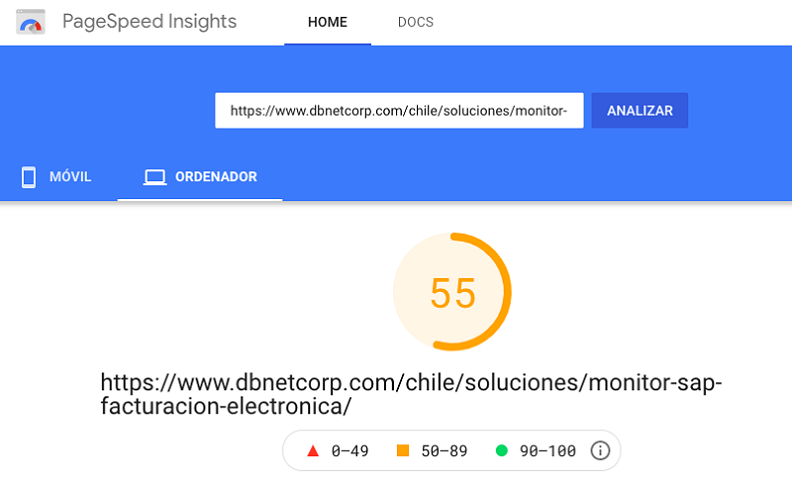
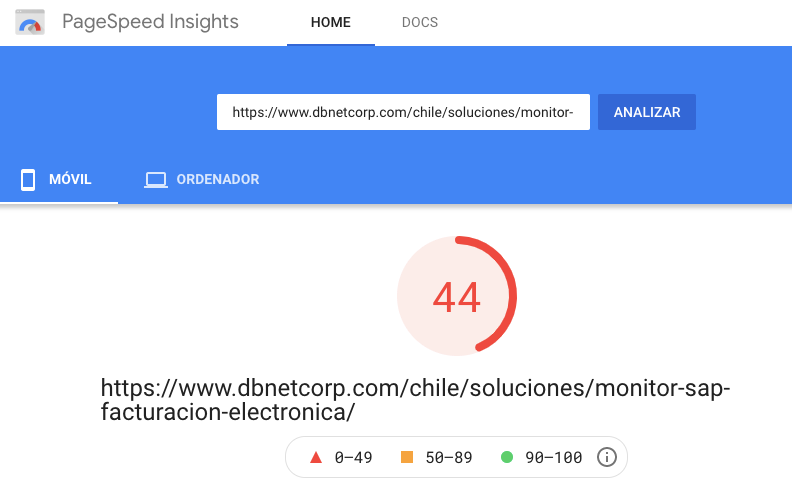
At this point, students reviewed site-level SEO aspects and identified a deficiency in the time it takes for the web page to load in the browser.
Load time is an increasingly important factor for Google's algorithms because it directly influences:
- positioning,
- indexability,
- bounce rate,
- conversion, and
- the success of pay-per-click campaigns.
Load time
Measurement of desktop load time using Google's PageSpeed Insights.
Measurement of mobile load time using Google's PageSpeed Insights.
Here I've only shown you a few examples of the audits conducted by students during the SEO Training: organic positioning techniques and tools.

 By
By