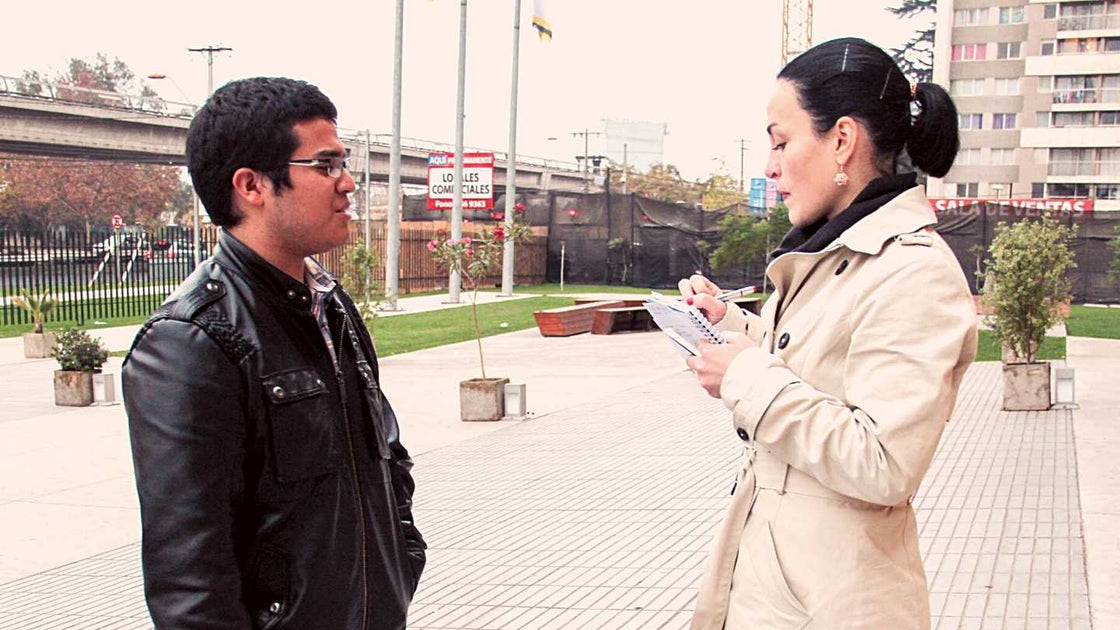
Field observation is a qualitative research method that involves directly witnessing how people use a service or interact with a space, without relying on what they say about themselves. It helps capture behaviors, routines, and problems that individuals often don't mention in an interview because they consider them normal.
It involves going to the place where the service occurs—a branch, a warehouse, a street, a user's home—and systematically recording what people do, not what they say they do. The researcher acts as an observer, with varying degrees of participation: they can stay on the sidelines, taking notes, or partially engage in the activity being studied.
Along with interviews, observation is one of the quintessential qualitative methods for getting closer to customers and other relevant stakeholders in the system. It helps detect the discrepancy between what people think they do and what they actually do, identify friction points that no one reports as a formal complaint, and gather visual evidence—photos, plans, screenshots—of the spaces where the user operates.
They are not competing methods but complementary ones: ideally, they should be combined in the same field visit. In-depth interviews gather opinions, attitudes, and perceptions; observation gathers real behavior, without the filter of what the person chooses to say.
| Criterion | Field Observation | Interview |
|---|
| What it captures | Real, non-verbalized behavior | Opinions, attitudes, narratives |
| Main risk | Interpreting without asking | Discourse different from practice |
| Typical timing | Before or alongside the interview, during the same visit | After observing, to delve into questions |
It is also useful to note the environmental context of the observation—noise, temperature, number of people in the place—because these external conditions often explain why the same touchpoint works well one day and creates friction the next.
Before going into the field, it is advisable to define a simple guide, with columns to record: who is acting, what they are doing, at which touchpoint, how long it takes, and what obstacles appear. In our workshops, we usually ask teams to define three or four guiding questions beforehand—for example, "where does the person stop without knowing what to do?"—so that the observation doesn't get scattered by noting everything without criteria. The guide should not be so rigid as to prevent recording unexpected findings, which are often the most valuable.
A format that has worked well for us is to divide the recording sheet into two columns: on the left, what is observed literally, minute by minute, and on the right, a blank space for questions that arise and should be resolved later in a brief follow-up interview.
- Field notes written by hand or on a mobile phone, with time and location
- Photographs of spaces, signage, and touchpoints
- Simple sketches of the observed person's physical path
- Verbatim quotes of spontaneous comments, if heard
We recommend systematizing notes on the same day of the field visit, while the context is fresh, and from the beginning, separating what was observed (facts) from what was interpreted (team hypotheses), so as not to mix both in the subsequent analysis.
There is no single correct duration, but in our projects, we usually plan field visits of at least 45 to 60 minutes per observed point, because the first few minutes often alter people's natural behavior as they get used to the observer's presence. When the service varies by time—a branch at opening versus closing, for example—it is advisable to schedule more than one visit, at different times of the day or week, instead of assuming that a single visit represents the entire operation of the service.
- Observer effect: the mere presence of the researcher can change the behavior of the observed person
- Confirmation bias: seeing only what confirms a team's prior hypothesis
- Unrepresentative sample: observing only one time slot or one type of user and generalizing to the entire service
- Over-interpretation: assuming intentions or emotions that cannot be verified solely by observation, without later contrasting with a brief interview
Field observation is not a single method: there is a range from non-participant observation, where the researcher remains on the sidelines taking notes without intervening, to participant observation, where they partially engage in the activity they are studying, for example, by queuing alongside other users. Choosing one degree or another depends on the context: in services where the presence of a stranger attracts a lot of attention, it is advisable to opt for a more discreet and shorter observation per session, to minimize the alteration of people's natural behavior.
The findings from field observation directly feed into other methods: they serve as input for a stakeholder map, to build more realistic user archetypes, or to set up a desktop walkthrough that represents the observed journey. Always systematize the data, identify recurring patterns across different field visits, and triangulate the findings with interviews conducted in the same study.

 By
By