In a context where solving everything online is increasingly common, the Sales Funnel is a key tool to guide consumers towards purchase and brand loyalty. In this article, we will explain what the Sales Funnel is and why SEO strategy is so relevant for moving users through its different stages.
The Sales Funnel is a model that represents the journey a potential customer takes from becoming aware of a need or learning about a product or service, to building a bond with the brand and becoming loyal.
This model is represented by a funnel, so we must imagine that many potential customers enter through the top (the widest part), but as they progress through the different stages, the number decreases until only a few complete the process towards loyalty and recommendation (the narrowest parts).
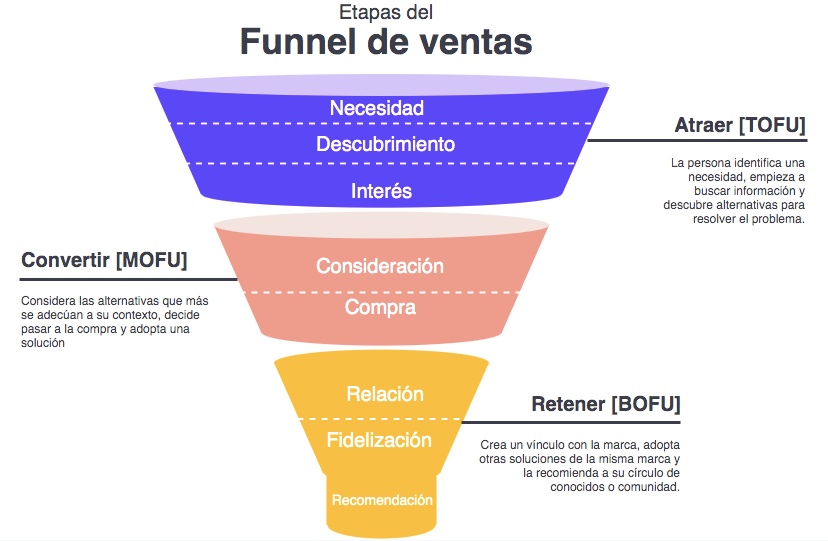
Thus, the Sales Funnel is composed of several stages that may vary depending on the business model, but generally looks similar to this scheme:
As we said, today we do almost everything online, from searching for information to buying products and hiring services, every time we want to satisfy a need. In this context, the Sales Funnel scheme can be explained as follows:
I- Attract
It is subdivided into three moments:
> The person identifies a need that leads them to
> start searching for information (for example, on Google and social media) that helps them discover alternatives to solve their problem and to
> awaken their interest in acquiring a product or service.
II- Convert
The person is in:
> a moment of considering the most suitable alternatives and
> then decides to adopt a definitive solution, which translates into the purchase of the product or service.
III- Retain
The person is already a customer and:
> builds a relationship with the brand,
> which can achieve their loyalty if adequate marketing work is done and
> the subsequent recommendation of the product/service or brand by the customer to their network.
Imagine you own a bicycle shop. Your Sales Funnel could look like this:
-
Need and discovery: John searches Google for tips on leading a healthier life and finds an article on your company's blog about the benefits of cycling. This is the entry point to your bicycle shop's Sales Funnel.
-
Interest: John visits a page on your shop's website where he can see what types of bicycles you offer.
-
Consideration: After comparing models and reading reviews, John focuses on a bicycle that fits his needs and budget. He decides he wants to buy that bicycle, but has some questions. He contacts your shop via Instagram to resolve them.
-
Purchase: Satisfied with your answers, John buys the bicycle through your shop's website.
In this example, John has gone through several stages of a Sales Funnel, from not knowing he needed a bicycle to making the purchase, all using the internet.
However, you must be clear that the Sales Funnel is an ideal representation of the stages a customer should go through from detecting a need to establishing a relationship with the brand. Therefore, it does not graph the journey the customer will always make to buy and engage with a brand, as this journey is not linear.
As we saw in the previous example, the bicycle shop guided John through the Sales Funnel by providing information and assistance at each stage, which ultimately led to a sale (a conversion). That is, by searching online, he found the appropriate content, created by the brand, to help the potential customer overcome each of the stages.
Explained in more detail, this means that:
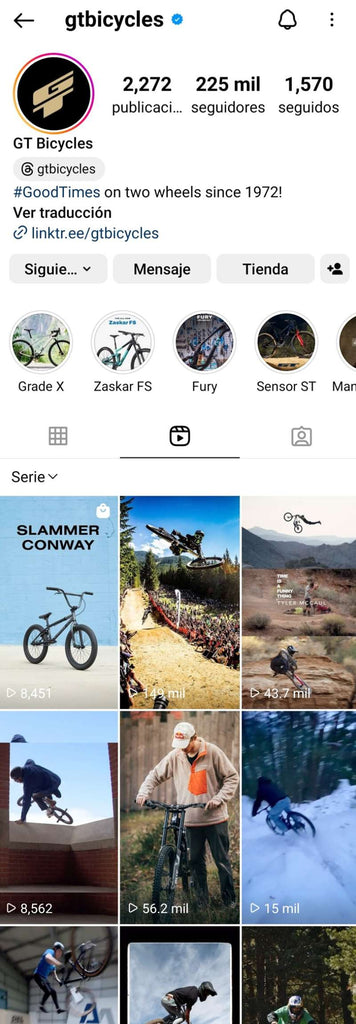
- The brand was present on social media where, in addition to showcasing its business, it addressed user inquiries.
- There were blog articles explaining the health benefits of cycling.
- There were product pages with different bicycle models.
- There were category or subcategory pages grouping these models.
- The text, photographs, and videos spoke to a specific user, considering their specific use context. For example, there were different specific landing pages for:
- a person buying their first bicycle,
- a new triathlete,
- an experienced triathlete,
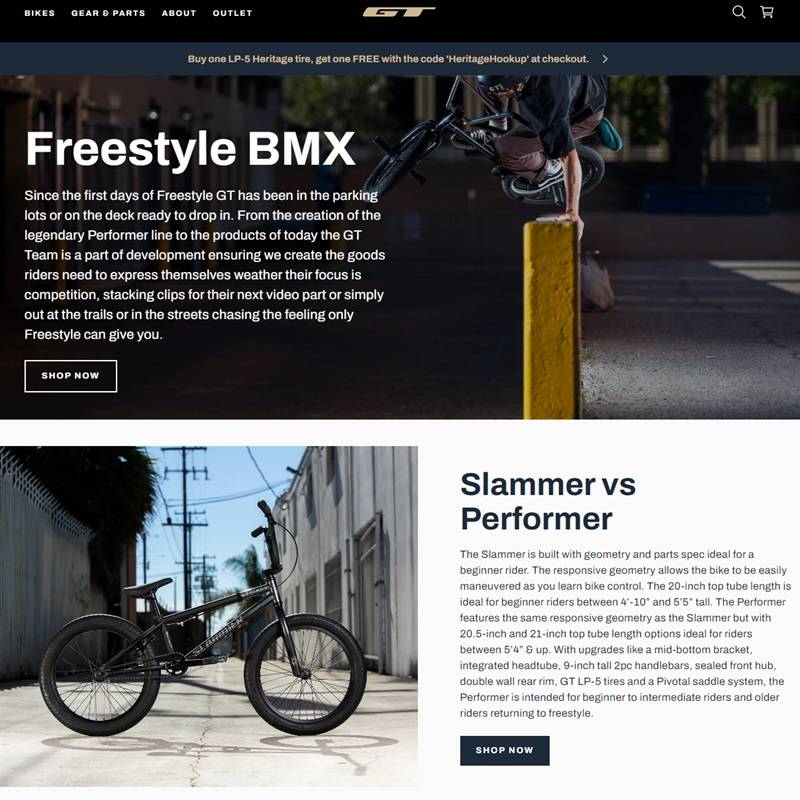
- someone looking for a specific type of bicycle (gravel, road, BMX…).
And all of this, according to the commercial offer and brand positioning of the shop. Let's look at a couple of examples:
Specific landing page for people looking for a BMX bike.
The same brand has a consistent presence on Instagram with consistent information and aesthetics.
This is where SEO comes into play, through the creation of optimized content for organic positioning on Google and for social media, using the right keywords, and with the necessary information to educate and inform the user about a topic, product, or service.
As we saw, the Sales Funnel is divided into three parts:
- TOFU (top of the funnel),
- MOFU (middle of the funnel), and
- BOFU (bottom of the funnel).
We must focus on creating precise content for these three parts, with the aim of helping to increase user awareness during their journey through the Sales Funnel, allowing them to progress until they are ready to make a purchase decision.
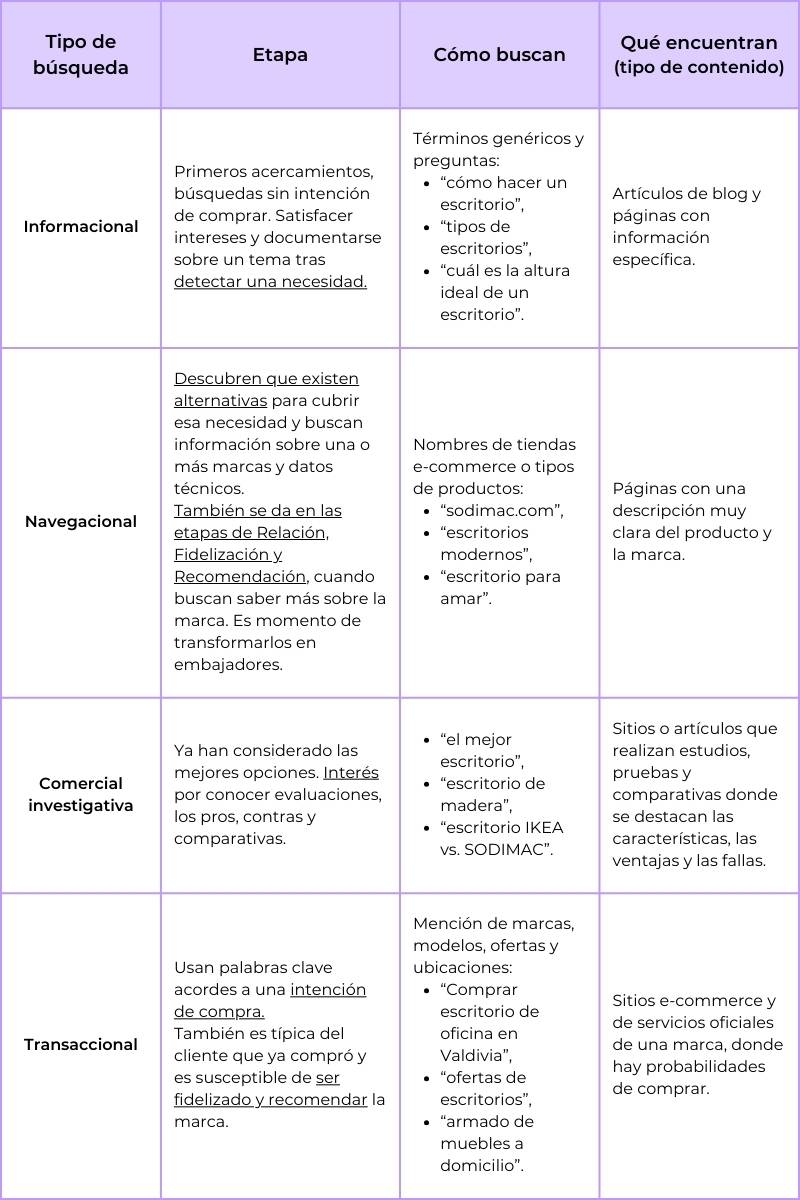
That is, the SEO strategy must aim to generate content for each consumer moment in this journey through the Sales Funnel, responding to their search intent when they turn to Google or social media for the information they need.
Let's see all this well-organized in the following table:
The mix between an SEO strategy, which develops optimized content, and the Sales Funnel is key, because the information we provide to the potential customer will help them experience a fluid journey through each stage of the funnel. But this will only be achieved if we provide information that adequately responds to their internet searches.
Always think about how to facilitate decision-making and purchase action, responding to the needs of the potential customer through content and interactions that help build the brand. Remember also that recurrent interactions at different touchpoints are relevant, so focus on how to create synergies between SEO and other digital marketing tactics.

 By
By